Key takeaways
- Recline range and lock type: A stated 135° means nothing without an infinite-position lock. Ratchet locks give you three or four fixed stops; infinite locks hold anywhere in the arc, which matters if you want a shallow 105° working tilt rather than a full nap position.
- Spring pack count: Multi-spring tilt assemblies distribute load across several coils instead of one. More spring packs generally mean smoother tension across the range and less chance of a single fatigued coil going soft.
- Weight rating versus your actual load: Treat the listed capacity as a ceiling, not a target. If you’re 250 lbs, a 400 lb chair gives you headroom on the gas cylinder and base — the two parts that fail first when a chair runs near its limit.
- Armrest mounting: Flip-up arms are genuinely useful for sliding under a low desk or sitting cross-legged, but check whether the hinge is metal or molded plastic. 4D arms add height, width, depth, and pivot — worth it if you alternate between typing and reclining.
- Base material and caster diameter: Nylon bases are fine at moderate weights; steel or aluminum is the upgrade. Larger casters roll better over rug transitions and put less stress on the base arms.
What's inside
I’ve disassembled enough office chairs to know that the recline mechanism is where the money goes — or doesn’t. Pop the seat pan off a budget chair and you’ll often find a stamped-steel tilt plate with a single spring and a friction knob doing all the work. That’s why so many chairs that felt fine in the showroom end up creaking backward under load six months later, or lock at exactly one useless angle. The listing photos never show the hardware, so buyers end up choosing on upholstery color and hoping for the best.
This guide takes the maker’s view: what’s actually inside the tilt housing, how the gas lift is rated, whether the armrests are bolted through the seat frame or screwed into plastic, and which chairs give you real adjustability rather than a marketing bullet. Below are six reclining chairs worth considering in 2026, each judged on mechanism quality, load rating, and how well it holds up to daily leaning.
As an Amazon Associate we earn from qualifying purchases.


🛒 Best Price Today on Amazon
Prime members get fast, free shipping on everything above, plus member-only deals. New members get a 30-day free trial — cancel anytime.
How to Choose a Reclining Office Chair (2026)
- Recline range and lock type: A stated 135° means nothing without an infinite-position lock. Ratchet locks give you three or four fixed stops; infinite locks hold anywhere in the arc, which matters if you want a shallow 105° working tilt rather than a full nap position.
- Spring pack count: Multi-spring tilt assemblies distribute load across several coils instead of one. More spring packs generally mean smoother tension across the range and less chance of a single fatigued coil going soft.
- Weight rating versus your actual load: Treat the listed capacity as a ceiling, not a target. If you’re 250 lbs, a 400 lb chair gives you headroom on the gas cylinder and base — the two parts that fail first when a chair runs near its limit.
- Armrest mounting: Flip-up arms are genuinely useful for sliding under a low desk or sitting cross-legged, but check whether the hinge is metal or molded plastic. 4D arms add height, width, depth, and pivot — worth it if you alternate between typing and reclining.
- Base material and caster diameter: Nylon bases are fine at moderate weights; steel or aluminum is the upgrade. Larger casters roll better over rug transitions and put less stress on the base arms.
The Best Reclining Office Chairs Reviewed
amseatec Big and Tall Office Chair with Footrest
The 20-spring-pack tilt assembly and infinite lock between 90° and 135° make this the most mechanically interesting chair here — you can dial in a precise angle and it holds without drift. The 300 lb rating is lower than the field, so match it honestly to your weight rather than assuming headroom.
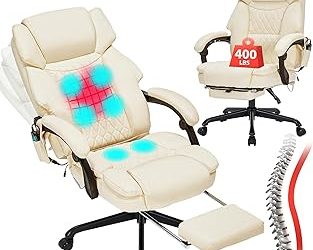
Ergonomic Office Chair with 3D Massage Lumbar Support
Adjustable seat depth is the standout feature and a rarity at this price; being able to set the pan so there’s a two-finger gap behind your knees changes how a recline feels entirely. The 4D headrest and armrests plus a 400 lb rating make it the most adjustable option on the list, though the massage function is a novelty rather than a reason to buy.
High Mesh Back Chair with Footrest
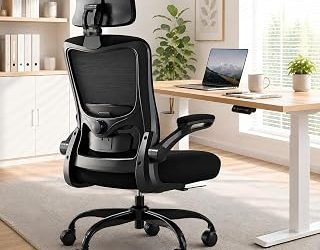
A mesh back is the sensible choice if you recline for long stretches, since a solid panel traps heat right where your shirt meets the chair. The thickened cushion and 400 lb frame give it a solid, planted feel, and the retractable footrest turns the 135° position into something you’d actually use.
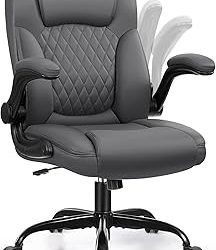
Executive Chair with Adjustable Lumbar and Flip-Up Arms
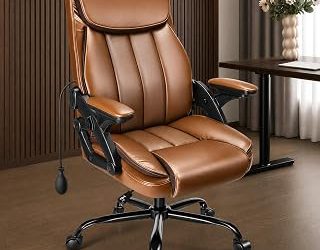
The adjustable lumbar pad slides vertically, which lets you place support at your own lordotic curve instead of wherever the factory guessed. Breathable mesh and a 400 lb capacity in a straightforward package — this is the pick if you want the fundamentals right and can skip the footrest.
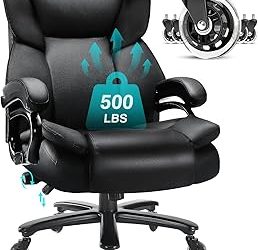
Big and Tall Chair with Crystal Velvet Wide Seat
The wide seat and flip armrests are aimed squarely at cross-legged sitting, and it delivers on that better than any conventional executive chair. Velvet is warmer than mesh and needs occasional brushing, but the extra seat width is a real ergonomic gain if you shift positions often.
Frequently Asked Questions
Does reclining damage the gas cylinder?
No — the cylinder handles vertical load only. Recline stress goes through the tilt mechanism and its mounting bolts, which is why those bolts are worth checking with a hex key every few months.
Is a footrest actually worth having?
Only if the chair reclines past about 120°. Below that your legs stay grounded and the footrest just adds a component to break. Past 120°, supporting your legs prevents the sliding-forward feeling that makes deep recline uncomfortable.
Why does my chair sink when I lean back?
Usually a failing gas cylinder seal, not the tilt. Cylinders are a standard-diameter replacement part on most chairs and swap out in about twenty minutes with a rubber mallet and a pipe wrench.
How much assembly should I expect?
Plan on 30 to 45 minutes. The tilt mechanism arrives bolted to the seat pan on most of these, so you’re mainly attaching the base, back, and arms — thread every bolt loosely first, then torque in sequence.
Final Thoughts
If mechanism quality is your priority, the amseatec chair’s infinite lock and multi-spring pack are the most honest engineering in this group. For maximum adjustability and a higher load rating, the 3D lumbar chair with adjustable seat depth is the better all-rounder, and the high mesh back model with footrest is the pick if you run warm and recline deeply.