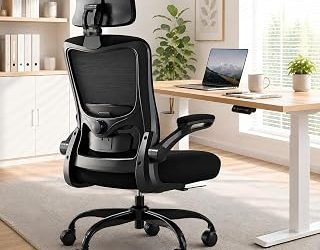
Key takeaways
- Lock type over lock count: An infinite-position lock, like the one on the amseatec big and tall, holds anywhere in its arc instead of clicking into three or four preset notches. Notched mechanisms wear unevenly at whichever detent you favor, and that’s the one that starts slipping first.
- Base material, stated plainly: Look for “steel base” in the listing text, not just a photo of something dark and chrome-ish. Nylon bases handle daily use fine but are the usual failure point on deep reclines, where load shifts toward two legs instead of five.
- Recline range you’ll actually use: 135° covers reading and phone calls. 155° to 170° is nap territory and needs real rear clearance — measure roughly 40 inches behind the base before you commit to a near-flat model.
- Footrest attachment: Slide-out ottomans housed inside the seat pan carry load through the frame. Fold-down styles hanging off a single hinge bracket take the whole weight of your legs at one pivot point. Check which you’re getting before assembly, not after.
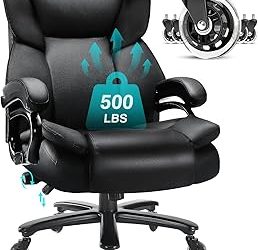
- Capacity as a margin, not a target: Buy 100 pounds above your actual weight. A 300 lb chair used at 290 lb is a chair whose gas cylinder is working overtime. Ratings from 350 to 420 lb buy you slack in every bearing.
What's inside
You can tell a lot about a reclining chair by the box it shows up in. Pull the parts out on the garage floor and the story writes itself: stamped steel that flexes when you press a thumb into it, or a base with real weight to it. A footrest that slides on nylon guides, or one bolted to a bracket that already has play in it. Most of the frustration people report six months in — the tilt that no longer holds, the ottoman that sags, the seat that creaks on every lean-back — traces straight back to hardware you could have inspected during assembly.
This guide looks at reclining office chairs with footrests the way you’d size up a workbench build: recline mechanism, base material, weight rating, and how the footrest actually anchors to the frame. Below are six chairs worth your Allen key, followed by the specs that separate a chair you’ll still be reclining in during 2029 from one you’ll be shimming by spring.
As an Amazon Associate we earn from qualifying purchases.


🛒 Best Price Today on Amazon
Prime members get fast, free shipping on everything above, plus member-only deals. New members get a 30-day free trial — cancel anytime.
How to Choose a Reclining Office Chair With Footrest (2026)
- Lock type over lock count: An infinite-position lock, like the one on the amseatec big and tall, holds anywhere in its arc instead of clicking into three or four preset notches. Notched mechanisms wear unevenly at whichever detent you favor, and that’s the one that starts slipping first.
- Base material, stated plainly: Look for “steel base” in the listing text, not just a photo of something dark and chrome-ish. Nylon bases handle daily use fine but are the usual failure point on deep reclines, where load shifts toward two legs instead of five.
- Recline range you’ll actually use: 135° covers reading and phone calls. 155° to 170° is nap territory and needs real rear clearance — measure roughly 40 inches behind the base before you commit to a near-flat model.
- Footrest attachment: Slide-out ottomans housed inside the seat pan carry load through the frame. Fold-down styles hanging off a single hinge bracket take the whole weight of your legs at one pivot point. Check which you’re getting before assembly, not after.
- Capacity as a margin, not a target: Buy 100 pounds above your actual weight. A 300 lb chair used at 290 lb is a chair whose gas cylinder is working overtime. Ratings from 350 to 420 lb buy you slack in every bearing.
The Best Reclining Office Chair With Footrest (2026)s Reviewed
amseatec Big and Tall Office Chair with Footrest
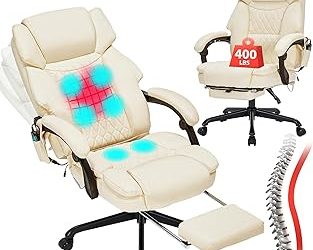
The twenty spring packs in the seat cushion are the standout here — a coil system rather than foam alone, which resists the permanent dish that develops in bonded leather chairs after a year of the same sit. Infinite locking across 90°–135° and a 300 lb rating make this the pick for anyone who adjusts their recline constantly through the day.
M30 Reclining Office Chair, 170-Degree
A 420 lb steel base and a recline that lays back nearly flat put this closer to a recliner with a desk job than an office chair that happens to tilt. Give it clearance behind the base and treat the adjustable headrest as essential, not optional — at 170° your neck carries the load without it.
CYKOV Ergonomic Office Chair with Footrest
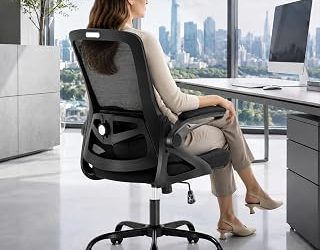
The lumbar support moves two ways — 2 inches vertically plus 1.18 inches of depth — which is the adjustment most mesh chairs skip and the one that actually matters for fitting a chair to your spine. Pair that with a four-way headrest and a five-year warranty and it’s the most tunable option on this list.
Ergonomic Mesh Chair with 3D Armrest and Steel Base
3D armrests adjust height, width, and pivot, letting you set them low enough that your shoulders stay down during long typing sessions. The large steel base and 300 lb heavy-duty build make it the breathable pick for warm rooms where leather turns unpleasant by mid-afternoon.
Thick Executive Leather Chair, 90–155° (Brown)
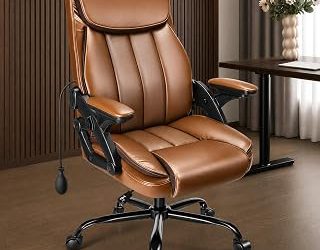
Padding depth is the selling point — thick cushioning that reads as traditional executive rather than task chair, with a 155° recline that clears comfortable napping range. Best suited to home offices where the chair is visible furniture as much as work equipment.
Frequently Asked Questions
Does the footrest weaken the chair over time?
Only if it’s badly mounted. Slide-out ottomans that retract into the seat pan distribute load through the frame. Single-hinge fold-down designs concentrate it at one bracket — check that bolt’s torque every few months.
Mesh or leather for a reclining chair?
Mesh wins on airflow and stays cooler through long sessions; leather wins on cushion depth and looks better in a shared room. For deep reclines past 145°, leather’s thicker padding tends to feel more supportive across the shoulders.
How much space does a near-flat recline need?
Allow around 40 inches of clear floor behind the base for a 170° model. Wall-adjacent setups should stay with a 135° chair instead.
Can I assemble one of these alone?
Yes, though the seat-to-base union on heavy models is easier with a second pair of hands. Tighten all bolts finger-snug first, seat the chair fully, then torque down in a cross pattern so nothing binds.
Final Thoughts
For most home offices the CYKOV earns the top spot on adjustability alone — two-way lumbar and a four-way headrest let you dial in a fit no fixed-back chair can match, and the five-year warranty backs it up. Heavier users and anyone who wants a genuine recline should look at the M30 for its 420 lb steel base and near-flat 170° range, while the amseatec big and tall is the smarter buy if infinite-position locking and a spring-pack seat matter more to you than laying all the way back.