Key takeaways
- Tank or tankless: A 3L tank stores air so the motor cycles on and off instead of running nonstop. That means steadier pressure through a long pull and a noticeably cooler motor. Tankless units are lighter and cheaper, but they run continuously and pulse slightly — fine for makeup or cake work, less ideal for gradient blends on furniture panels.
- Working pressure range: Most furniture-adjacent airbrushing lives between 15 and 30 PSI. Thin dyes and inks flow at 15-20; heavier acrylics and primers want 25-40. Buy a unit with a regulator that adjusts smoothly in that band rather than one that only offers fixed steps.
- Moisture trap and regulator: Compressed air carries water, and water in the line turns into blotches under a clear coat. A filter-regulator combo is not optional. Check that the bowl is drainable and the gauge reads in a range you actually use.
- Duty cycle and cooling: If you spray in 30-minute stretches, look for an auto shut-off and either a tank or an active cooling fan. Oil-free piston pumps handle heat better when they aren’t asked to run indefinitely, and thermal cutouts save the motor from a hard death.
- Noise in a shared space: Anything in the 35-50 dB range is quiet enough to run in a spare room without clearing the house. Louder diaphragm units are tolerable in a garage but wearing over a full afternoon.
What's inside
Spray a coat of satin lacquer onto a refinished nightstand drawer front and you’ll learn fast whether your air supply is up to the job. Airbrushes are unforgiving about pressure: too little and the paint spits and stipples, too much and you get overspray fog drifting across your workbench. Most people shopping for their first compressor end up either overbuying a loud pancake unit borrowed from the framing-nailer aisle or underbuying a toy-grade pump that pulses so badly it ruins a fade. Neither one belongs next to a piece of furniture you’ve spent a weekend sanding.
This guide comes from the perspective of someone who uses an airbrush for real shop work — stain touch-ups on chair spindles, faux-grain repairs, distressing painted cabinet doors, and detail work on small builds. Below are the compressors worth putting on a bench, with notes on tank capacity, duty cycle, noise, and moisture control. Then a short buying framework and answers to the questions that come up most often once the box is open.
As an Amazon Associate we earn from qualifying purchases.


🛒 Best Price Today on Amazon
Prime members get fast, free shipping on everything above, plus member-only deals. New members get a 30-day free trial — cancel anytime.
How to Choose a/an Air Compressor For Airbrush (2026)
- Tank or tankless: A 3L tank stores air so the motor cycles on and off instead of running nonstop. That means steadier pressure through a long pull and a noticeably cooler motor. Tankless units are lighter and cheaper, but they run continuously and pulse slightly — fine for makeup or cake work, less ideal for gradient blends on furniture panels.
- Working pressure range: Most furniture-adjacent airbrushing lives between 15 and 30 PSI. Thin dyes and inks flow at 15-20; heavier acrylics and primers want 25-40. Buy a unit with a regulator that adjusts smoothly in that band rather than one that only offers fixed steps.
- Moisture trap and regulator: Compressed air carries water, and water in the line turns into blotches under a clear coat. A filter-regulator combo is not optional. Check that the bowl is drainable and the gauge reads in a range you actually use.
- Duty cycle and cooling: If you spray in 30-minute stretches, look for an auto shut-off and either a tank or an active cooling fan. Oil-free piston pumps handle heat better when they aren’t asked to run indefinitely, and thermal cutouts save the motor from a hard death.
- Noise in a shared space: Anything in the 35-50 dB range is quiet enough to run in a spare room without clearing the house. Louder diaphragm units are tolerable in a garage but wearing over a full afternoon.
The Best Air Compressor For Airbrush (2026)s Reviewed
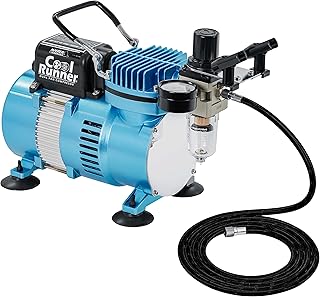
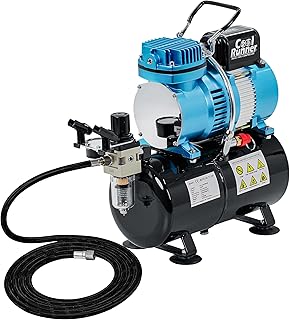
Master Airbrush TC-320 Cool Runner II
The dual-fan cooling on this one is the real story — it lets you run long sessions without the motor heat-soaking and drifting off pressure, which matters when you’re feathering a stain match across a tabletop. It ships tankless with a regulator, water trap, and holder, so it’s ready to spray out of the box and stays light enough to move between benches.
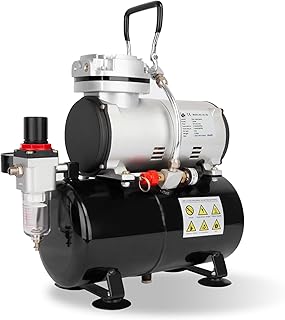
Timbertech AS186 with 3L Tank
A single-piston oil-free pump paired with a 3L tank gives you the most consistent airflow in this group, with the motor kicking in only to top off the reservoir. It’s the pick if your work involves sustained coverage — painted cabinet doors, headboard panels, anything where a pressure dip mid-pass shows up in the finish.
Timbertech ABPST08 Upgraded
Essentially the AS186 formula with a cooling fan added, which extends how long you can spray before the thermal cutout intervenes. Worth the small step up if you tend to lose track of time at the bench or work in a warm garage through summer.
Gaahleri Ambition GTS-06 Kit
The onboard air control puts fine pressure adjustment right where your hand already is, which shortens the feedback loop when you’re dialing in a new paint thinning ratio. A sensible complete kit for someone moving from rattle cans to proper atomized finishing.
Portable 27PSI Ultra-Quiet Kit
At roughly 35 dB and with seven preset pressure levels, this one is built for indoor use where noise is a real constraint. The 27 PSI ceiling limits you to thinner mediums, but for touch-up work, glazes, and detail passes on small pieces it’s genuinely pleasant to use.
Frequently Asked Questions
What PSI should I use for furniture touch-ups?
Start at 18-22 PSI for thinned acrylics and dyes on wood, and nudge upward only if the paint is drying before it levels. Higher pressure increases overspray and dry-tip, both of which are harder to fix than a slightly slow build.
Do I really need the tank version?
If your passes last more than a few seconds at a stretch, yes. The tank absorbs pressure fluctuation and lets the motor rest, which translates to smoother coats and a longer-lived pump.
Can I use these for spraying a whole dresser?
Not efficiently. Airbrush compressors move small volumes of air, which is perfect for detail and repair but painfully slow for large surfaces. Those jobs want an HVLP setup fed by a larger tank.
How do I keep water out of my finish?
Drain the moisture trap at the end of every session, don’t let the tank sit full of condensate overnight, and if you spray in humid conditions consider adding a second inline filter close to the airbrush.
Final Thoughts
For general shop use where finish quality is the priority, the Timbertech AS186 with its 3L tank is the most dependable choice — steady pressure, cool operation, and enough capacity for real project work. The Master Airbrush TC-320 Cool Runner II is the better pick if portability and long continuous runs matter more than tank storage, and the ultra-quiet 27PSI kit makes sense for anyone doing detail and touch-up work inside a living space.