Key takeaways
- Sweep over speed: A 96″ fan turning slowly moves more air with less noise than a 52″ fan screaming at top speed. Measure your bay before you shop — you want at least 18″ of clearance from blade tip to wall, and 7′ minimum from floor to blade so you’re not trimming anyone’s hair.
- CFM you can actually verify: Ignore vague “powerful airflow” claims and look for a stated number. Roughly 6,000 CFM handles a standard two-car bay; push toward 10,000+ if you’ve got a three-car, high ceilings, or a workshop where you’re generating heat with tools.
- DC motor, no exceptions: DC pulls a fraction of the wattage, runs noticeably quieter, and gives you six real speed steps instead of three coarse ones. It also means reversible airflow via remote, which matters more in a garage than a living room — winter downdraft pushes trapped ceiling heat back to where you’re standing.
- Damp rating and mounting hardware: Any garage with an open door is functionally outdoor space. Look for a damp-rated listing, and check that the box includes multiple downrods plus a bracket rated for sloped ceilings — many garages pitch toward the door and a flush-only bracket will leave you improvising.
- Blocking and box rating: A 96″ metal-blade fan is a serious load. Plan on running solid blocking between joists and installing a fan-rated brace box. This is the step people skip, and it’s the reason wobble complaints exist.
What's inside
Garages punish ceiling fans. You’re dealing with unconditioned air, joists that were never meant to carry rotating mass, ceilings that slope toward the door, and in summer a heat load that a 52″ bedroom fan simply cannot move. Most people buy the wrong thing twice: first a builder-grade fan that wobbles and stirs nothing below eight feet, then a shop drum fan that eats floor space and drowns out the radio. The actual answer is a large-diameter, low-RPM fan on a DC motor — the same principle behind those enormous warehouse units, scaled down to something you can hang yourself with a helper and a stepladder.
This guide is written from the ladder, not the spec sheet. I’ve mounted these in a two-car with 10′ ceilings, dealt with the downrod math, and learned which mounting brackets are honest about sloped installs. Below you’ll find the fans worth your money in 2026, sized from 65″ up to 96″, plus a plain-English breakdown of CFM, damp ratings, and the joist-blocking question nobody mentions in the listings.
As an Amazon Associate we earn from qualifying purchases.



🛒 Best Price Today on Amazon
Prime members get fast, free shipping on everything above, plus member-only deals. New members get a 30-day free trial — cancel anytime.
How to Choose a Ceiling Fan For Garage (2026)
- Sweep over speed: A 96″ fan turning slowly moves more air with less noise than a 52″ fan screaming at top speed. Measure your bay before you shop — you want at least 18″ of clearance from blade tip to wall, and 7′ minimum from floor to blade so you’re not trimming anyone’s hair.
- CFM you can actually verify: Ignore vague “powerful airflow” claims and look for a stated number. Roughly 6,000 CFM handles a standard two-car bay; push toward 10,000+ if you’ve got a three-car, high ceilings, or a workshop where you’re generating heat with tools.
- DC motor, no exceptions: DC pulls a fraction of the wattage, runs noticeably quieter, and gives you six real speed steps instead of three coarse ones. It also means reversible airflow via remote, which matters more in a garage than a living room — winter downdraft pushes trapped ceiling heat back to where you’re standing.
- Damp rating and mounting hardware: Any garage with an open door is functionally outdoor space. Look for a damp-rated listing, and check that the box includes multiple downrods plus a bracket rated for sloped ceilings — many garages pitch toward the door and a flush-only bracket will leave you improvising.
- Blocking and box rating: A 96″ metal-blade fan is a serious load. Plan on running solid blocking between joists and installing a fan-rated brace box. This is the step people skip, and it’s the reason wobble complaints exist.
The Best Ceiling Fan For Garage (2026)s Reviewed
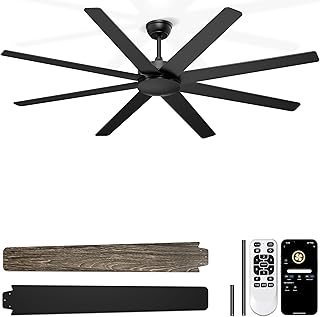
72″ Black Large Ceiling Fan with Remote/App Control
At 7,138 CFM from eight blades, this hits the sweet spot for a standard two-car garage without demanding warehouse-scale ceiling height. App control is genuinely useful here — you can spin it up from inside the house before you head out to work, and the DC motor is quiet enough at speeds one through three that it disappears behind a shop vac.
ZMISHIBO 65 Inch Ceiling Fan, 6-Speed
The pick for tighter single-bay garages or lower ceilings where a 96″ sweep isn’t physically possible. 6,116 CFM out of a 65″ span is efficient work, and the six-step DC control means you can dial in a low background breeze rather than choosing between “off” and “hurricane.”
ZMISHIBO 80″ Ceiling Fan with 3-CCT LED
If your garage lighting is a single sad bulb, this solves two problems on one electrical box. The 24W LED offers three color temperatures — go with the coolest setting for detail work — and the dual-finish blades look sharp enough that it wouldn’t be out of place on a covered patio.
ZMISHIBO 96 Inch Industrial Ceiling Fan
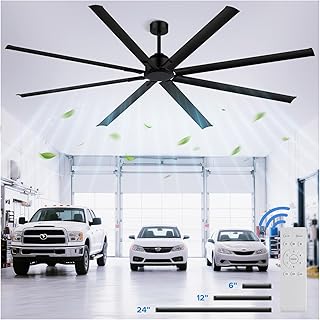
Eight aluminum blades, three included downrods, and a bracket that handles flat or sloped ceilings — this is the most installer-friendly of the big units. It’s also the one I’d choose for a three-car or a detached shop, where the extra sweep pays for itself in even air distribution.
96 Inch HVLS Shop Ceiling Fan
A true high-volume, low-speed design that moves enormous air at a lazy RPM, which is exactly why it stays quiet. Best suited to garages with 11′ or taller ceilings and proper joist blocking — give it the mounting it deserves and it runs dead smooth.
Frequently Asked Questions
How much CFM do I need for a two-car garage?
Around 6,000 CFM is a solid baseline for a standard 20×20 bay with 8–9′ ceilings. Bump to 7,000–10,000 if you’re in a hot climate, working with the door open, or running heat-generating equipment like a welder or compressor.
Can I install a 96″ fan myself?
Yes, with a helper and honest prep. The blades bolt on after the motor is hung, so the heavy lift is one component. Install a fan-rated brace box with blocking between joists first — that’s the non-negotiable part, and it’s a 30-minute job with a circular saw and a couple of 2×8 offcuts.
Does a garage fan need to be damp rated?
If the door ever opens, treat it as damp-rated territory. Humidity swings and airborne moisture will corrode non-rated internals over a few seasons, and a damp rating costs essentially nothing extra on these DC models.
Why reversible airflow in a garage?
Summer downdraft cools you directly. Winter updraft — or in a high-ceiling garage, a gentle downdraft on low — pulls the stratified warm air off the ceiling and mixes it back down, which makes a space heater far more effective. It’s the single most underused feature on these fans.
Final Thoughts
For most garages, the 72″ black fan with app control is the balanced buy — 7,138 CFM, quiet DC motor, and a diameter that fits a typical two-car without clearance headaches. Step up to the ZMISHIBO 96″ industrial if you’ve got a three-car or shop and want the smoothest install thanks to its three downrods and sloped-ceiling bracket, or take the ZMISHIBO 80″ with LEDs if you need lighting and airflow from a single box. All three reward you for doing the blocking properly.