Key takeaways
- Measure the diagonal, not the wall: A “57-inch” corner desk usually means each leg is 57 inches, so the hypotenuse across the front is well over six feet. Chalk the outline on your floor with painter’s tape before you buy — including chair pull-back room, which needs 30 inches minimum.
- Check the leg geometry: Splayed farmhouse legs and X-braces add rigidity but steal knee space. Straight square-tube legs with a rear crossbar give you more usable room underneath, which matters if you’re stacking a CPU tower or a filing cube down there.
- Verify the outlet placement: Built-in charging stations are genuinely useful, but look at where the pigtail cord exits. If it’s on the short side and your receptacle is on the long wall, you’ll be running an extension before you finish setup.
- Test the reversibility claim: Many L-shaped desks advertise left or right orientation. Confirm the pre-drilled holes are symmetrical rather than mirrored on one panel only — otherwise you’re drilling fresh pilot holes with a hand drill and hoping the alignment holds.
- Weigh the top thickness against your load: Anything under 15mm MDF will bow under dual monitors over a year. Look for 18mm or thicker, or plan to sister a length of 1×2 poplar underneath the span as a stiffener — a ten-minute upgrade that pays off.
What's inside
Corner desks look like the obvious answer to a cramped room, right up until the box arrives and you discover the diagonal front eats 40 inches of wall you didn’t have to spare. I’ve assembled enough of these in spare bedrooms and basement nooks to know the failure points: a footprint measured in advertising inches rather than real ones, particleboard legs that rack under a monitor arm, and cable routing that assumes your outlet lives directly behind the desk. None of that shows up in a product photo.
This guide covers what actually matters when you’re fitting a workstation into a corner that also has a baseboard heater, a closet door swing, or a window sill in the way. I’ve broken down the measuring math, the hardware you should inspect before the first bolt goes in, and six desks worth considering in 2026 — from a compact 32-inch triangle to a full electric sit-stand L. Whether you’re building out a permanent home office or carving a desk into a shared living room, there’s a shape here that fits.
As an Amazon Associate we earn from qualifying purchases.


How to Choose a Corner Desk For Small Spaces (2026)
- Measure the diagonal, not the wall: A “57-inch” corner desk usually means each leg is 57 inches, so the hypotenuse across the front is well over six feet. Chalk the outline on your floor with painter’s tape before you buy — including chair pull-back room, which needs 30 inches minimum.
- Check the leg geometry: Splayed farmhouse legs and X-braces add rigidity but steal knee space. Straight square-tube legs with a rear crossbar give you more usable room underneath, which matters if you’re stacking a CPU tower or a filing cube down there.
- Verify the outlet placement: Built-in charging stations are genuinely useful, but look at where the pigtail cord exits. If it’s on the short side and your receptacle is on the long wall, you’ll be running an extension before you finish setup.
- Test the reversibility claim: Many L-shaped desks advertise left or right orientation. Confirm the pre-drilled holes are symmetrical rather than mirrored on one panel only — otherwise you’re drilling fresh pilot holes with a hand drill and hoping the alignment holds.
- Weigh the top thickness against your load: Anything under 15mm MDF will bow under dual monitors over a year. Look for 18mm or thicker, or plan to sister a length of 1×2 poplar underneath the span as a stiffener — a ten-minute upgrade that pays off.
The Best Corner Desk For Small Spaces (2026)s Reviewed
57″ L-Shaped Corner Desk with File Drawers
This is the pick if you need a desk that doubles as your filing system — the hanging-file drawers are properly sized for letter folders rather than the token half-depth bins you often get at this price. Budget an hour for assembly and pre-thread the cam locks by hand before you commit them.
32″ Farmhouse Corner Desk with Power Outlets
The most genuinely small-space option here: a true triangle that tucks flush into a 90-degree corner without the long return arms. Perfect for a laptop-and-notebook setup in a bedroom, though you’ll outgrow it fast if you run dual monitors.
Kingant L-Shaped Standing Desk
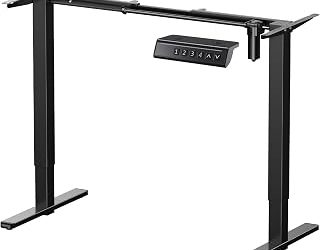
An electric sit-stand corner desk at this size is a real engineering ask, and the dual-motor frame here handles it without noticeable wobble at full extension. Do the cable management before you first raise it — pinched cords are the number one way people damage these.
42″ Reversible L-Shaped Gaming Desk
The compact 42-inch footprint makes this one of the few gaming corner desks that fits a dorm or box bedroom, and the reversible design means you can swap orientation if you rearrange. The monitor riser and headset hook are functional rather than gimmicky, though the LED strip is USB-powered and easy to leave unplugged.
SEDETA Farmhouse Corner Desk, White
Cleanest visual footprint of the group — the white finish and slim profile keep it from dominating a shared living space. Solid choice for a writing or study desk, with shelving that suits books and a printer more than heavy equipment.
Frequently Asked Questions
How much wall space does a corner desk actually need?
Add the two leg lengths, then plan for the diagonal front edge to project roughly 70% of the longest leg into the room. A 42-inch corner desk typically claims about a 30-inch bite of floor at its deepest point.
Can I put a corner desk against a flat wall instead?
Yes, and reversible L-shaped models handle this well — you lose the corner-nesting advantage but gain a longer continuous work surface. Triangle desks don’t adapt as gracefully.
Are built-in USB ports and outlets worth it?
For a small space, yes. They eliminate a power strip and the cord tangle that comes with it. Check the amperage rating if you’re charging a tablet, since some units cap at 1A per port.
Do these desks support monitor arms?
Clamp-style arms need an unobstructed rear edge and a top thick enough to grip — 18mm or more. Check for an apron or backer rail that would block the clamp jaw before you order.
Final Thoughts
For most small rooms, the 32″ Farmhouse Corner Desk offers the smallest honest footprint with real storage, while the 57″ L-Shaped Desk with File Drawers is the better call if you need filing capacity in the same square footage. If you want height adjustability and have the corner to give it, the Kingant L-Shaped Standing Desk is the most capable build of the group.