Key takeaways
- Footprint over shelf count: A 10-inch-deep tower with eight tiers holds more than a 4-tier unit twice its width. Check the depth spec first — anything past 13 inches starts eating floor space you’ll notice when you walk past it.
- Frame material and sag resistance: Steel-framed units with a backboard resist racking far better than all-particleboard designs. If you’re shelving hardbacks or vinyl, look for metal uprights; thin engineered wood shelves over 24 inches wide will bow within a year under real weight.
- Anti-tip hardware: Any bookcase over 40 inches tall on a narrow base needs wall anchoring, full stop. Confirm the kit is included and that you have a stud or can use a proper drywall toggle — the plastic plugs in the box are usually the weak link.
- Tiered vs. rectangular: Tree-style shelves with staggered widths tuck into corners and dead zones that boxy units can’t reach. Rectangular shelves store more per tier but demand a flat, unobstructed wall run.
- Assembly reality check: Cam-lock joints go together in 20 minutes; units with 40-plus screws and separate metal brackets take an hour and reward a power driver on low torque. Read the parts count before you commit your Saturday.
What's inside
Measure the wall you want to fill and you’ll usually find the same frustrating number: somewhere between 10 and 30 inches of usable width. Standard bookcases assume you have four feet to spare. When you don’t, you end up with a unit that blocks a doorway swing, crowds a radiator, or forces the sofa two inches further into the walking path than it should be. I’ve assembled enough flat-pack shelving in cramped apartments to know that the fix isn’t a smaller version of a big bookcase — it’s a different shape entirely.
This guide looks at bookcases built specifically for tight footprints: narrow spine towers, tiered tree designs that widen as they climb, and low three-tier units that slot under windows. I’ve flagged which ones handle real hardback weight, which ones need wall anchoring before you load them, and where the assembly gets fussy. Everything here fits in under a couple of square feet of floor.
As an Amazon Associate we earn from qualifying purchases.




How to Choose a Bookcase For Small Spaces (2026)
- Footprint over shelf count: A 10-inch-deep tower with eight tiers holds more than a 4-tier unit twice its width. Check the depth spec first — anything past 13 inches starts eating floor space you’ll notice when you walk past it.
- Frame material and sag resistance: Steel-framed units with a backboard resist racking far better than all-particleboard designs. If you’re shelving hardbacks or vinyl, look for metal uprights; thin engineered wood shelves over 24 inches wide will bow within a year under real weight.
- Anti-tip hardware: Any bookcase over 40 inches tall on a narrow base needs wall anchoring, full stop. Confirm the kit is included and that you have a stud or can use a proper drywall toggle — the plastic plugs in the box are usually the weak link.
- Tiered vs. rectangular: Tree-style shelves with staggered widths tuck into corners and dead zones that boxy units can’t reach. Rectangular shelves store more per tier but demand a flat, unobstructed wall run.
- Assembly reality check: Cam-lock joints go together in 20 minutes; units with 40-plus screws and separate metal brackets take an hour and reward a power driver on low torque. Read the parts count before you commit your Saturday.
The Best Bookcase For Small Spaces (2026)s Reviewed
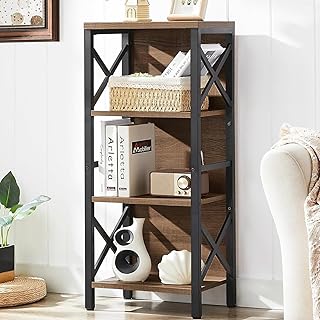
TUTOTAK 8-Tier Narrow Spine Bookshelf
At 10.4 inches wide and nearly four feet tall, this is the most vertical storage you’ll get from the smallest floor claim in the roundup — it disappears into a corner or beside a desk. The trade-off is shelf depth, so plan on paperbacks and slim hardbacks rather than oversized art books, and anchor it before loading the top tiers.
SUNMORY 6-Tier Tree Bookshelf with Cabinet
The staggered tree layout does clever work here: narrow at the top for display, wider at the base for heavier books, with an enclosed cabinet at the bottom to hide cables and clutter. Assembly is more involved than the simpler units, but the mixed open-and-closed storage makes it the most versatile pick for a bedroom or home office.
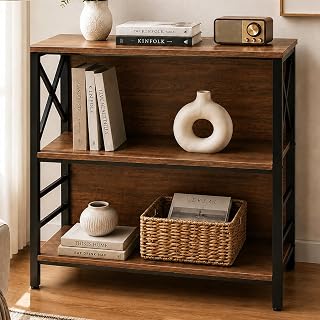
MNEETRUNG 3-Tier Industrial Bookshelf
At 29.5 inches tall, this short unit slides under a window sill or beside a bed where taller shelving won’t fit, and the steel frame plus backboard means it stays square under load. It’s the sturdiest option here per dollar, and low enough that anchoring is optional rather than essential.
LEYAOYAO Cube Bookshelf with Legs
The raised mid-century legs are the detail that matters in a small room — visible floor underneath reads as more open space, and it makes cleaning underneath trivial. Three open cubes handle books, baskets, or plants equally well, though it’s the lightest-duty frame in this group.
Casaottima 6-Tier Tree Bookshelf with LED Lights
Integrated LED strips turn this into a lit display piece, which earns its keep in a small room where you don’t have space for a separate lamp. The steel-and-wood build is solid and the bottom cabinet adds hidden storage, just budget extra time for routing the light wiring during assembly.
Frequently Asked Questions
How much weight can a narrow bookcase actually hold?
Metal-framed units with a backboard typically manage 25 to 40 pounds per shelf; all-particleboard designs are closer to 15 to 20. Distribute heavy books across the lower tiers rather than stacking them at the top, which also lowers the tipping risk.
Do I have to anchor it to the wall?
For anything taller than about 40 inches with a base under 14 inches deep, yes. Narrow-and-tall geometry is inherently tippy once loaded, and it’s a genuine safety issue in homes with kids or pets. Low three-tier units are stable enough to skip it.
Are tree-style bookshelves worth the odd shape?
They are if you’re filling a corner or an awkward alcove, since the varying tier widths follow spaces a rectangle can’t. If you have a clean flat wall, a straight narrow tower gives you more usable shelf per inch.
Can I add shelves or modify these units later?
Most fixed-shelf designs don’t accommodate extras, but you can gain vertical space with shelf risers or stack a second short unit on a longer wall. Drilling new holes in engineered wood weakens the panel, so I’d avoid it.
Final Thoughts
For the tightest spots, the TUTOTAK 8-Tier tower gives you the best storage-to-footprint ratio of anything here. If you want sturdier construction and don’t need the height, the MNEETRUNG 3-Tier is the one I’d trust with heavy hardbacks, while the SUNMORY 6-Tier Tree hits the sweet spot between open display, hidden cabinet storage, and corner-friendly shape.