Key takeaways
- Depth over width: Anything under 20 inches deep forces your keyboard to the edge and your monitor too close. Aim for 22 to 24 inches of depth even if you sacrifice a few inches of width — your neck will thank you.
- Leg geometry: Straight vertical legs slide flush against baseboards; angled or splayed legs push the whole desk two inches into the room. Check the product photos from the side, not the front.
- Load-bearing reality: A stated 100 lb capacity assumes weight distributed evenly across the surface. Clamping a monitor arm to one corner concentrates force where the particleboard is weakest, so look for a reinforced steel frame or a thicker top edge.
- Assembly honesty: Folding desks with pre-attached hardware genuinely take five minutes. Anything with 40+ screws and a cam-lock system will eat an hour, and pre-drilled hole tolerance varies enough that a hand drill helps.
- Storage tradeoffs: Fixed drawers eat knee clearance. Fabric bins and open shelves keep the underside breathable and let you reclaim the space when you’d rather stretch out.
What's inside
Measure the wall before you fall in love with a desk. That’s the lesson every apartment dweller learns the hard way, usually after wrestling a 55-inch slab up two flights of stairs only to find it blocks the closet door. Small-space desks live under a different set of rules: depth matters more than width, cable routing has to happen without a rear cavity, and every drawer you add steals legroom you can’t spare. Manufacturers know shoppers scan for the word “compact,” so plenty of listings stretch the definition until it snaps.
I’ve assembled, disassembled, and re-leveled enough flat-pack desks to have opinions about cam locks and MDF thickness. This guide sorts through the current crop of genuinely small desks — 27 to 40 inches wide — and flags which ones hold up under a monitor arm, which fold flat for a studio, and which ones need a shim under the back left leg. Below are the models worth your floor space in 2026.
As an Amazon Associate we earn from qualifying purchases.




How to Choose a/an Computer Desk For Small Spaces (2026)
- Depth over width: Anything under 20 inches deep forces your keyboard to the edge and your monitor too close. Aim for 22 to 24 inches of depth even if you sacrifice a few inches of width — your neck will thank you.
- Leg geometry: Straight vertical legs slide flush against baseboards; angled or splayed legs push the whole desk two inches into the room. Check the product photos from the side, not the front.
- Load-bearing reality: A stated 100 lb capacity assumes weight distributed evenly across the surface. Clamping a monitor arm to one corner concentrates force where the particleboard is weakest, so look for a reinforced steel frame or a thicker top edge.
- Assembly honesty: Folding desks with pre-attached hardware genuinely take five minutes. Anything with 40+ screws and a cam-lock system will eat an hour, and pre-drilled hole tolerance varies enough that a hand drill helps.
- Storage tradeoffs: Fixed drawers eat knee clearance. Fabric bins and open shelves keep the underside breathable and let you reclaim the space when you’d rather stretch out.
The Best Computer Desk For Small Spaces (2026)s Reviewed
Lufeiya 40″ Small White Desk with Drawers
The reversible layout is the real selling point here — you decide which side gets the fabric drawer during assembly, which matters enormously when your only outlet sits behind the desk’s left leg. At 40 inches it’s the widest pick on this list while staying shallow enough for a hallway nook, and the white finish keeps a cramped bedroom from feeling boxed in.
COTUBLR 27.5″ Small Computer Desk
That built-in adjustable monitor riser does double duty: it lifts your screen to eye level and creates a keyboard garage underneath, which is how you make 27.5 inches feel workable. The rustic brown laminate hides scuffs better than the pale finishes, and the side storage handles a router or a stack of notebooks without cluttering the top.
WOHOMO 31.5″ Folding Desk
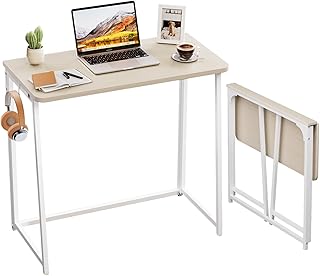
The fold mechanism uses spring-loaded pins rather than friction hinges, so it locks with a satisfying click and doesn’t creep loose over months of use. Assembly means attaching four screws to the legs and nothing else, and the oak veneer looks convincingly like real timber under warm lighting.
GreenForest Folding Desk, No Assembly
Out of the box and standing in under a minute — the two-tier design ships fully built, which makes it the obvious pick for dorm move-in day or a guest room that occasionally becomes an office. The lower shelf is shallow, better suited to a laptop bag or printer than heavy books, but the steel frame stays rock-solid at 27.3 inches wide.
39″ Fluted Computer Desk with 2 Drawers
Fluted panel detailing is having a moment, and this desk delivers the texture without the boutique markup. Two proper wooden drawers on smooth runners give it more permanence than the fabric-bin alternatives, though you’ll want to verify your chair clears the drawer box before committing.
Frequently Asked Questions
What’s the smallest desk width that still works for two monitors?
Around 40 inches, and only with a dual monitor arm rather than the included stands. Below that, stack vertically or use a single ultrawide instead.
Can I mount a monitor arm to a particleboard desk?
Usually yes, but add a metal backing plate or a hardwood spacer under the clamp to spread the load. Bare clamps compress MDF and leave permanent dents.
Do folding desks feel wobbly during use?
Quality ones don’t. The tell is whether the leg braces form a triangle — X-braced or cross-supported frames stay rigid, while simple hinge-only designs develop side-to-side sway.
How do I manage cables without a grommet hole?
Adhesive cable clips along the rear underside plus a small velcro-wrapped bundle at the leg handles most setups. A stick-on cable tray works if there’s a support rail to mount it to.
Final Thoughts
If you need one desk to settle the question, the Lufeiya 40-inch with reversible drawer offers the most usable surface for the footprint. For studios and dorms where the desk has to disappear, the GreenForest no-assembly folding model earns its keep, and the COTUBLR 27.5-inch is the smartest choice when your only available wall is genuinely tiny.