Key takeaways
- Throat depth vs. resaw height: Throat depth (the 8, 9, or 10 inches in the product name) limits how wide a workpiece you can swing past the frame. Resaw height — often just 3 to 5 inches — limits thickness. Check both against your typical project, because they fail you in completely different ways.
- Material match: Wood wants blade speeds in the thousands of FPM; steel and aluminum want a few hundred. Variable-speed models in the 137–472 FPM range are built for metal, while a 2,500 FPM woodworking saw will burn a blade to nothing on stock steel.
- Worktable rigidity and tilt: A cast-aluminum table with a machined surface stays flat and lets stock glide. Look for a 0–45° tilt with positive stops if you plan on bevels, and be skeptical of thin stamped-steel tables that flex under a heavy board.
- Guide and fence quality: Blade drift is almost always a guide-adjustment problem. Prioritize accessible upper and lower guide blocks plus a fence that locks parallel without shifting — a double-sided fence adds flexibility for narrow rips.
- Blade availability: Confirm the exact blade length before buying and check that replacements are easy to source. An orphan blade size turns a good saw into an expensive paperweight the first time you snap one.
What's inside
A benchtop band saw is the tool that finally lets you cut the shapes a table saw refuses to touch — cabriole legs, curved chair backs, tight radii on a shelf bracket. But shopping for one is oddly frustrating. Spec sheets throw around throat depth, resaw height, and blade speed as if every buyer already knows which numbers matter, and the difference between a saw that tracks a pencil line and one that wanders off it has almost nothing to do with horsepower. Most disappointment comes from buying a machine sized for the wrong job: a woodworker who ends up with a metal-cutting portaband, or a hobbyist who wanted to resaw 4-inch stock on a saw capable of 3.
This guide sorts the current crop of tabletop band saws by what they actually do well. I’ve grouped them by cutting capacity, motor draw, and worktable quality — the three things that determine whether a saw earns its bench space or gathers dust. Below you’ll find a shortlist of the strongest options for 2026, a buying checklist built around real shop problems, and answers to the questions that come up most often once the saw is unboxed.
As an Amazon Associate we earn from qualifying purchases.


🛒 Best Price Today on Amazon
Prime members get fast, free shipping on everything above, plus member-only deals. New members get a 30-day free trial — cancel anytime.
How to Choose a Table Top Band Saw (2026)
- Throat depth vs. resaw height: Throat depth (the 8, 9, or 10 inches in the product name) limits how wide a workpiece you can swing past the frame. Resaw height — often just 3 to 5 inches — limits thickness. Check both against your typical project, because they fail you in completely different ways.
- Material match: Wood wants blade speeds in the thousands of FPM; steel and aluminum want a few hundred. Variable-speed models in the 137–472 FPM range are built for metal, while a 2,500 FPM woodworking saw will burn a blade to nothing on stock steel.
- Worktable rigidity and tilt: A cast-aluminum table with a machined surface stays flat and lets stock glide. Look for a 0–45° tilt with positive stops if you plan on bevels, and be skeptical of thin stamped-steel tables that flex under a heavy board.
- Guide and fence quality: Blade drift is almost always a guide-adjustment problem. Prioritize accessible upper and lower guide blocks plus a fence that locks parallel without shifting — a double-sided fence adds flexibility for narrow rips.
- Blade availability: Confirm the exact blade length before buying and check that replacements are easy to source. An orphan blade size turns a good saw into an expensive paperweight the first time you snap one.
The Best Table Top Band Saws Reviewed
WEN 10-Inch Two-Speed Band Saw with Stand (BA3962)
The most complete package here: a 3.5-amp motor, two speeds for switching between wood and softer metals, a 10-inch throat, and an included stand that saves you from building one. It’s the pick for a general-purpose shop where the saw needs to handle scrollwork on Monday and a resaw cut on Saturday.
SEESII Benchtop Band Saw, 8-Inch
SEESII focuses on precision detail work — the 0–45° tilting table, miter gauge, and double-sided fence make it genuinely capable of repeatable joinery cuts rather than just rough shaping. The 3-1/8-inch cutting height is modest, so treat it as a curve-and-detail saw, not a resaw machine.
9-Inch Portable Benchtop Band Saw, 2,526 FPM
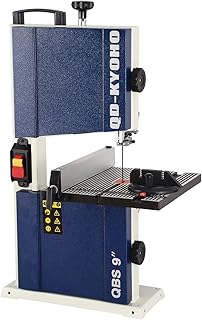
A fast blade speed and a cast-aluminum worktable with a built-in scale make this one of the cleaner-cutting woodworking options in the lineup. The 1/3 HP output keeps it in hobby territory, but for cutting templates, small furniture parts, and hardwood curves it holds a line well.
Variable-Speed 5-Inch Deep-Cut Metal Band Saw
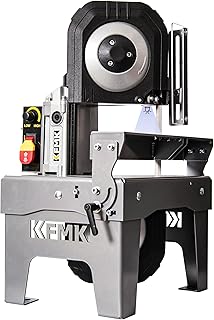
This is a metal-cutting machine first: 137–472 FPM adjustable speed, a 10-amp motor, and a liftable worktable that converts it between benchtop and freehand use. If your projects involve steel tube, angle iron, or hairpin-leg fabrication for furniture builds, this outclasses any woodworking saw on this list.
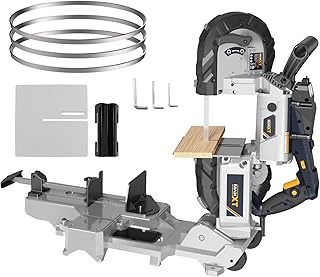
MAXXT 2-in-1 Band Saw with Table Saw Base
The dual-purpose design — a portable 5-inch deep-cut band saw that drops into a rolling base to become a stationary cutter — is smart for cramped garages. The lightweight aluminum body and variable speed make it the most flexible option for anyone splitting time between metal and wood.
Frequently Asked Questions
Can I use one band saw for both wood and metal?
Only if it offers variable speed and you swap blades. Metal requires slow speeds and a fine tooth pitch; wood needs high speed and aggressive teeth. Fixed-speed woodworking saws will overheat and dull instantly in steel.
Why does my blade keep drifting off the line?
Usually dull teeth, insufficient blade tension, or guide blocks set too far from the blade. Set the upper guide roughly 1/8 inch above the stock, tension until the blade barely deflects with light finger pressure, and replace blades sooner than you think you need to.
Do I need a stand, or is a bench fine?
A solid bench works well and dampens vibration. A stand matters most when you need mobility or when your bench height puts the cut line uncomfortably low — sustained curve cutting is easier with the table near elbow height.
How much resaw capacity do I actually need?
For most furniture work, 3 to 4 inches covers drawer sides, thin panels, and bookmatched veneer from typical 4/4 stock. If you plan to resaw 6-inch-wide boards regularly, a benchtop saw isn’t the right tool.
Final Thoughts
For the widest range of furniture projects, the WEN 10-Inch BA3962 delivers the best balance of capacity, two-speed versatility, and value with its stand included. Detail-focused woodworkers will get more precision from the SEESII 8-Inch with its tilting table and double-sided fence, while anyone cutting metal legs and frames should go straight to the variable-speed 5-inch deep-cut saw or the MAXXT 2-in-1 for its portability.