Key takeaways
- Max PSI with headroom: Look up your tire sidewall rating, then buy a compressor rated at least 20 PSI above it. A unit that tops out at 100 PSI will crawl painfully as it approaches its ceiling, so 150 PSI capability is the sweet spot for anything running 80 PSI tires.
- Duty cycle, not just CFM: CFM tells you speed on tire one. Duty cycle tells you whether you finish tire six. Continuous or 100% duty cycle ratings mean the motor is built with thermal overhead instead of a thermal cutoff you will meet often.
- Power delivery method: Cigarette-lighter plugs cap out around 10 to 15 amps, which limits real output. Direct battery clamps unlock the bigger motors, and cordless lithium units trade some run time for the freedom to walk around a 40-foot coach without dragging cable.
- Hose reach and chuck design: Measure from your battery bay to your furthest tire, then add slack. A 25-foot hose is not luxury on a Class A. Screw-on brass chucks with a 90-degree option are the only thing that reliably reaches inner duals.
- Preset shutoff and gauge accuracy: Digital preset lets you dial 80 PSI once and let the machine do the counting while you inspect tread. Verify readings against a known-good stick gauge before you trust any inflator’s display for the season.
What's inside
Anyone who has crouched beside a dual-rear-wheel motorhome at a gas station air pump knows the drill: the hose is six inches too short, the gauge reads whatever it feels like, and the compressor gives up somewhere around 55 PSI while your tire wants 80. RV tires are a different animal from car tires. They run high pressure, hold a lot of volume, and they punish underinflation with blowouts that take fender skirts and wiring with them. A cheap 12V pump built for a Civic will overheat long before it moves a Class C tire off the rim pressure it lost sitting all winter.
This guide is written from the perspective of someone who actually carries tools in a bay and has burned out a few inflators learning the difference between advertised CFM and real-world duty cycle. Below you will find current picks for towables, Class A and C rigs, and van conversions, plus the specs that genuinely matter when you are topping off six tires in a dirt lot at 6 a.m. We cover cordless units for quick checks and hardwired workhorses for full inflation jobs.
As an Amazon Associate we earn from qualifying purchases.




🛒 Best Price Today on Amazon
Prime members get fast, free shipping on everything above, plus member-only deals. New members get a 30-day free trial — cancel anytime.
How to Choose a/an Rv Air Compressor (2026)
- Max PSI with headroom: Look up your tire sidewall rating, then buy a compressor rated at least 20 PSI above it. A unit that tops out at 100 PSI will crawl painfully as it approaches its ceiling, so 150 PSI capability is the sweet spot for anything running 80 PSI tires.
- Duty cycle, not just CFM: CFM tells you speed on tire one. Duty cycle tells you whether you finish tire six. Continuous or 100% duty cycle ratings mean the motor is built with thermal overhead instead of a thermal cutoff you will meet often.
- Power delivery method: Cigarette-lighter plugs cap out around 10 to 15 amps, which limits real output. Direct battery clamps unlock the bigger motors, and cordless lithium units trade some run time for the freedom to walk around a 40-foot coach without dragging cable.
- Hose reach and chuck design: Measure from your battery bay to your furthest tire, then add slack. A 25-foot hose is not luxury on a Class A. Screw-on brass chucks with a 90-degree option are the only thing that reliably reaches inner duals.
- Preset shutoff and gauge accuracy: Digital preset lets you dial 80 PSI once and let the machine do the counting while you inspect tread. Verify readings against a known-good stick gauge before you trust any inflator’s display for the season.
The Best Rv Air Compressor (2026)s Reviewed
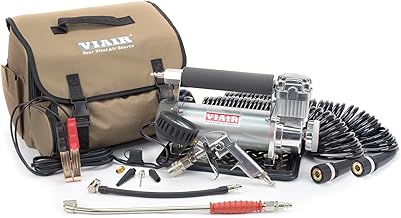
VIAIR 450P-RV Portable Kit
This is the one seasoned full-timers keep in a bay, and for good reason: a genuine 100% duty cycle motor, 1.80 CFM, 150 PSI, battery clamps, and a hose long enough to reach the back duals without repositioning. It is heavy and it is not cheap, but it will inflate every tire on a diesel pusher in one session without a cooldown break.
RV Air Compressor 12V 150PSI with Preset
The 5.65 CFM rating makes this the speed champion of the group, and the preset auto shutoff means you set your target pressure and walk away. Corded and battery-clamp fed, so treat it as a stay-in-the-bay tool rather than something you toss in a backpack.
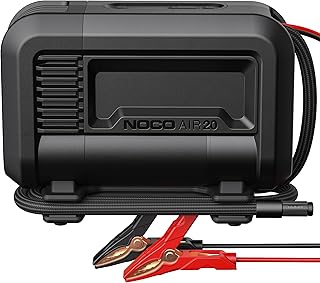
NOCO AIR20 47 LPM 12V Inflator
Zero to 40 PSI in about two and a half minutes is genuinely fast, and the battery clamp connection lets the motor draw what it needs instead of choking on a socket fuse. The 100 PSI ceiling is the one caveat, so verify your tire spec first if you run heavy duals.
NOCO Air AL5 Cordless Inflator
A tidy cordless unit that doubles as a USB-C power bank, rated to 130 PSI and sized for tires up to 31 inches. Best used as the quick-check tool you keep in the cab for topping off toad-vehicle tires, bikes, and the occasional low reading on the road.
ETENWOLF VORTEX S6 Cordless Compressor
Dual cylinders and a 19,200mAh pack give this one real staying power for a cordless design, with a 100% duty cycle claim and a bright LED for roadside work after dark. A solid pick for van lifers who want capability without running cables to the battery.
Frequently Asked Questions
Can a standard tire inflator handle RV tires?
Usually not well. Most consumer inflators are optimized for 35 PSI passenger tires and will overheat or stall before reaching the 65 to 110 PSI range that RV tires require.
Do I need battery clamps instead of a 12V socket?
For high-output compressors, yes. Socket circuits are typically fused at 15 amps, while larger motors draw 20 to 30 amps and need a direct connection to avoid blown fuses and melted plugs.
How long should inflating all six tires take?
With a 1.5 to 2 CFM continuous-duty unit, expect roughly three to five minutes per tire for a modest top-off. Filling from significantly low pressure can double that.
Should I store the compressor in a heated bay?
Keep it dry above all else. Moisture in the cylinder and hose causes corrosion and seized pistons, so drain any moisture trap and store the unit in a sealed case.
Final Thoughts
If you want one compressor to own the job outright, the VIAIR 450P-RV earns its keep through sheer stamina and reach. The 5.65 CFM RV Air Compressor with digital preset is the faster option for anyone tired of standing around, while the NOCO Air AL5 makes a smart cordless companion for quick pressure checks between stops.