Key takeaways
- Rip capacity vs. shop footprint: A 30-inch rip handles most cabinet parts; 50 inches lets you break down full sheet goods solo. Measure your walk-around space before you buy the bigger table, because a saw you have to shuffle around becomes a saw you stop using.
- Fence quality above all: The fence is the part you touch on every cut. Look for a rack-and-pinion or T-square design that locks square without tapping, and check whether it stays parallel when you slide it to the far right of the table.
- Motor type and power supply: Universal motors on 15-amp 120V saws are loud, light, and fine for framing lumber and plywood. Induction motors on 230V single-phase saws run quieter and won’t bog in thick hardwood, but you’ll need a dedicated circuit installed first.
- Trunnion and table material: Cabinet-mounted trunnions on a cast-iron top hold bevel and blade alignment far longer than stamped-steel table-mounted assemblies. If you plan on production-level accuracy, this is where the money goes.
- Dust collection and guarding: Check for a shrouded blade with a 4-inch port on stationary saws and a usable 2.5-inch port on portables. Riving knives that tool-lessly drop below the blade get reinstalled; ones that require a wrench do not.
What's inside
Ask ten woodworkers who builds the best table saw and you’ll get ten answers, usually followed by a story about a warped fence or a rip cut that wandered halfway down a board. The frustration is real: table saws all look roughly the same in a photo, but the difference between a saw that tracks true at 32 inches of rip and one that drifts a sixteenth over four feet comes down to fence design, trunnion mounting, and how much cast iron the manufacturer was willing to pay for. Spec sheets rarely tell you which corners got cut.
This guide sorts the field by what the saw is actually for. Job-site and folding-stand models get judged on portability, stand rigidity, and whether the fence survives being tossed in a truck bed. Cabinet saws get judged on power delivery, vibration, and long-rip accuracy. And small craft saws get judged on precision at a scale where a full-size blade would be absurd. Below are the six saws worth your attention in 2026, followed by the buying criteria I use in my own shop.
As an Amazon Associate we earn from qualifying purchases.




🛒 Best Price Today on Amazon
Prime members get fast, free shipping on everything above, plus member-only deals. New members get a 30-day free trial — cancel anytime.
How to Choose a Who Makes The Best Table Saw (2026)
- Rip capacity vs. shop footprint: A 30-inch rip handles most cabinet parts; 50 inches lets you break down full sheet goods solo. Measure your walk-around space before you buy the bigger table, because a saw you have to shuffle around becomes a saw you stop using.
- Fence quality above all: The fence is the part you touch on every cut. Look for a rack-and-pinion or T-square design that locks square without tapping, and check whether it stays parallel when you slide it to the far right of the table.
- Motor type and power supply: Universal motors on 15-amp 120V saws are loud, light, and fine for framing lumber and plywood. Induction motors on 230V single-phase saws run quieter and won’t bog in thick hardwood, but you’ll need a dedicated circuit installed first.
- Trunnion and table material: Cabinet-mounted trunnions on a cast-iron top hold bevel and blade alignment far longer than stamped-steel table-mounted assemblies. If you plan on production-level accuracy, this is where the money goes.
- Dust collection and guarding: Check for a shrouded blade with a 4-inch port on stationary saws and a usable 2.5-inch port on portables. Riving knives that tool-lessly drop below the blade get reinstalled; ones that require a wrench do not.
The Best Who Makes The Best Table Saw (2026)s Reviewed
DEWALT DWE7491RS 10-Inch with Rolling Stand
The rack-and-pinion fence on this one is genuinely excellent, gliding to 32-1/2 inches of rip capacity and locking parallel without the usual nudge-and-check ritual. The foldable rolling stand deploys in seconds and takes real abuse, which is why this saw shows up on so many job sites and in so many one-car garages.
SKIL TS6307-00 15 Amp Portable Jobsite Saw
SKIL built this around a rack-and-pinion fence and a foldable stand at a price that undercuts most of the competition, and the flat cast-aluminum top surprised me for the money. The onboard dust port pulls better than expected, though you’ll want to shim the miter gauge if you’re doing fussy crosscuts.
JET JTAS-10XL30-DX Deluxe XACTA, 30-Inch Rip
This is where the conversation shifts from portable to permanent: 3 HP through a 230V induction motor, cast-iron top, and cabinet-mounted trunnions that hold alignment through months of hardwood. The 30-inch rip is the sweet spot for a serious home shop that still wants to park a car inside.
Prostormer 10-Inch Benchtop Saw with Stand
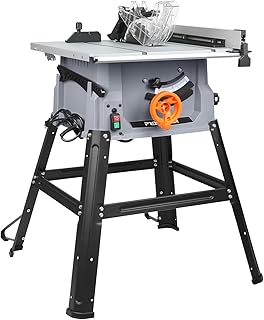
At 15 amps and 5,000 RPM with 45-degree bevel capability, this is a straightforward entry point for deck boards, trim, and shed projects. Treat it as a rough-cut workhorse rather than a joinery saw and it earns its keep, especially if this is your first table saw.
JET JTAS-10XL50-1DX Deluxe XACTA, 50-Inch Rip
The 50-inch version of JET’s XACTA is the saw you buy when breaking down full sheets of plywood alone is a weekly reality. Same 3 HP drivetrain and cast-iron accuracy as its smaller sibling, with an extension table that turns sheet goods from a two-person wrestling match into a one-person routine.
Frequently Asked Questions
Do I need a 230V saw for a home shop?
Only if you’re regularly ripping thick hardwood or running a saw for hours. A 15-amp 120V portable handles plywood, pine, and occasional oak without complaint, and it plugs into any outlet.
What’s the difference between rip capacity numbers?
Rip capacity is the maximum distance between blade and fence. A 24-inch rip handles most furniture parts; 50 inches lets you cut a 4×8 sheet down the center with the factory edge riding the fence.
Is a mini craft saw worth owning alongside a full-size saw?
Yes, if you build small. A 96W precision craft saw with variable speed and a 1/2-inch cut depth handles PCB, acrylic, and thin stock with control a 10-inch blade simply can’t offer at that scale.
How often should I check blade alignment?
Check parallelism to the miter slot every few months on a cast-iron saw, and after every transport on a portable. A five-minute check with a combination square prevents burn marks and binding.
Final Thoughts
For most home furniture builders, the DEWALT DWE7491RS remains the best all-around pick, delivering fence accuracy and mobility that punch well above its class. Step up to the JET XACTA 30-inch if you have the space and a 230V circuit, or the 50-inch XACTA if sheet goods dominate your work. Budget-conscious first-timers should start with the SKIL TS6307-00 and put the savings toward a quality blade.