Key takeaways
- Swing and throat depth: A 12-inch swing means you can center a bit six inches from the edge of your stock. For chair parts and drawer boxes that is plenty; for boring into the middle of a tabletop, no benchtop press will reach, so plan on a jig instead.
- Speed changes: Belt-and-pulley systems are cheaper but mean opening the head and moving a belt every time you switch from a 1/8-inch brad point to a 2-inch Forstner. Variable speed via a dial saves real time if you jump between bit sizes constantly.
- Table tilt and travel: Look for a table that tilts to at least 45 degrees and raises on a rack-and-pinion crank rather than a friction collar. Sliding a heavy cast iron table by hand and hoping it stays put gets old fast.
- Quill runout: This is the wobble in the spindle, and it is the single biggest factor in whether your holes come out round. Cast iron heads and columns dampen vibration far better than stamped steel, which is why the heavier machines drill cleaner even at the same horsepower.
- Chuck capacity: A 1/2-inch keyed chuck handles nearly every woodworking bit. If you are running large Forstners or hole saws, verify the chuck opens wide enough before you buy the bits.
What's inside
Anyone who has tried to bore a clean mortise for a table leg with a handheld drill knows the frustration. The bit wanders, the hole drifts off perpendicular, and by the time you flip the workpiece over the exit is a splintered mess a half-inch from where you planned. A drill press solves that problem mechanically rather than through steady hands, which is why it tends to be the third or fourth stationary tool most furniture builders buy after a saw and a sander.
The tricky part is that “drill press” covers a huge range of machines, from a $40 stand that holds a rotary tool to a magnetic-base unit that clamps to steel beams. This guide walks through six options that actually make sense in a home shop, what specs matter when you are drilling hardwood versus metal, and which model fits which kind of work. I have focused on benchtop machines since almost nobody building furniture in a garage needs a floor-standing column.
As an Amazon Associate we earn from qualifying purchases.


🛒 Best Price Today on Amazon
Prime members get fast, free shipping on everything above, plus member-only deals. New members get a 30-day free trial — cancel anytime.
How to Choose a Drill Press For Home Shop (2026)
- Swing and throat depth: A 12-inch swing means you can center a bit six inches from the edge of your stock. For chair parts and drawer boxes that is plenty; for boring into the middle of a tabletop, no benchtop press will reach, so plan on a jig instead.
- Speed changes: Belt-and-pulley systems are cheaper but mean opening the head and moving a belt every time you switch from a 1/8-inch brad point to a 2-inch Forstner. Variable speed via a dial saves real time if you jump between bit sizes constantly.
- Table tilt and travel: Look for a table that tilts to at least 45 degrees and raises on a rack-and-pinion crank rather than a friction collar. Sliding a heavy cast iron table by hand and hoping it stays put gets old fast.
- Quill runout: This is the wobble in the spindle, and it is the single biggest factor in whether your holes come out round. Cast iron heads and columns dampen vibration far better than stamped steel, which is why the heavier machines drill cleaner even at the same horsepower.
- Chuck capacity: A 1/2-inch keyed chuck handles nearly every woodworking bit. If you are running large Forstners or hole saws, verify the chuck opens wide enough before you buy the bits.
The Best Drill Press For Home Shop (2026)s Reviewed
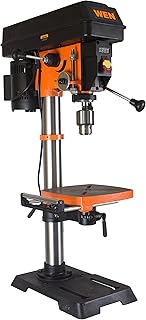
WEN 12-Inch Variable Speed Benchtop (DP1263V)
The variable speed motor is the headline feature here, letting you dial in anything from a slow crawl for large-diameter Forstners to high RPM for small twist bits without touching a belt. Combined with the 12-inch swing and cast iron head, this is the machine I would point most furniture builders toward if the budget allows.
SKIL 6.2 Amp 10-Inch 5-Speed (DP9505-00)
SKIL’s laser alignment system uses two crossing beams that meet exactly at the bit center, which is genuinely more useful than the single-line lasers on cheaper presses. The 10-inch swing is a bit tighter than the WEN, but the fit and finish on the depth stop and table crank are excellent for the price.
WEN 8-Inch 5-Speed Cast Iron (4206T)
At 2.3 amps this is the lightest-duty press on the list, and it will bog down in thick hard maple. For drawer pulls, shelf pin holes, dowel joinery, and general small-part work it is completely adequate and takes up remarkably little bench space.
8-Inch Benchtop Press with Tilting Table (620-3100 RPM)
The standout here is a table that tilts a full 45 degrees and adjusts for height easily, which matters more than people expect when drilling angled sockets for chair spindles. The 3.1-amp motor splits the difference between the two WEN models.
Dremel Rotary Tool Workstation (220-01)
This is not a drill press in the traditional sense; it is a stand that converts a rotary tool into one, with two inches of plunge depth. If you already own a Dremel and mostly need precise shallow holes in small parts, it costs a fraction of a real press and stores in a drawer.
Frequently Asked Questions
Do I need a floor-standing model?
Only if you regularly drill into tall workpieces standing on end, like a bed post. A benchtop press mounted on a sturdy bench handles virtually all furniture work, and you can always cut a hole in your bench top to gain vertical clearance when you need it.
What speed should I run for wood?
Roughly inverse to bit diameter. Small twist bits under 1/4 inch are happy at 3000 RPM, while a 2-inch Forstner wants to be down around 250 to 500 RPM or it will scorch the wood and dull the cutting edges.
Is the laser guide actually useful?
Somewhat. Crossing-beam lasers help with rough positioning, but for precision work you will still lower the bit to touch your layout mark. Treat it as a convenience feature rather than a reason to choose one machine over another.
Why would I want a magnetic drill press?
The VEVOR mag drill exists for a different job entirely: boring large holes through steel that cannot be brought to a bench. If you fabricate steel bases for furniture or do structural work, it clamps directly to the workpiece with nearly 3000 pounds of holding force.
Final Thoughts
For most home furniture shops the WEN DP1263V is the sensible buy, since variable speed and a 12-inch swing cover everything from dowel joinery to large Forstner work without compromise. The SKIL DP9505-00 is a strong alternative if you prefer its crossing-laser setup and do not need the extra swing, while the compact WEN 4206T makes sense for small-parts work in a tight space.