Key takeaways
- Deck rigidity: Press your thumb hard into the centre of the surface. If it dishes even slightly, a pen tip will punch through your paper on heavy strokes. Look for MDF or ply cores rather than thin injection-moulded plastic, and be sceptical of any deck under about 8mm thick.
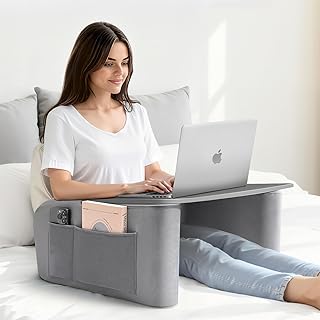
- Cushion behaviour: Microbead fill conforms nicely but can shift and let the desk roll sideways as you write. Firmer foam or dual-bolster designs split the load across both thighs and resist that tipping motion, which matters far more for handwriting than for typing.
- Usable margin: A composition book is roughly 7.5 x 9.75 inches, but you also need room for your writing hand to travel past the page edge. Aim for at least 20 inches of width so your elbow isn’t hanging in space at the end of a line.
- Wrist and forearm support: Padded wrist rests help typists, but writers benefit more from a flat, uninterrupted plane and arm rests at the outer edges. Raised lips and ledges that are great for laptops become obstacles when your hand needs to slide freely.
- Legs versus lap contact: Folding-leg tables give you a truly level, non-rocking surface and let you sit upright, which is better posture for long writing stints. Cushioned models are more portable and warmer to use but always transmit some leg movement to the page.
What's inside
Handwriting on your lap is a different problem than typing on your lap. A keyboard just needs a flat plane and somewhere for your palms to land, but a pen needs a surface that doesn’t flex under point pressure, doesn’t tilt when you lean into a downstroke, and sits high enough that your wrist isn’t cocked at an awkward angle. I’ve spent enough time clamping plywood offcuts to sofa arms to know that most lap desks are engineered for laptops first and writing second, which is why so many of them feel mushy the moment you put ink to paper.
This guide looks at lap desks specifically through a writing lens: how rigid the deck is under a pen nib, whether the cushion resists rocking or amplifies it, how much usable margin you get beside a notebook, and how the geometry treats your forearms over a long session. I’ve included both cushioned models and hard-legged folding tables, since the right answer depends on whether you write in bed, on a couch, or in a chair with your feet planted.
As an Amazon Associate we earn from qualifying purchases.




How to Choose a Lap Desk For Writing (2026)
- Deck rigidity: Press your thumb hard into the centre of the surface. If it dishes even slightly, a pen tip will punch through your paper on heavy strokes. Look for MDF or ply cores rather than thin injection-moulded plastic, and be sceptical of any deck under about 8mm thick.
- Cushion behaviour: Microbead fill conforms nicely but can shift and let the desk roll sideways as you write. Firmer foam or dual-bolster designs split the load across both thighs and resist that tipping motion, which matters far more for handwriting than for typing.
- Usable margin: A composition book is roughly 7.5 x 9.75 inches, but you also need room for your writing hand to travel past the page edge. Aim for at least 20 inches of width so your elbow isn’t hanging in space at the end of a line.
- Wrist and forearm support: Padded wrist rests help typists, but writers benefit more from a flat, uninterrupted plane and arm rests at the outer edges. Raised lips and ledges that are great for laptops become obstacles when your hand needs to slide freely.
- Legs versus lap contact: Folding-leg tables give you a truly level, non-rocking surface and let you sit upright, which is better posture for long writing stints. Cushioned models are more portable and warmer to use but always transmit some leg movement to the page.
The Best Lap Desk For Writing (2026)s Reviewed
OPTIXCELL Wooden Lap Desk Pillow
The 23.7-inch wooden deck is the most pen-friendly surface here: it doesn’t deflect under point pressure, and the integrated arm rests let you anchor your forearm instead of floating it, which is the single biggest fatigue-saver in a long writing session. The 44 lb rating is overkill for a notebook, but that structural margin is exactly why the surface stays dead flat.
LAPGEAR Home Office Pro
The dual-bolster microbead cushion is the smart bit of engineering here, spreading the load across both thighs so the desk resists the sideways roll that ruins handwriting on single-cushion models. The built-in mouse pad also doubles as a low-friction blotter surface if you write with a lighter touch.
BUYIFY 23″ Foldable Lap Desk
Folding legs and a full 23-inch span give you a genuinely level, rock-solid plane that behaves like a real desk rather than a tray, and it arrives with no assembly required. The trade-off is bulk, so it suits a dedicated writing spot on the bed or couch more than something you carry room to room.
LAPGEAR The Original Lap Desk
The built-in pencil tray sounds like a gimmick until you’ve watched a favourite pen roll off a cushioned desk and vanish under a sofa. Fits 17-inch laptops, so there’s ample margin for a notebook plus reference material, though the single microbead cushion is softer than I’d choose for very heavy-handed writers.
HUANUO Lap Desk
The wood-grain deck is noticeably stiffer than most plastic-topped competitors, and the pen holder plus tablet slot make it a tidy setup for anyone transcribing notes from a screen. Padded wrist support is generous, though the raised holders eat into your hand’s travel area on wider pages.
Frequently Asked Questions
Is a cushioned lap desk or a folding-leg table better for handwriting?
Folding-leg tables win on stability because the surface sits independently of your body, so shifting your weight doesn’t move the page. Cushioned desks are lighter and more comfortable against your legs, and dual-bolster designs close much of the stability gap.
How large a surface do I actually need?
For a standard notebook plus room to rest your hand, look for 20 inches or more of width. Anything narrower forces you to write with your elbow unsupported, which shows up in your handwriting within about ten minutes.
Can I add a writing slope to a flat lap desk?
Yes, and it’s a worthwhile DIY tweak. A wedge of scrap ply or dense foam cut at roughly 15 degrees, secured with hook-and-loop tape, gives you a proper drafting angle without permanently modifying the desk.
Will a lap desk work on a soft mattress?
Cushioned models work best there, since folding legs can sink unevenly into a mattress. If you prefer legs, set them on a rigid board or bed tray base to spread the load.
Final Thoughts
For serious handwriting, the OPTIXCELL Wooden Lap Desk is my top pick thanks to its unflexing deck and integrated arm rests. If you want stability without the bulk of a hard surface, the LAPGEAR Home Office Pro’s dual-bolster cushion is the most stable soft-base option, while the BUYIFY 23″ Foldable is the closest thing to a real desk you can set up on a bed.