Key takeaways
- Tooth count: For clean moulding cuts, 60 to 100 teeth is a useful range on a 10- or 12-inch blade. More teeth generally produce a smoother edge, though they cut more slowly.
- Tooth design: A blade with alternating top bevel teeth is a dependable choice for crosscutting trim. Look for a profile intended for fine finish or woodworking rather than demolition.
- Blade diameter: Match the blade diameter to your saw. A 10-inch saw needs a 10-inch blade, while a 12-inch saw requires a 12-inch model; never substitute sizes casually.
- Arbor and kerf: Confirm the arbor hole before ordering, and check whether the blade’s kerf suits your saw. A thinner kerf can reduce waste and load on smaller saws, but it must remain stable during the cut.
- Material and upkeep: Carbide-tipped teeth hold an edge longer than basic steel teeth. Keep the blade clean of resin and adhesive, and replace it when sharpening no longer restores a crisp cut.
What's inside
Cutting moulding cleanly is less about brute force and more about controlling the cut. A blade with too few teeth can tear delicate profiles, while an overly aggressive or poorly matched blade may leave chipped corners, fuzzy edges, or a finish that demands unnecessary sanding. The right choice also depends on whether you are trimming lightweight casing, cutting hardwood crown moulding, or making repeated compound miters for a full room.
This guide looks at practical blade options for home workshops and furniture projects, with attention to tooth count, carbide quality, kerf, arbor fit, and the kind of finish you can expect at the saw. These picks cover dedicated fine-finish blades as well as more versatile combinations for makers who want one blade to handle moulding and general woodwork.
As an Amazon Associate we earn from qualifying purchases.


🛒 Best Price Today on Amazon
Prime members get fast, free shipping on everything above, plus member-only deals. New members get a 30-day free trial — cancel anytime.
How to Choose a Miter Saw Blade For Moulding (2026)
- Tooth count: For clean moulding cuts, 60 to 100 teeth is a useful range on a 10- or 12-inch blade. More teeth generally produce a smoother edge, though they cut more slowly.
- Tooth design: A blade with alternating top bevel teeth is a dependable choice for crosscutting trim. Look for a profile intended for fine finish or woodworking rather than demolition.
- Blade diameter: Match the blade diameter to your saw. A 10-inch saw needs a 10-inch blade, while a 12-inch saw requires a 12-inch model; never substitute sizes casually.
- Arbor and kerf: Confirm the arbor hole before ordering, and check whether the blade’s kerf suits your saw. A thinner kerf can reduce waste and load on smaller saws, but it must remain stable during the cut.
- Material and upkeep: Carbide-tipped teeth hold an edge longer than basic steel teeth. Keep the blade clean of resin and adhesive, and replace it when sharpening no longer restores a crisp cut.
The Best Miter Saw Blade For Moulding (2026)s Reviewed
DEWALT 12-Inch 100-Tooth Fine Finish Blade
The DEWALT Miter Saw Blade DWA112100 is the most straightforward choice here for a 12-inch saw dedicated to finish carpentry. Its 100 carbide teeth are well suited to crosscutting painted trim, hardwood moulding, and furniture components where a clean exit edge matters more than speed. It is especially appealing for repeated miters, provided the saw is accurately aligned and the workpiece is firmly supported.
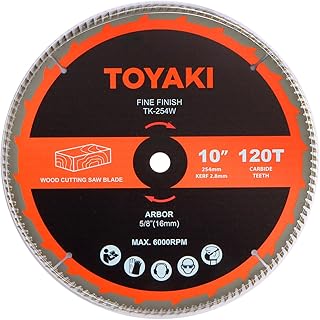
10-Inch 120-Tooth Fine-Finish Blade
This 10-Inch Miter Saw Blade uses a very high tooth count for smooth, controlled cuts in moulding and other fine woodworking stock. It is a strong option when minimizing visible chipping is the priority, although the dense tooth pattern rewards a steady feed rate and a properly tuned saw. Verify the 5/8-inch arbor before buying.
LM6300 12-Inch 100T Miter Joint Blade
The LM6300 Miter Joint Saw Blade combines a 12-inch diameter with 100 teeth, making it naturally suited to detailed trim work and crisp picture-frame or furniture joints. Its 1-inch bore is the key compatibility detail, so measure your saw’s arbor rather than assuming every 12-inch blade will fit. For a workshop with a matching machine, it offers a finish-focused configuration without unnecessary complexity.
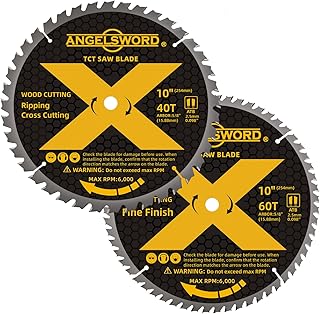
ANGELSWORD 10-Inch 40T/60T Two-Pack
The ANGELSWORD 10 Inch Table Saw Blade/Miter Saw Blade two-pack is a practical setup for makers who want both a general-purpose 40-tooth blade and a finer 60-tooth option. Use the 60T blade for visible moulding cuts and reserve the 40T blade for ripping, rougher crosscuts, or stock preparation. It is less specialized than a 100T finish blade, but the flexibility can be valuable in a small home shop.
ANGELSWORD 10-Inch 32T/60T/80T Three-Pack
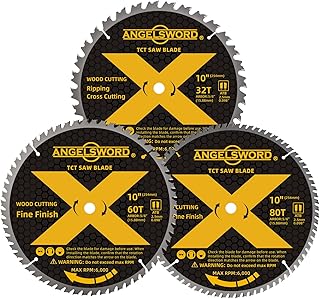
This ANGELSWORD 10 Inch three-pack covers a broad range, from 32T framing work to 60T fine finishing and 80T ultra-fine cutting. The 80T blade is the most relevant for delicate moulding, while the other two give you useful options for breaking down boards and handling less demanding cuts. It is a sensible value-oriented kit for DIYers building a blade collection rather than buying a single-purpose model.
Frequently Asked Questions
How many teeth should a miter saw blade have for moulding?
A 60-tooth blade is a good starting point for general trim, while 80 to 100 teeth can produce a cleaner edge on fine or easily chipped moulding. Very high tooth counts trade cutting speed for finish quality.
Is a 120-tooth blade better for every moulding cut?
Not necessarily. A 120-tooth blade can reduce splintering, but it may cut slowly and create more friction. It works best when the blade is sharp, the material is supported, and you are making controlled finish cuts rather than removing a lot of stock.
Should I use a combination blade for moulding?
A combination blade is useful if the same blade will handle ripping, crosscutting, and occasional trim work. For highly visible miters, however, a dedicated fine-finish blade usually gives more predictable results.
Why does my new blade still chip the moulding?
Blade choice is only part of the equation. Check saw alignment, support the moulding close to the cut, clamp narrow pieces safely, keep the finished face oriented correctly, and allow the blade to reach full speed before entering the wood.
Final Thoughts
For the cleanest dedicated trim work, the DEWALT 12-Inch 100-Tooth blade is the strongest all-around pick, while the 10-Inch 120-Tooth blade suits smaller saws and exceptionally finish-sensitive cuts. For a flexible DIY setup, the ANGELSWORD 10-Inch 32T/60T/80T pack offers the broadest coverage with useful options beyond moulding.