Key takeaways
- Tabletop finish and edge treatment: Melamine and laminate tops vary wildly. Look for a wrapped or sealed edge rather than a raw seam — that’s the first place a desk starts looking cheap after a year of forearms resting on it. Glass tops sidestep the issue entirely but show fingerprints.
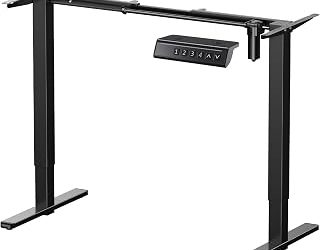
- Frame profile: Two-stage legs are chunkier and slower; three-stage legs are slimmer and quieter, and they tuck away more neatly at seated height. If the desk sits in a shared space, the slimmer profile makes a visible difference.
- Cable routing built in: Grommets, under-desk trays, and integrated USB ports separate a tidy setup from a spaghetti situation. If the desk has none, budget for an adhesive cable raceway and plan to run it before you flip the top upright.
- Footprint versus room scale: A 48-inch top reads light and disappears against a wall. A 72-inch top becomes furniture — it needs the room to carry it. Measure your wall, then subtract six inches for the frame’s rear clearance.
- Assembly honesty: Most of these ship in two boxes with pre-drilled tops. The real work is aligning the crossbar and getting the leg brackets square. Use a hand driver for the final turns on tabletop screws — an impact driver will strip particleboard fast.
What's inside
Most standing desks look like they escaped from a warehouse. Bare steel legs, a laminate slab with visible particleboard edges, a tangle of cables sagging underneath — functional, sure, but nothing you’d want anchoring a living room corner or sitting behind you on a video call. The frustration is real: you want the ergonomics without turning your home into a cubicle farm, and the desks that photograph well in showrooms often cost as much as a decent sofa.
I’ve assembled, disassembled, and re-leveled enough of these frames to know that good looks come down to three things: how the tabletop edge is finished, how well the frame hides its own hardware, and whether the cable management was designed in or bolted on as an afterthought. This guide covers six electric height-adjustable desks that hold up visually in a real room, with notes on build quality, finish durability, and what you’ll actually be doing during assembly.
As an Amazon Associate we earn from qualifying purchases.


How to Choose a Looking Standing Desk (2026)
- Tabletop finish and edge treatment: Melamine and laminate tops vary wildly. Look for a wrapped or sealed edge rather than a raw seam — that’s the first place a desk starts looking cheap after a year of forearms resting on it. Glass tops sidestep the issue entirely but show fingerprints.
- Frame profile: Two-stage legs are chunkier and slower; three-stage legs are slimmer and quieter, and they tuck away more neatly at seated height. If the desk sits in a shared space, the slimmer profile makes a visible difference.
- Cable routing built in: Grommets, under-desk trays, and integrated USB ports separate a tidy setup from a spaghetti situation. If the desk has none, budget for an adhesive cable raceway and plan to run it before you flip the top upright.
- Footprint versus room scale: A 48-inch top reads light and disappears against a wall. A 72-inch top becomes furniture — it needs the room to carry it. Measure your wall, then subtract six inches for the frame’s rear clearance.
- Assembly honesty: Most of these ship in two boxes with pre-drilled tops. The real work is aligning the crossbar and getting the leg brackets square. Use a hand driver for the final turns on tabletop screws — an impact driver will strip particleboard fast.
The Best Looking Standing Desk (2026)s Reviewed
FEZIBO 48 × 24 Electric Standing Desk, Maple
The maple finish is the quiet standout here — warm, low-sheen, and convincingly wood-like at a distance rather than the orange-tinted laminate you often get at this size. Three memory presets and a compact footprint make it the easiest pick for a bedroom corner or small home office where the desk needs to blend in.
Veken 55 Inch Large Electric Standing Desk, White
Clean white top, minimal frame, and enough surface for a dual-monitor arm without crowding. The gloss picks up dust and light scratches more readily than a matte finish, so a felt desk mat under the keyboard area is worth adding on day one.
Marsail Glass Standing Desk with Drawer
This is the most visually distinct desk on the list — tempered glass top, integrated drawer, and USB charging ports that eliminate the need for a separate hub. The one-piece top means no seam to align during assembly, though glass demands a level floor and a careful hand when tightening brackets.
Vari Classic Electric Standing Desk, 72×30 Walnut/Slate
The walnut-and-slate pairing is the closest thing here to actual furniture, and the frame rigidity at full extension is noticeably better than the budget field. Assembly is genuinely quick because the top arrives pre-attached to mounting hardware, which matters at this size — a 72-inch top is a two-person flip.
ErGear 55 × 28 Standing Desk, Vintage Brown
The vintage brown reads darker and more textured than most laminates in this price range, hiding scuffs well over time. Solid mid-size proportions and a stable frame, though the underside has no cable tray, so plan on mounting one yourself.
Frequently Asked Questions
Do I need a second person for assembly?
For 48-inch tops, no — you can assemble the frame face-down and flip it solo. For 55-inch and larger, especially glass, get help for the flip. That’s the step where tops crack and thumbs get pinched.
Will a laminate top hold up to daily use?
Yes, if you protect the two contact zones: where your forearms rest and where your chair armrests hit the edge. A desk mat and a felt edge guard handle both. Direct sunlight is the bigger long-term risk for color fading.
How stable are these at full standing height?
Three-stage legs with a rigid crossbar handle typing fine. Any wobble usually traces back to loose leg brackets or an uneven floor, both fixable — re-torque every bolt after the first week of use, since the frame settles.
Can I swap the tabletop later?
Most of these frames use standard mounting patterns, so a butcher block or solid-wood top is a straightforward upgrade. Check the frame’s stated weight capacity first, since a hardwood top can eat 40 pounds of it.
Final Thoughts
If looks are the priority and budget allows, the Vari Classic in walnut and slate is the one that reads as real furniture. The Marsail glass desk is the better pick for a modern, minimal room where storage and charging ports need to disappear into the design, and the FEZIBO maple is the smart small-space choice — warm finish, tidy footprint, and the least fussy assembly of the group.