Key takeaways
- CFM at 90 PSI is the number that counts: Ignore peak PSI marketing and look at sustained delivery. For full-panel or whole-car work with an HVLP gun, you want 5 CFM minimum and ideally more; anything under 4 CFM will have you pausing between passes while pressure recovers.
- Tank size buys you continuity: A larger tank doesn’t create air, but it stores enough to smooth out the gaps while the pump catches up. Twenty gallons and up lets you finish a door or fender without interruption. Small tanks under 5 gallons cycle constantly, which means pressure fluctuation right where you need consistency.
- Noise matters more than you think: Painting takes hours, often in a closed garage with a respirator on. Oil-free direct-drive units can hit 90 dB and become genuinely miserable. Quiet models in the 60 to 70 dB range let you hear what you’re doing and keep the neighbors friendly.
- Plan for moisture and filtration: Compressed air carries water and oil vapor, both of which cause fisheyes in fresh paint. Budget for an inline water separator, a desiccant dryer, and ideally a long run of copper or steel line to drop condensate before it reaches the gun. Oil-free pumps simplify one half of this problem.
- Check your circuit before you buy: Most 120V compressors draw 13 to 15 amps and will trip a shared household breaker mid-spray. Confirm you have a dedicated 15 or 20 amp line, or be ready to run one.
Spraying a car in your own garage lives or dies on air supply. The gun itself is the cheap part — most HVLP setups need somewhere between 8 and 14 CFM at 30 to 40 PSI to lay down a wet, even coat, and a compressor that can’t keep up will stutter mid-pass, leaving dry spray, tiger stripes, and orange peel that you’ll spend a weekend sanding out. The catch is that spec sheets rarely make this obvious. A tank stamped “175 PSI” tells you nothing about whether it can feed a gun continuously, and CFM ratings get quoted at pressures nobody paints at.
This guide sorts through what actually matters for home automotive paint work: sustained airflow, tank volume as a buffer, duty cycle, and how much noise you’re willing to live with in an attached garage. We’ve pulled together six compressors spanning full-size vertical units down to compact quiet models, with honest notes on which ones can handle a full panel, which are better suited to touch-ups and detail work, and where each one fits in a home shop budget.
Our top picks



As an Amazon Associate we earn from qualifying purchases at no extra cost to you. Ratings are shown as listed on Amazon.
🛒 Best Price Today on Amazon
Prime members get fast, free shipping on everything above, plus member-only deals. New members get a 30-day free trial — cancel anytime.
How to Choose a/an Air Compressor For Painting Cars At Home (2026)
- CFM at 90 PSI is the number that counts: Ignore peak PSI marketing and look at sustained delivery. For full-panel or whole-car work with an HVLP gun, you want 5 CFM minimum and ideally more; anything under 4 CFM will have you pausing between passes while pressure recovers.
- Tank size buys you continuity: A larger tank doesn’t create air, but it stores enough to smooth out the gaps while the pump catches up. Twenty gallons and up lets you finish a door or fender without interruption. Small tanks under 5 gallons cycle constantly, which means pressure fluctuation right where you need consistency.
- Noise matters more than you think: Painting takes hours, often in a closed garage with a respirator on. Oil-free direct-drive units can hit 90 dB and become genuinely miserable. Quiet models in the 60 to 70 dB range let you hear what you’re doing and keep the neighbors friendly.
- Plan for moisture and filtration: Compressed air carries water and oil vapor, both of which cause fisheyes in fresh paint. Budget for an inline water separator, a desiccant dryer, and ideally a long run of copper or steel line to drop condensate before it reaches the gun. Oil-free pumps simplify one half of this problem.
- Check your circuit before you buy: Most 120V compressors draw 13 to 15 amps and will trip a shared household breaker mid-spray. Confirm you have a dedicated 15 or 20 amp line, or be ready to run one.
The Best Air Compressor For Painting Cars At Home (2026)s Reviewed
Klutch 29-Gallon Vertical Compressor
With 5.1 CFM at 90 PSI and a 29-gallon reservoir, this is the most capable option here for genuine automotive paint work — the tank volume gives you enough buffer to spray a full panel without chasing pressure. Oil-free means less upkeep, and the vertical footprint plus large wheels make it manageable in a single-bay garage.
VEVOR 13-Gallon Compressor
A well-judged middle ground at 4.6 SCFM and 66 dB, quiet enough for extended sessions in an attached garage. The 13-gallon tank handles smaller panels, bumpers, and wheels comfortably, though a full respray will have you working in stages while pressure recovers.
15-Gallon Vertical Twin Cylinder
The twin-cylinder pump delivers 4.5 CFM while keeping noise near 66 dB, which is an unusual combination at this size. The vertical tank saves floor space and the extra two gallons over the VEVOR give you slightly more runway on longer passes.
California Air Tools CAT-4610AC
A genuinely quiet twin-tank unit that’s a pleasure to work beside, but the 4.6-gallon capacity limits it to touch-ups, spot repairs, and detail spraying rather than whole panels. Excellent as a second compressor or for anyone doing small cosmetic corrections.
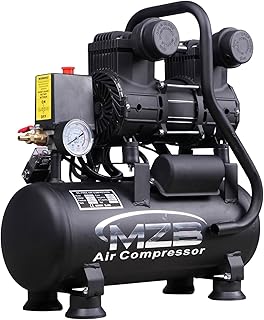
MZB 2.4 Gallon Ultra Quiet
Rated at 5.65 CFM, the pump itself is surprisingly strong, but the 2.4-gallon tank and 115 PSI ceiling mean near-constant cycling under a spray gun. Best treated as a compact option for airbrush work, primer touch-ins, and blow-down between coats.
Frequently Asked Questions
What size compressor do I actually need to paint a whole car?
Realistically, 20 gallons and 5-plus CFM at 90 PSI is the practical floor for continuous work. Below that you can still get good results by painting in sections and letting pressure recover, but the process takes longer and consistency gets harder.
Do I need an oil-lubricated compressor for paint work?
No — oil-free is arguably safer for painting, since there’s no risk of oil carryover contaminating your finish. Oil-lubricated pumps run quieter and last longer under heavy duty cycles, but they demand proper filtration and regular maintenance.
Can I use a small compressor with an LVLP gun instead?
Yes, and it’s a smart workaround. LVLP guns typically need 3 to 6 CFM rather than 10-plus, which brings mid-size compressors into play. Transfer efficiency is good, though you’ll trade some atomization quality and coverage speed.
Why does my paint look pitted or cratered?
Almost always moisture or oil in the air line. Drain your tank before every session, run a water separator plus desiccant dryer at the gun, and let hot compressed air cool through a length of line so condensate drops out before it hits the surface.
Final Thoughts
For anyone serious about spraying complete panels or a full car at home, the Klutch 29-Gallon is the clear choice here — the airflow and tank volume are what the job genuinely requires. The VEVOR 13-Gallon is the smarter pick if noise and space are constraints and you’re mostly doing repairs and single panels, while the 15-Gallon Vertical Twin Cylinder splits the difference nicely with a compact footprint and quiet operation.