Key takeaways
- Continuous CFM at working pressure: Match the compressor’s sustained delivery at 40 PSI to your gun’s requirement, then add roughly 30% headroom. An LVLP gun wanting 4 CFM needs a machine that genuinely holds 5, not one that peaks there.
- Tank size versus duty cycle: Larger tanks buy you spraying time between cycles, but a strong pump on a small tank recovers faster. For furniture panels, 6 to 8 gallons is the practical sweet spot; anything under 3 gallons means working in short bursts.
- Oil-free versus oil-lubricated: Oil-free pumps eliminate the risk of oil mist reaching your finish, which is the single worst contamination in a clear coat. Oil-lubricated units run quieter and last longer but demand a proper coalescing filter.
- Noise rating in dBA: Anything at or below 70 dBA lets you spray without ear protection and without a neighbor dispute. Standard pancake compressors sit near 80 to 90 dBA, which is genuinely punishing in a closed garage.
- Moisture management: Compressed air carries water, and water carries fisheye. Look for an accessible tank drain, and plan on adding a desiccant dryer or water separator at the gun regardless of what the compressor includes.
Spraying finish on a dresser or a set of cabinet doors is where most home shops hit a wall. The gun atomizes fine for about twenty seconds, then the pressure sags, the fan pattern collapses into a stripe, and you’re left with orange peel across a panel you spent a weekend sanding. The culprit almost never sits in the gun itself — it’s a compressor that can’t feed it. Spray guns are unusual among air tools because they draw continuously, not in bursts, so a machine rated for nailing can look strong on paper and still starve a needle valve.
This guide sorts through the compressors worth putting behind a spray gun in a home or garage furniture shop, with an eye on continuous CFM, recovery speed, and noise you can tolerate indoors. I’ve weighted quiet oil-free units heavily, since finishing usually happens in an attached garage or basement where a screaming direct-drive pump makes the whole house miserable. Below you’ll find the picks, a short buying framework, reviews of the top five, and answers to the questions that come up most often once someone starts shooting lacquer or waterborne topcoats.
Our top picks



As an Amazon Associate we earn from qualifying purchases at no extra cost to you. Ratings are shown as listed on Amazon.
🛒 Best Price Today on Amazon
Prime members get fast, free shipping on everything above, plus member-only deals. New members get a 30-day free trial — cancel anytime.
How to Choose a/an Air Compressor For Spray Gun (2026)
- Continuous CFM at working pressure: Match the compressor’s sustained delivery at 40 PSI to your gun’s requirement, then add roughly 30% headroom. An LVLP gun wanting 4 CFM needs a machine that genuinely holds 5, not one that peaks there.
- Tank size versus duty cycle: Larger tanks buy you spraying time between cycles, but a strong pump on a small tank recovers faster. For furniture panels, 6 to 8 gallons is the practical sweet spot; anything under 3 gallons means working in short bursts.
- Oil-free versus oil-lubricated: Oil-free pumps eliminate the risk of oil mist reaching your finish, which is the single worst contamination in a clear coat. Oil-lubricated units run quieter and last longer but demand a proper coalescing filter.
- Noise rating in dBA: Anything at or below 70 dBA lets you spray without ear protection and without a neighbor dispute. Standard pancake compressors sit near 80 to 90 dBA, which is genuinely punishing in a closed garage.
- Moisture management: Compressed air carries water, and water carries fisheye. Look for an accessible tank drain, and plan on adding a desiccant dryer or water separator at the gun regardless of what the compressor includes.
The Best Air Compressor For Spray Gun (2026)s Reviewed
California Air Tools 8010 PK Ultra Quiet Kit
This is the closest thing to a purpose-built furniture finishing setup in the category — an 8-gallon oil-free tank running at 60 dBA, bundled with an LVLP gun that’s already matched to the pump’s output. The low-RPM motor means it recovers quietly while you’re mid-panel, and the wheeled steel tank moves between a garage bay and a driveway spray station without a fight.
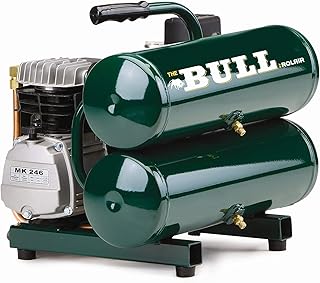
Rolair FC2002 Twin Stack
Rolair builds contractor-grade iron, and the FC2002’s cast-iron pump delivers steady air far longer than the aluminum units in this price bracket. It’s louder than the quiet-series machines, but if you’re spraying large casework or running a conversion gun that wants real volume, this is the one that won’t flinch.
Rolair JC10 Plus
A 2.5-gallon jobsite compressor with a reputation for surviving abuse, the JC10 Plus punches well above its footprint thanks to an efficient pump and genuinely low noise. Treat it as a touch-up and small-project machine — chairs, drawer fronts, edge banding — rather than a full kitchen’s worth of doors.
Metabo HPT EC914S Pancake
At 6 gallons and 4 CFM, the EC914S has the tank capacity and delivery to feed a modest HVLP gun while doubling as a nailer supply for carcass assembly. It’s the pragmatic pick for a shop that builds as much as it finishes, though the noise level means hearing protection is not optional.
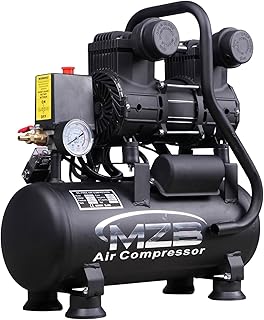
MZB 2.4 Gallon Ultra Quiet
Rated at 5.65 CFM from a 1.2 HP oil-free pump at 70 dB, the MZB posts unusually strong airflow numbers for its size and price. Verify actual sustained output against your gun’s spec before committing to a big spray session, but as a quiet, compact finishing compressor it’s a legitimate value.
Frequently Asked Questions
How much CFM does a spray gun actually need?
LVLP guns typically want 2 to 5 CFM at 25 to 40 PSI, while traditional HVLP conversion guns can demand 10 to 14 CFM. Always check the gun’s air cap rating, since that number, not the gun body, determines your compressor requirement.
Can I spray furniture with a pancake compressor?
Yes, for small pieces and touch-ups, provided the unit delivers at least 4 CFM. You’ll be pausing between passes on large panels while the tank refills, which risks visible lap marks on fast-drying finishes.
Do I need a water separator?
Absolutely. Even a well-drained tank sends humid air downstream, and water droplets in a topcoat cause fisheye and blush that only sanding will fix. A cheap inline separator plus a desiccant filter at the gun handle is money well spent.
Is an oil-free compressor worth the shorter lifespan?
For finishing work, yes. Oil carryover contaminates a clear coat in ways that are nearly impossible to correct, and modern oil-free pumps last plenty long under intermittent hobby use.
Final Thoughts
For most home furniture builders, the California Air Tools 8010 PK is the straightforward answer — quiet enough for an attached garage, large enough to spray a full door without stalling, and paired with a gun that already matches its output. If you’re spraying larger volumes or want a machine that will outlive several projects, step up to the Rolair FC2002. And for small-batch work in tight quarters, the Rolair JC10 Plus gives you jobsite durability in a package you can carry with one hand.