Anyone who has dragged a corded compressor across a garage floor, hunted for an outlet behind a workbench, or tried to top off a trailer tire in a gravel driveway knows the frustration. Air is one of those shop utilities you only miss when it isn’t there, and the moment you need it is almost never the moment you’re standing next to a receptacle. Battery-powered compressors solve that gap, but the category is muddled: some units are glorified tire pumps, others are genuine tankless nailer feeders, and the spec sheets rarely make the difference obvious.
This guide sorts them out from a maker’s perspective. I care about how long a pack lasts when you’re seating four tires, whether the auto shut-off actually stops at the number on the screen, how loud the thing is at midnight in an attached garage, and whether it runs on a battery platform you already own. Below are the models worth your money in 2026, followed by the specs that matter and the ones that are marketing filler.
Our top picks


As an Amazon Associate we earn from qualifying purchases at no extra cost to you.
🛒 Best Price Today on Amazon
Prime members get fast, free shipping on everything above, plus member-only deals. New members get a 30-day free trial — cancel anytime.
How to Choose a Battery-Powered Air Compressor (2026)
- Volume vs. pressure: PSI is the headline number, but LPM or CFM determines how fast you actually fill. A 160 PSI rating means nothing if the pump moves 12 liters per minute; look for 30 LPM or better for truck and SUV tires.
- Battery platform: If you already run DeWalt, Milwaukee, or Ryobi packs, a bare-tool inflator is the cheapest air you’ll ever buy. Standalone units with built-in lithium cells are simpler but leave you with one more charger and one more thing to remember.
- Dual power fallback: A 12V DC cord is worth having. Batteries self-discharge in a cold trunk over winter, and a cigarette-lighter plug turns a dead pack into a minor annoyance instead of a stranding.
- Duty cycle and heat: Small pumps run hot. Check whether the manual specifies a rest interval, and expect to pause between tires on any handheld unit. Tank models like the 0.26-gallon DeWalt-compatible compressor handle sustained work far better.
- Tank or tankless: Tankless is right for tires, bikes, and sports gear. If you want to drive a brad nailer or blow out a dusty router table, you need a reservoir and roughly 65 dB or quieter if you value your neighbors.
The Best Battery-Powered Air Compressors (2026) Reviewed
DEWALT 20V MAX Tire Inflator (DCC020IB)
Sold as a bare tool, this is the smart pick if you already have 20V MAX packs on the shelf, and the high-volume/high-pressure switchover plus a genuinely useful LED work light make it the most complete handheld here. The auto shut-off tracks closely to the set pressure in our research, which is not something every unit in this class can claim.
Cordless 0.26-Gallon Tank Compressor for DeWalt 20V
This is the outlier and the one most makers overlook: an oil-free tank compressor that runs off DeWalt packs at around 65 dB, quiet enough for indoor trim work without ear protection. It won’t keep up with a framing gun, but for brad nailers, upholstery staplers, and blowing chips off a workbench it replaces a much larger machine.
OlarHike 12000mAh Heavy Duty Inflator
The 12000mAh cell and 150 PSI ceiling give this one the endurance to handle light truck, Jeep, and RV tires without stopping to recharge halfway through the set. Dual 12V and cordless operation makes it the most sensible permanent resident of a trailer toolbox.
AVID POWER 20V Rechargeable Inflator (30 LPM)
Thirty liters per minute is real throughput for this price bracket, and the digital gauge with auto shut-off makes topping off a set of car tires close to unattended work. The 12V adapter is the safety net that earns it a spot in the emergency kit.
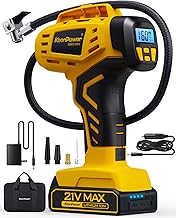
21V Dual Power 160 PSI Portable Inflator
The highest pressure rating in the group, which matters for road bike tires and motorcycle rears where 100 PSI-plus is routine. Treat it as a versatile all-rounder rather than a truck-tire tool, and respect the cool-down intervals.
Frequently Asked Questions
Can a battery inflator fill a completely flat tire?
Yes, but budget five to eight minutes per passenger tire and expect the pump housing to get hot. Higher-capacity units like the OlarHike handle a full fill more comfortably than compact models.
Will one of these run air tools?
Only the tank models. Handheld inflators produce pressure in short bursts with no reservoir, so even a brad nailer will outrun them. The 0.26-gallon DeWalt-compatible unit is the entry point for actual tool work.
How accurate are the digital gauges?
Generally within 1 to 2 PSI, which is fine for tires. Verify against a separate stick gauge once when the unit is new so you know its offset, then trust it.
Should I store the battery in the car?
Avoid it in freezing or high-heat conditions, since both shorten lithium cell life. Keep the pack indoors and rely on the 12V cord for roadside emergencies.
Final Thoughts
For most makers already invested in a battery platform, the DEWALT DCC020IB is the easiest recommendation, while the 0.26-gallon DeWalt-compatible tank compressor is the one that genuinely expands what you can build without a cord. If you want a single grab-and-go unit for a truck or RV, the OlarHike 12000mAh has the capacity to finish the job.