Key takeaways
- Cylinder stroke, not just max height: A class-4 cylinder with 5 inches of travel gets you to roughly 21-22 inches at full extension. Measure from your heel to the crease behind your knee in shoes, and make sure the top of the range clears it with room to spare.
- Seat depth adjustment: Longer femurs need 19-21 inches of pan. A sliding seat is the single feature that separates a chair that fits from a chair you tolerate, because it lets you keep two fingers of clearance behind your knees.
- Backrest height above the seat: Look for at least 24 inches of back from pan to headrest base. If the headrest lands on your neck instead of your skull, it becomes a fulcrum that pushes your head forward all day.
- Weight rating as a proxy for build: A 400 or 500 lb rating usually means thicker gauge steel in the frame, a wider spider base, and better bearings in the casters. Even at 200 lbs, a taller body puts more leverage on those joints.
- Armrest travel in all three axes: Fixed arms sit too low for long torsos. 3D or 4D arms let you raise them until your shoulders relax, and flip-up designs let you tuck the chair under a standing desk frame.
What's inside
I build furniture for a living and tear apart the stuff I don’t build, so I’ve had more office chairs in pieces on my shop floor than I’d like to admit. What I keep finding is that most of them are engineered around a 5’8″ body. The seat pan is 18 inches deep, the backrest tops out somewhere around your shoulder blades, and the gas cylinder runs out of travel two inches before your thighs are level. If you’re 6’2″ or taller, you’re not sitting badly because of poor posture. You’re sitting badly because the geometry was never yours to begin with.
This guide is built from measurements rather than marketing copy. I’ve pulled tape on seat heights, checked cylinder stroke, poked at frame welds, and paid close attention to which chairs use bolt-through steel bases versus glued-in plastic. Below are the big-and-tall ergonomic chairs worth your money in 2026, plus the specs I’d check before clicking buy on anything not on this list.
As an Amazon Associate we earn from qualifying purchases.



🛒 Best Price Today on Amazon
Prime members get fast, free shipping on everything above, plus member-only deals. New members get a 30-day free trial — cancel anytime.
How to Choose an Ergonomic Office Chair For Tall People (2026)
- Cylinder stroke, not just max height: A class-4 cylinder with 5 inches of travel gets you to roughly 21-22 inches at full extension. Measure from your heel to the crease behind your knee in shoes, and make sure the top of the range clears it with room to spare.
- Seat depth adjustment: Longer femurs need 19-21 inches of pan. A sliding seat is the single feature that separates a chair that fits from a chair you tolerate, because it lets you keep two fingers of clearance behind your knees.
- Backrest height above the seat: Look for at least 24 inches of back from pan to headrest base. If the headrest lands on your neck instead of your skull, it becomes a fulcrum that pushes your head forward all day.
- Weight rating as a proxy for build: A 400 or 500 lb rating usually means thicker gauge steel in the frame, a wider spider base, and better bearings in the casters. Even at 200 lbs, a taller body puts more leverage on those joints.
- Armrest travel in all three axes: Fixed arms sit too low for long torsos. 3D or 4D arms let you raise them until your shoulders relax, and flip-up designs let you tuck the chair under a standing desk frame.
The Best Ergonomic Office Chair For Tall People (2026)s Reviewed
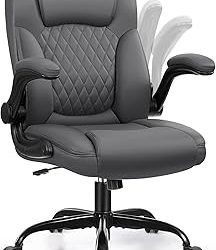
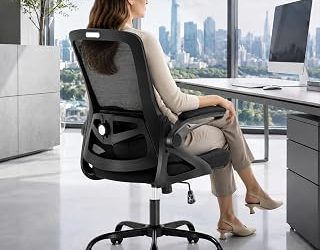
High Back Mesh Task Chair with Flip-Up Arms
The 90-120° tilt lock is the standout here, giving you four usable recline positions instead of the usual upright-or-flopped-back choice. The wide cushion and generous backrest height suit broad, long-torso frames, and the flip-up arms make it genuinely easy to roll under a sit-stand desk.
X100 Ergonomic Mesh Chair with Footrest
Five-way armrests and a 3D lumbar pad that moves up, down, and forward mean you can dial this one in rather than adapt to it. The retractable footrest is more useful than it sounds for tall users, since it supports your calves during recline when your legs extend well past the seat edge.
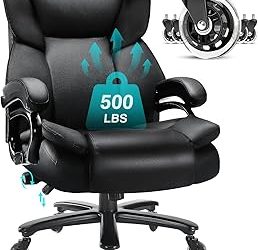
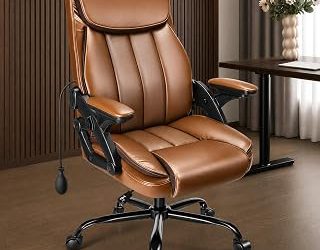
500lb Big and Tall Executive Chair
This is the tank of the group: heavy-duty base, upgraded casters, and thick armrest padding that holds up to real elbow weight. If you’ve cracked a plastic base before or you want the widest seat here, this is where I’d put my money.
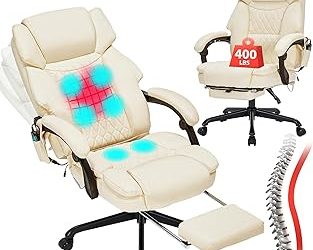
Big and Tall Mesh Chair with Footrest and Seat Depth
Adjustable seat depth plus 3D armrests and independent lumbar makes this the most tunable option for anyone with a long inseam. The breathable mesh back keeps things cool through a full workday, and the high back handles torsos other chairs abandon at shoulder level.
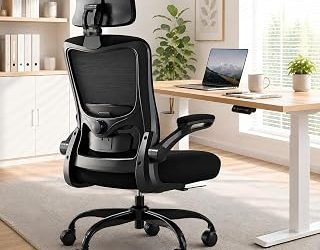
400lb Mesh Chair with 4D Flip-Up Arms
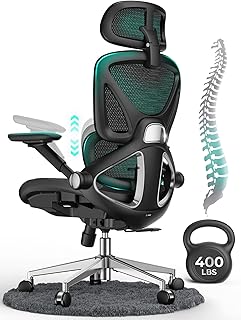
A 3D headrest that pivots and slides is a real advantage if you sit tall, letting you support your skull rather than your neck. Combined with 4D flip-up arms, three-stage tilt, and quiet PU casters, it’s the best balance of adjustability and price in this lineup.
Frequently Asked Questions
What seat height do I actually need if I’m 6’4″?
Roughly 20-22 inches, depending on your inseam. Sit on a stack of books until your thighs are level and your feet are flat, then measure from floor to the underside of your thigh. That number is your target.
Is mesh or foam better for long sessions?
Mesh wins for airflow and even pressure distribution over a wide pan. Foam feels plusher on day one but compresses under sustained load, and taller users generally put more weight through a smaller contact area.
Can I swap in a taller gas cylinder?
Often yes. Most chairs use a standard 50mm taper, so an extended-stroke replacement is a 15-minute job with a pipe wrench and a rubber mallet. Check the taper spec first and verify the mechanism still clears the base at full drop.
Are lighter-duty chairs like the Marsail a bad idea for tall users?
Not at all, if your build is lean. The Marsail’s high mesh back, adjustable lumbar, and 3D armrests cover the ergonomic fundamentals well; it just doesn’t have the frame mass of the 400 and 500 lb models.
Final Thoughts
If you want the most adjustment per dollar, the 400lb mesh chair with 4D flip-up arms and a pivoting 3D headrest is the one I’d order first. Choose the Big and Tall Mesh Chair with Footrest and Seat Depth if your inseam is the limiting factor, and step up to the 500lb Big and Tall Executive Chair if you’ve ever broken a base and want hardware that won’t flinch.