Key takeaways
- Shaped lumbar support: Run your hand down the backrest before you buy — you want a genuine convex bump in the lower third, not a flat panel with a “lumbar” label. If the chair can’t fill the hollow of your lower back, your spine will flatten under load no matter how soft the padding is.
- Seat depth and height: Aim for roughly two fingers of clearance behind your knees and feet flat on the floor. Too deep and you’ll slide forward into a slouch; too low and standing up loads your lumbar discs hard every single time.
- Recline geometry: A lay-flat or near-flat position takes real pressure off the spine, but only if the seat pan tilts with the back. Push-back models that pivot only at the backrest tend to open a gap right where you need contact.
- Frame and mechanism quality: Look for a hardwood or steel-reinforced frame and metal recline hardware rather than plastic linkages. A wobbly chair forces your core to stabilize constantly, which is the opposite of rest.
- Heat and massage placement: Vibration nodes are genuinely useful when they sit at the lumbar band, and gentle heat helps loosen tight erectors. Treat these as bonuses, not substitutes for correct support geometry.
What's inside
Sitting down shouldn’t be the hardest part of your day, but for anyone with a cranky lower back, the wrong chair turns an evening on the couch into a negotiation. Most seating fails in the same predictable way: the lumbar curve gets no support, the seat pan is too deep, and the recline mechanism dumps your pelvis backward into a slouch that flattens your spine. If you’ve ever pulled a chair apart to see what’s underneath, you already know why — thin foam over a flat plywood deck, a fixed backrest angle, and zero adjustability where it counts.
This guide takes a builder’s view of recliners: what the frame is made of, whether the lumbar support is actually shaped or just marketing, how the footrest and backrest move relative to each other, and whether the assembly holds up after a year of daily use. Below are six recliners worth considering in 2026, each judged on back-pain relief first and comfort features second — plus a short buying checklist and answers to the questions people ask right before they commit.
As an Amazon Associate we earn from qualifying purchases.


🛒 Best Price Today on Amazon
Prime members get fast, free shipping on everything above, plus member-only deals. New members get a 30-day free trial — cancel anytime.
How to Choose a/an Recliner Chairs For Back Pain (2026)
- Shaped lumbar support: Run your hand down the backrest before you buy — you want a genuine convex bump in the lower third, not a flat panel with a “lumbar” label. If the chair can’t fill the hollow of your lower back, your spine will flatten under load no matter how soft the padding is.
- Seat depth and height: Aim for roughly two fingers of clearance behind your knees and feet flat on the floor. Too deep and you’ll slide forward into a slouch; too low and standing up loads your lumbar discs hard every single time.
- Recline geometry: A lay-flat or near-flat position takes real pressure off the spine, but only if the seat pan tilts with the back. Push-back models that pivot only at the backrest tend to open a gap right where you need contact.
- Frame and mechanism quality: Look for a hardwood or steel-reinforced frame and metal recline hardware rather than plastic linkages. A wobbly chair forces your core to stabilize constantly, which is the opposite of rest.
- Heat and massage placement: Vibration nodes are genuinely useful when they sit at the lumbar band, and gentle heat helps loosen tight erectors. Treat these as bonuses, not substitutes for correct support geometry.
The Best Recliner Chairs For Back Pain (2026)s Reviewed
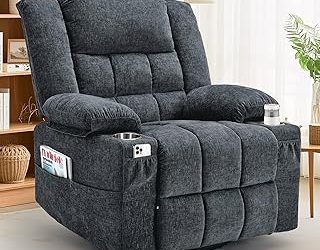
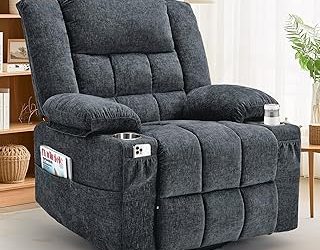
Massage Recliner Chair with Lumbar Support (Ink)
This one gets the fundamentals right: a defined lumbar bolster paired with a padded fabric back that keeps contact through the full recline arc, so your spine doesn’t lose support halfway down. The upholstery breathes better than leatherette, which matters if you sit for long stretches.
MCombo Power Lift Recliner 7040
The power lift is the standout feature here — it raises you toward standing without the forward lurch that aggravates a bad back, making it the pick for anyone with limited mobility or post-surgery restrictions. FSC-certified framing, heat, massage, and USB-C charging round out a well-considered package.
Sweetcrispy Massage Recliner for Small Spaces
A tidy footprint with a surprisingly supportive lumbar section, this is the one to specify when the room is tight but you still need proper spinal contact. The reclining action is smooth and the beige fabric hides less-than-perfect wall clearance nicely.
GarveeHome Power Recliner with Heat and Massage
The tall back is the reason to look here — it supports the thoracic spine and neck rather than stopping at the shoulder blades, which helps anyone whose back pain radiates upward. Powered recline means you can fine-tune the angle in small increments instead of committing to fixed stops.
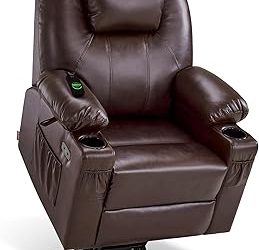
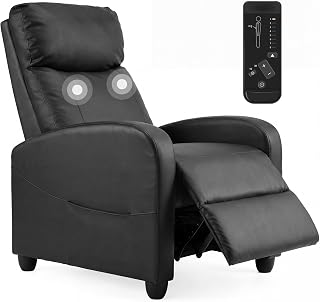
BestMassage 2-Point Massage Recliner (PU Brown)
A straightforward, honest chair: solid lumbar padding, a wide seat and footrest, and a manual push-back that avoids motor failure points entirely. Assembly is genuinely simple, which is refreshing if you’ve wrestled with hidden brackets before.
Frequently Asked Questions
Can a recliner actually reduce back pain?
It can, mainly by reducing compressive load on the lumbar discs when you recline past roughly 120 degrees. The benefit only holds if the chair supports your lumbar curve in that position rather than letting your pelvis roll back.
Is a power recliner worth the extra cost?
For back pain, usually yes. Powered adjustment lets you stop at the exact angle that feels right and avoids the sharp core engagement needed to yank a manual footrest into place.
Does the massage function do anything real?
Vibration massage increases local blood flow and can help tight muscles relax, and paired heat makes that more effective. It’s symptomatic relief, not a fix for underlying posture or disc issues.
How can I improve a recliner I already own?
Add a firm lumbar roll or a rolled towel at belt height and check that your feet reach the floor comfortably. Those two adjustments solve more complaints than replacing the chair does.
Final Thoughts
If mobility is your main concern, the MCombo Power Lift 7040 is the most practical choice thanks to its assisted stand and thoughtful build. For everyday lumbar support in a normal living room, the Massage Recliner Chair in Ink delivers the best combination of shaped support and breathable upholstery, while the GarveeHome Power Recliner is the one to pick if you need full-height back and neck coverage.