Key takeaways
- Single vs. dual motor: A single motor moves the backrest and footrest together on one fixed arc. Dual motor units drive them independently, so you can drop the back without launching your feet skyward. If you need a true zero-gravity or lay-flat position to unload the lumbar discs, dual motor is not a luxury, it’s the whole point.
- Frame and joinery: Look for kiln-dried hardwood or a steel-reinforced frame with bolted rather than purely stapled joints. Grab the arm and give it a firm twist during setup: any creak or flex at that stage tells you exactly where it’ll fail later.
- Actual lumbar geometry: Heat coils feel great, but they don’t hold your spine up. Check whether the backrest has a shaped lumbar curve built into the cushion or just a loose pillow. A removable lumbar pillow is a bonus because you can swap in your own wedge if the factory one doesn’t match your curve.
- Seat depth and dimension match: Measure from the back of your knee to your tailbone and compare it to the listed seat depth. Too deep and the front edge cuts circulation; too shallow and you lose thigh support. Brands offering small, medium, and large versions of the same chair are worth the extra sizing homework.
- Serviceability: Ask where the hand control plugs in, whether the battery backup is a standard 9V, and if the motor is a common linear actuator. Chairs built with accessible connectors and standard hardware can be fixed with a screwdriver instead of a warranty claim.
What's inside
If you’ve ever spent a weekend flat on the garage floor after wrestling a sheet of plywood, you already know the cruel joke of back pain: the chair you sink into for relief is often the thing making it worse. Most living room recliners are built around a soft, scooped seat that lets the pelvis roll backward and drags the lumbar spine into a slouch. Add a headrest angle that shoves your neck forward and you’ve got a piece of furniture actively working against your spine. Shoppers researching this category usually run into the same wall: glossy marketing copy about “cloud-soft cushions” with almost nothing about frame construction, motor behavior, or whether the lumbar support is real structure or a decorative pillow stapled to a backrest.
This guide takes a builder’s approach. I look at these chairs the way I’d look at any assembly coming off a bench: what’s the frame made of, how do the linkage points move, how many motors are driving the geometry, and what can you actually service yourself when a bolt loosens two years in. Below you’ll find the current standouts in power lift recliners with heat and massage, followed by a buying checklist, honest reviews of the top five, and answers to the questions that come up most often once the box hits your driveway.
As an Amazon Associate we earn from qualifying purchases.


🛒 Best Price Today on Amazon
Prime members get fast, free shipping on everything above, plus member-only deals. New members get a 30-day free trial — cancel anytime.
How to Choose a Recliner For Back Pain Consumer Reports (2026)
- Single vs. dual motor: A single motor moves the backrest and footrest together on one fixed arc. Dual motor units drive them independently, so you can drop the back without launching your feet skyward. If you need a true zero-gravity or lay-flat position to unload the lumbar discs, dual motor is not a luxury, it’s the whole point.
- Frame and joinery: Look for kiln-dried hardwood or a steel-reinforced frame with bolted rather than purely stapled joints. Grab the arm and give it a firm twist during setup: any creak or flex at that stage tells you exactly where it’ll fail later.
- Actual lumbar geometry: Heat coils feel great, but they don’t hold your spine up. Check whether the backrest has a shaped lumbar curve built into the cushion or just a loose pillow. A removable lumbar pillow is a bonus because you can swap in your own wedge if the factory one doesn’t match your curve.
- Seat depth and dimension match: Measure from the back of your knee to your tailbone and compare it to the listed seat depth. Too deep and the front edge cuts circulation; too shallow and you lose thigh support. Brands offering small, medium, and large versions of the same chair are worth the extra sizing homework.
- Serviceability: Ask where the hand control plugs in, whether the battery backup is a standard 9V, and if the motor is a common linear actuator. Chairs built with accessible connectors and standard hardware can be fixed with a screwdriver instead of a warranty claim.
The Best Recliner For Back Pain Consumer Reports (2026)s Reviewed
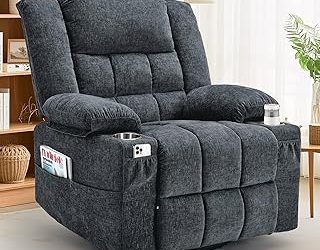
Power Lift Recliner with Vibration Massage and Lumbar Heating
A well-balanced oversized single-seat option that puts lumbar heating exactly where most people need it rather than spreading warmth across the whole backrest. The cup holder and USB port keep you from twisting sideways to reach a side table, which sounds trivial until you’ve tweaked your back doing it.
MCombo Power Lift Recliner 7040 (Medium)
MCombo’s multiple-size approach is the smartest thing in this roundup, because a recliner that fits your torso length does more for back pain than any massage motor. Build quality on the 7040 is solid, with FSC certified wood framing and faux leather that wipes clean after a dusty shop day.
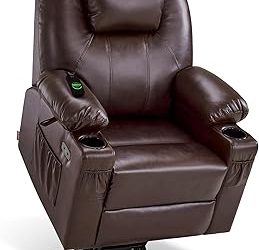
Dual Motor Power Lift Recliner, Brown Leather
The infinite-position dual motor setup lets you find a true lay-flat or slight zero-gravity angle, which is the position most physical therapists point to for decompressing the lower back. Wireless charging and dual USB ports mean fewer cords snaking under the footrest linkage.
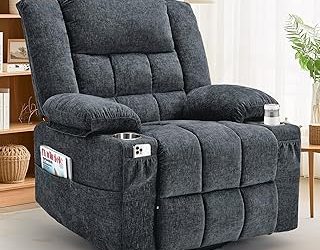
Tami Tami Dual Motor Lift Chair (T6015)
The adjustable headrest is the standout here, letting you dial out the forward neck push that turns a comfortable recliner into a tension headache after an hour. Plush fabric breathes better than leather in warm rooms, and the medium size suits average-height users well.
MAHOMICO Power Lift Recliner with Lumbar Heating
A straightforward, value-focused pick that handles the fundamentals: smooth lift assist, targeted lumbar warmth, and enough side storage to keep the remote and a heat pack within arm’s reach. Assembly is genuinely a two-piece backrest slide-on job, doable solo in about fifteen minutes.
Frequently Asked Questions
Is a lift recliner better for back pain than a standard one?
Usually yes, because the lift mechanism raises you to near-standing without requiring you to hinge forward at the waist. That single motion is where a lot of flare-ups happen.
Do heat and massage actually help?
Heat helps by increasing blood flow to tight paraspinal muscles, and vibration massage can reduce perceived stiffness. Neither corrects posture, so treat them as comfort features layered on top of good geometry.
How much clearance do I need behind the chair?
Most lay-flat dual motor models want 12 to 20 inches from the wall at full recline. Measure before you commit, and check the manual for a wall-hugger rating.
Can I assemble one of these myself?
Almost always. The base ships assembled and the backrest slides onto steel brackets with locking levers. The heavy part is moving the box, so plan for a second set of hands or a furniture dolly.
Final Thoughts
If you want the most spine-friendly setup available, the Dual Motor Power Lift Recliner in brown leather earns the top spot for its infinite-position range and true lay-flat capability. The MCombo 7040 is the smarter buy for anyone whose proportions fall outside “average,” thanks to genuine size options and a well-built FSC certified frame, while the Tami Tami T6015 wins on neck comfort with its adjustable headrest. Match the seat depth to your body first, then let the heat and massage features be the bonus they were always meant to be.