Standing at the base of a 9/12 pitch with a bundle of shingles on your shoulder is where most weekend projects quietly turn into professional invoices. The problem isn’t nerve — it’s that a standard extension ladder stops being useful the second you clear the eave. Above that line you need something that grips the slope, spreads your weight, and doesn’t shift when you turn to reach for a nail gun. Buyers routinely discover this the hard way, halfway up, with no good way back down.
This guide covers the gear that actually solves that gap: steep-assist roof ladders that hook the ridge and lie flat against the pitch, adjustable multi-position ladders for reaching a second-story eave from uneven ground, chicken ladder sets for working long runs of steep roof, and the stabilizers that keep your base ladder honest. Everything below is judged on published load rating, listed weight and setup requirements, and whether one person can realistically handle it alone.
Our top picks


As an Amazon Associate we earn from qualifying purchases at no extra cost to you.
Updated October 2026 — Quick answer: The best roofing ladder depends on the job: for pitches of 7/12 and steeper, a steep-assist ladder such as The Goat Steep Assist Roof Ladder (Compact) gives you level footing; for reaching the eave, the Louisville 24 ft Fiberglass Extension Ladder (FE3224) covers most two-story homes with a Type IA 300 lb rating; and for occasional roof work on a budget, a pair of wheeled roof hooks on a sound extension ladder is the cheapest safe setup. Add a standoff stabilizer such as the Ladder-Max Original and a fall-arrest kit on any steep or high roof.
🛒 Best Price Today on Amazon
Prime members get fast, free shipping on everything above, plus member-only deals. New members get a 30-day free trial — cancel anytime.
How to Choose a Roofing Ladder (2026)
- Match the tool to the pitch: Under 6/12 you can often work with a good stabilizer and roof boots. At 7/12 and steeper, a steep-assist wedge or a hooked chicken ladder stops being optional — friction alone won’t hold you.
- Read the duty rating, not the length: Type IAA (375 lb) gives you real headroom once you add a tool belt, a compressor hose, and a bundle of shingles. Type I ratings get eaten fast by working loads.
- Check how it anchors: Ridge hooks, gutter clips, and rope tie-offs each fail differently. A wheeled roof hook lets you roll the ladder up the slope solo; a rope-and-wedge system depends on a solid anchor point you must verify first.
- Weigh it before you buy it: A ladder you can’t carry up a driveway alone is a ladder you’ll set up badly. Aluminum saves your back; steel earns its weight on repeat commercial jobs.
- Plan for storage: Folding sections, nesting rungs, and a carry bag decide whether this lives in your garage or gets sold in two years. Measure your storage wall before your roof.
Roof Ladder Types: Which One Actually Solves Your Problem?
“Roofing ladder” covers several very different tools, and most buying mistakes come from picking the wrong category rather than the wrong brand. Before comparing models, decide which part of the job you need help with: getting up to the eave, moving safely across the slope, or protecting yourself if something goes wrong. Many roofs need gear from two or even three of the groups below.
Steep-Assist Wedge Ladders
Steep-assist ladders are folding, angled frames that hook over the ridge and give you a level platform or a set of flat steps on a pitched surface. Instead of balancing on the slope, you stand on rungs that are closer to horizontal. They shine on pitches from roughly 7/12 upward, where boots and friction stop being reliable. The trade-offs are weight, bulk, and price: they are some of the most expensive pieces of roof gear a homeowner can buy, and the longer units are awkward to carry up an extension ladder alone.
Hook Ladders, Chicken Ladders, and Roof Hooks
A hook ladder is a straight ladder with a ridge hook at the top, often with a wheel so you can roll it up the slope before flipping it over to bite the far side of the ridge. Chicken ladders are the older, modular version of the same idea, built from short sections joined end to end. Bolt-on roof hooks with wheels turn the fly section of an ordinary extension ladder into a hook ladder, which is the most affordable route for an occasional job. All of these lie flat on the roof, so they suit long runs, tear-offs, and chimney or vent work near the ridge.
Extension Ladders
Every roof job starts with getting onto the roof, and that is still the extension ladder’s job. Length matters more than most buyers expect: the rails should extend at least 3 feet above the eave so you have something to hold while stepping on and off. As a rough guide, a single-story home with a typical eave usually calls for a 16- to 20-foot ladder, while a two-story eave often needs 24 to 28 feet once you account for the setup angle.
Multi-Position and Telescoping Ladders
Articulating ladders such as the Little Giant family can switch between A-frame, extension, and stairway modes, which makes them useful on uneven ground and inside the house long after the roof is finished. Telescoping ladders collapse to a few feet for storage and are popular for RV roofs and single-story access. They are convenient, but check that the locking mechanism is fully engaged at every section before climbing, and treat the rated load as a hard ceiling.
Stabilizers and Standoffs
A stabilizer bolts across the top of an extension ladder, widening its footprint and holding the rails off fragile gutters. The transition from ladder to roof is where many falls start, so a standoff that keeps the ladder from sliding sideways is one of the cheapest safety upgrades available. Some roofing-specific standoffs sit on the roof surface itself and include padding to protect shingles.
Roof Anchors and Fall-Arrest Kits
None of the ladders above will stop a fall. A roof anchor screwed into the framing, paired with a full-body harness, rope grab, and vertical lifeline, is the gear that does. Professional roofers in the United States are required to use fall protection, and homeowners on steep or high roofs benefit from the same habit.
Ladder Duty Ratings Explained
The duty rating printed on a ladder’s label tells you the maximum combined load it is designed to carry: your body weight plus clothing, boots, tool belt, and whatever you are hauling up. Roofers routinely blow past their body weight once a bundle of shingles is on the shoulder, which is why a rating that looks generous on paper can be tight in practice. The standard U.S. ladder classes are:
| Duty Rating | Maximum Load | Typical Use |
|---|---|---|
| Type IAA (Special Duty) | 375 lb | Professional and heavy-load work, roofing with materials |
| Type IA (Extra Heavy Duty) | 300 lb | Contractors and serious DIY roof work |
| Type I (Heavy Duty) | 250 lb | General construction and lighter roof tasks |
| Type II (Medium Duty) | 225 lb | Painting, light maintenance |
| Type III (Light Duty) | 200 lb | Household chores only, not recommended for roofing |
Ladders built to the European EN131 standard, such as many telescoping models, are generally rated at 150 kg, or roughly 330 lb. Steep-assist frames and roof hooks often publish their own load figures rather than an ANSI type, so read the listing carefully and use the lowest-rated component in your setup as your real limit. For roofing, Type IA is a sensible floor and Type IAA is worth the extra weight if you carry materials or weigh more than average.
Aluminum vs. Fiberglass vs. Steel
Material affects weight, durability, and one safety factor many homeowners overlook: electrical conductivity.
- Aluminum is the lightest option and resists corrosion, which makes it the easiest material to carry and position alone. It conducts electricity, so it should never be used anywhere near overhead service drops or power lines. A common rule of thumb is to keep the ladder and yourself at least 10 feet away from any line.
- Fiberglass is non-conductive when clean and dry, which is why electricians and many roofers prefer it for base ladders. It is noticeably heavier than aluminum and can be damaged by long-term UV exposure, so store it out of direct sun.
- Steel shows up mostly in chicken ladder sets and roof hooks. It shrugs off abrasion from shingles, tools, and equipment dragged across the rungs, but it is heavy and conductive. It makes the most sense for crews and repeat jobs.
A practical combination for many homes is a fiberglass extension ladder to reach the eave, paired with an aluminum steep-assist or hook ladder on the roof itself, where weight matters most.
Best Roofing Ladders (2026) Reviewed
VELCKING 18 Foot 500LB All-Metal Steep Assist Roof Ladder
The listing states a 500 lb rating, an all-metal build and a 10-meter safety rope, which makes this the longest budget steep-assist frame here, and the extra length means fewer repositioning stops on a big pitch. It is heavier than the compact wedges, so plan on staging it before you start hauling material, and because the brand has a short track record, inspect the welds and ridge hook as soon as it arrives.
The Goat Steep Assist Roof Ladder (Compact)
The Goat has earned its reputation among roofers for a reason: the wedge geometry puts you in a stable, upright working stance instead of clinging to the slope. The compact version is the one to get if you’re loading it into a pickup bed or a hatchback regularly.
Werner D7124-2LV 24 ft Fiberglass Extension Ladder
This is the heavy-duty base ladder for the trip from the ground to the eave. The Werner D7124-2 series is a 24-foot fiberglass D-rung extension ladder with a Type IAA duty rating of 375 lb, which leaves real headroom for a tool belt and a bundle of shingles, and the LV version adds built-in leveling on the legs for sloped yards. Werner lists about 21 feet of extended length, enough for many two-story eaves with the 3-foot step-off, but expect roughly 60 to 70 pounds, so plan on a second person to raise it.
ACRO 11610/11601 Steel Chicken/Roof Ladder Set
Four 6-foot steel sections plus a wheeled roof hook gives you 24 feet of modular walkway, which is the right answer for long steep runs and full tear-offs. It’s the heaviest option here and clearly built for crews, but nothing else on this list handles sustained roof work as comfortably.
Echo Ridge 18 Foot Steep Assist Roof Ladder
Echo Ridge undercuts the premium wedges while still including the 10-meter rope and a storage bag, making it a sensible entry point for a one-off re-roof or a chimney repair. Seat the ridge contact properly before committing weight, and because it is a newer listing with limited independent history, inspect the welds and pins on arrival.
Bighorn Ladder Stabilizer for Roof Safety
The Bighorn is an accessory, not a roof ladder. It slides onto the top of a base extension ladder and widens your contact point at the eave. Its listing highlights a lightweight aluminum frame, adjustable fit, gutter clips or hooks, handle supports for stepping onto the roof, and a fold-down design for storage. Seller pages generally describe it as about 16 pounds and 24 inches wide, but they disagree on the load rating, so confirm that figure with the maker before relying on it. Use it with a sound base ladder, a roof ladder or hooks, and a harness and anchor rather than in place of them.
More Roofing Ladders and Roof Access Gear Worth Considering
The ladders above handle the slope itself. A complete roof setup also needs a reliable way up to the eave, something to keep the base ladder steady, and a way to stop a fall if your footing goes. These five picks fill those gaps across a wide range of budgets, from inexpensive hook kits to full-size fiberglass extension ladders.
Louisville 24 ft Fiberglass Extension Ladder (FE3224) — Best for Reaching a Two-Story Eave
As an Amazon Associate we earn from qualifying purchases at no extra cost to you.

Most steep-roof gear assumes you are already standing at the eave, and on a two-story house that means a long extension ladder. The Louisville FE3224 is a 24-foot fiberglass extension ladder with a Type IA rating of 300 lb, which gives a working roofer room for a tool belt and a reasonable load of materials. At 24 feet it can reach many two-story eaves while still leaving enough length to extend past the roof edge for a safe step-off, though very tall gables may call for a 28-foot model.
Fiberglass rails are the main reason to choose it over a lighter aluminum ladder. They are non-conductive when clean and dry, an important margin around service drops. The cost of that protection is weight, so plan on two people for raising and lowering it if you are not used to handling long ladders. It usually sells for around $320 to $360, a reasonable price for a ladder that will outlast several roofs.
Pros
- Type IA 300 lb rating suits roofing loads
- Non-conductive fiberglass rails for work near electrical lines
- Enough reach for many two-story homes
Cons
- Heavy and awkward for one person to raise
- Needs covered storage to protect the fiberglass from UV damage
DeWalt 16 ft Fiberglass Extension Ladder (DXL3020-16PT) — Best for Single-Story Homes

If your eave sits around 9 to 12 feet off the ground, a 24-foot ladder is more weight than you need. The DeWalt DXL3020-16PT is a 16-foot fiberglass extension ladder with a 300 lb load capacity and a Type IA rating, the same duty class as the Louisville above in a far more manageable package. It is the natural partner for a steep-assist or hook ladder on a ranch, a garage, or a single-story addition.
The shorter length makes it easier to carry around the house, set at the correct angle, and store on a garage wall. Keep in mind that the usable height of any extension ladder is less than its nominal length once you account for section overlap and the setup angle, so measure your eave height before ordering. It typically sells for around $280 to $320.
Pros
- Type IA 300 lb rating in a compact 16 ft size
- Fiberglass construction for safer work near wiring
- Easy to carry and store compared with longer ladders
Cons
- Too short for most two-story eaves
- Heavier than an aluminum ladder of the same length
Foozet Roof Ladder Hook 2-Pack with Wheel — Best Budget Hook Conversion

A pair of bolt-on roof hooks is the least expensive way to get a proper hook ladder. The Foozet kit attaches to the top of a straight ladder or the fly section of an extension ladder; you roll it up the slope on the wheel, then flip it so the hook bites over the ridge. The listing describes heavy-duty steel construction with a 500 lb weight rating, and a two-pack lets you secure both rails.
This is a smart buy for a homeowner who already owns a sound extension ladder and needs roof access for a gutter, vent, or chimney job rather than a full re-roof. The ladder you attach the hooks to still determines your real load limit, so pair it with at least a Type IA ladder and check every bolt before each use. Expect to pay roughly $40 to $60.
Pros
- Very low cost compared with dedicated roof ladders
- Wheel makes it easy to roll the ladder up the slope
- Steel hooks with a listed 500 lb rating
Cons
- Only as strong and as stable as the ladder you mount it to
- Bare hooks can scuff ridge caps unless padded
Tie Down Roof Zone Adjustable Roofing Standoff — Best Roofing-Specific Stabilizer

Standard ladder stabilizers rest against a wall or gutter. The Tie Down Roof Zone is designed specifically for roofing: it is a height-adjustable standoff that rests on the roof surface and includes surface protection so the contact points do not chew up shingles. The quick-connect assembly is meant to go on and come off the ladder without a toolbox, which matters on jobs where you move the ladder several times a day.
It is a good complement to the Bighorn stabilizer covered above if your eave is crowded with gutter guards or fragile gutters, and it is far cheaper than most roof ladders, usually around $80 to $100. Like any standoff, it changes where the ladder contacts the house, so recheck your setup angle after installing it.
Pros
- Built for roofing rather than general wall work
- Adjustable height and surface protection for shingles
- Quick-connect design for frequent repositioning
Cons
- Does not replace a roof ladder on steep pitches
- Fit varies by ladder rail design, so confirm compatibility
Guardian 00815 Rooftop Safety Kit — Best Fall Protection Add-On

A roof ladder keeps you from sliding; a fall-arrest kit catches you if you do. The Guardian 00815 bundles the core pieces into one storage bucket: a 50 ft vertical lifeline assembly, a reusable roof anchor, and a full-body harness. For a homeowner who has never bought fall protection, a complete kit removes the guesswork of matching connectors and rope sizes.
The anchor must be fastened into solid framing following the manufacturer’s instructions, not just into roof sheathing, and the lifeline length should be planned so you cannot reach the ground before the system arrests a fall. Read the included instructions fully before the first use and inspect the harness and rope every time. It usually costs around $90 to $110, which is modest next to the cost of the ladders it protects you on.
Pros
- Complete starter kit with harness, anchor, and lifeline
- Reusable anchor for repeat projects
- Storage bucket keeps everything together and dry
Cons
- Anchor installation takes time and must hit framing
- Harness fit varies by body size, so adjust carefully
Also Consider: Four More Roofing Ladders and Accessories Roofers Recommend
Other 2026 roofing-ladder guides lean heavily on a few names we had not covered: an articulating ladder that doubles as scaffolding, a contractor-grade telescoping ladder, the standoff stabilizer most often recommended for direct roof placement, and the classic steel ladder hook. Each fills a specific gap in a roof setup.
Little Giant Velocity Model 17 (15417-001) — Best multi-position ladder for uneven ground
Unlike a self-supporting stepladder, the Little Giant Velocity Model 17 is a true articulating ladder that also works as an extension ladder, which is the mode you need to lean against an eave. It is a sensible base ladder for single-story roofs, sloped yards and stairwells.
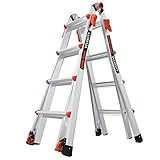
- Rating: ANSI Type IA, 300 lb in all configurations
- Weight: 30.5 lb, aluminum
- Reach: up to about 18 ft (listing); A-frame size 4 ft 6 in to 7 ft 6 in
- Modes: A-frame, extension, staircase, 90-degree and trestle-plank scaffold
- Storage height: 4 ft 7 in; Tip-N-Glide wheels; limited lifetime warranty
Pros: one ladder for roof access and indoor work; Type IA rating; wheels make it easy to move around the house.
Cons: too short for most two-story eaves once you add the 3-foot extension above the roof edge; heavier than a basic aluminum extension of similar length.
Skip it if… your eave is higher than about 13 feet; buy a 20–24 ft extension ladder instead.
Xtend & Climb 785P+ — Best telescoping ladder for single-story and RV roofs
Telescoping ladders get a bad name from cheap imports, but the Xtend & Climb Pro Series 785P+ is built to the U.S. ANSI A14.2 standard rather than only EN131. Each rung locks individually with a visible indicator, which addresses the main risk with telescoping designs.

- Rating: ANSI Type I, 250 lb
- Extended length: about 15.5 ft; collapses to about 36 in
- Weight: about 35–38 lb depending on the listing
- Locks: individual rung locks with lock/release indicators
- Material: aircraft-grade aluminum alloy, carry handle and closure strap
Pros: fits in a car trunk or closet; ANSI-tested rather than only EN131-rated; soft-close rungs reduce pinched fingers.
Cons: 250 lb rating leaves little room for a heavy roofer plus a shingle bundle; too short for two-story homes.
Skip it if… you carry materials up regularly; a Type IA fiberglass extension ladder has more headroom.
Ladder-Max Original Standoff Stabilizer — Best stabilizer for direct roof placement
The Ladder-Max Original is the stabilizer roofing guides mention most. Its long arms rest on the roof or wall instead of the gutter and hold the ladder top about 19 inches out, which also gives you a more natural stance when stepping on and off.

- Standoff: 19 in from gutter, roof or wall; 36 in tip to tip
- Rating: Type IAA, 375 lb (maker states ANSI A14 testing)
- Weight: about 7.7 lb; 16-gauge galvanized steel
- Fit: ladder rails more than 11 3/4 in apart, rungs 12 in on center
- Made in the USA
Pros: keeps all ladder weight off gutters; wide four-point contact resists sideways slip; works with ladder jacks per the maker.
Cons: does not fit every rung profile, so measure rung depth first; bulkier to store than a clip-on stabilizer.
Skip it if… you already own the Bighorn or Tie Down Roof Zone above and your gutters are sound.
Guardian (Qualcraft) 2481 Ladder Hook with Wheel — Best single steel roof hook
The Guardian 2481, sold for years under the Qualcraft name, is the classic powder-coated steel hook that bolts over the top two rungs of a straight or extension ladder. Two hooks per ladder turn it into a hook ladder you roll up the slope and flip over the ridge.
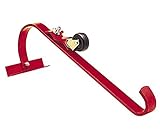
- Material: powder-coated steel
- Size: about 21 1/2 x 13 in; about 4.6–5.3 lb each
- Fit: single or extension ladders in wood, fiberglass or aluminum, round or D rungs
- Wheel: single 360-degree swivel wheel for rolling up the roof
- Sold individually; use two per ladder
Pros: established brand from a fall-protection maker; fits most ladder materials and rung shapes; replacement parts are easy to find.
Cons: some ladders need a new bolt hole if rung spacing does not match; the swivel wheel can drift sideways on the way up.
Skip it if… you want a ready-made two-pack with rubber ridge pads; the Foozet set above costs less for two.
Roofing Ladder Comparison
Use this table to see how every product in this guide fits into a roof setup. Ratings are shown only where the product listing states them; check the current label before buying.
| Product | Category | Length / Reach | Stated Rating | Best For |
|---|---|---|---|---|
| 18 Foot 500LB All-Metal Steep Assist | Steep-assist ladder | 18 ft | 500 lb | Very steep pitches, long runs |
| The Goat Steep Assist (Compact) | Steep-assist ladder | Compact length | See listing | Pickups, frequent transport |
| Echo Ridge 18 Foot Steep Assist | Steep-assist ladder | 18 ft | See listing | One-off re-roofs on a budget |
| ACRO Steel Chicken/Roof Ladder Set | Modular hook ladder | 4 x 6 ft sections | See listing | Crews, full tear-offs |
| Werner D7124-2LV | Fiberglass extension | 24 ft (about 21 ft extended) | Type IAA, 375 lb | Heavy loads, sloped yards |
| Louisville FE3224 | Fiberglass extension | 24 ft | Type IA, 300 lb | Two-story eaves |
| DeWalt DXL3020-16PT | Fiberglass extension | 16 ft | Type IA, 300 lb | Single-story homes |
| Bighorn Ladder Stabilizer | Stabilizer | Fits base ladder | See listing | Protecting gutters, wider stance |
| Tie Down Roof Zone Standoff | Roofing standoff | Height adjustable | See listing | Shingle-safe ladder support |
| Foozet Roof Hook 2-Pack | Hook conversion | Mounts to ladder | 500 lb | Budget hook ladder |
| Guardian 00815 Rooftop Kit | Fall protection | 50 ft lifeline | See listing | Fall arrest on any roof |
| Little Giant Velocity Model 17 | Multi-position ladder | Up to 17 ft; about 18 ft reach | Type IA, 300 lb | Uneven ground, single-story roofs |
| Xtend & Climb 785P+ | Telescoping ladder | 15.5 ft extended, about 36 in collapsed | Type I, 250 lb | Single-story and RV roofs |
| Ladder-Max Original | Standoff stabilizer | 19 in standoff, 36 in wide | Type IAA, 375 lb | Direct roof placement, gutter protection |
| Guardian (Qualcraft) 2481 Ladder Hook | Steel roof hook | About 21 1/2 x 13 in; sold singly | See listing | Single hook; use two per ladder |
Best Roofing Ladder by Budget
Roof access gear spans a huge price range. These tiers use typical October 2026 street prices; each pick gets one spec line: type · length · rating.
Best roofing ladder gear under $150
- Foozet Roof Ladder Hook 2-Pack: hook conversion · mounts to your ladder · 500 lb listed
- Guardian (Qualcraft) 2481 Ladder Hook: steel hook · use two per ladder · fits round or D rungs
- Ladder-Max Original: standoff stabilizer · 19 in standoff · Type IAA 375 lb
- Tie Down Roof Zone Standoff: roofing standoff · height adjustable · shingle protection
- Guardian 00815 Rooftop Safety Kit: fall arrest · 50 ft lifeline · harness and reusable anchor
What to expect at this tier:
- Upgrades to a ladder you already own, not complete ladders.
- Hooks turn an extension ladder’s fly section into a hook ladder for occasional jobs.
- Your real load limit is still the base ladder’s duty rating.
- A complete fall-arrest kit fits in this budget, so there is no reason to skip it on steep roofs.
Best roofing ladders from $150 to $500
- DeWalt DXL3020-16PT: fiberglass extension · 16 ft · Type IA 300 lb
- Louisville FE3224: fiberglass extension · 24 ft · Type IA 300 lb
- Little Giant Velocity Model 17: multi-position · about 18 ft reach · Type IA 300 lb
- Xtend & Climb 785P+: telescoping · about 15.5 ft · Type I 250 lb
- 18 Foot 500LB All-Metal Steep Assist: steep assist · 18 ft · 500 lb listed
- Bighorn Ladder Stabilizer: stabilizer · aluminum · gutter clips included
What to expect at this tier:
- Base ladders that get you to the eave, with Type IA ratings on the name-brand models.
- Fiberglass costs more and weighs more than aluminum but is non-conductive near service drops.
- Budget steep-assist frames from lesser-known brands appear here; check welds and ridge hooks closely.
Best roofing ladders over $500
- The Goat Steep Assist (Compact): steep assist wedge · compact length · roofer favorite
- ACRO 11610/11601 Steel Chicken Ladder Set: modular hook ladder · 4 x 6 ft · steel
- Werner D7124-2LV: fiberglass extension · 24 ft · Type IAA 375 lb
- Echo Ridge 18 Foot Steep Assist: steep assist · 18 ft · 10 m rope and storage bag included
What to expect at this tier:
- Purpose-built steep-roof systems that let you stand upright on 8/12 to 12/12 pitches.
- Steel chicken ladder sets for long runs and full tear-offs, mostly bought by crews.
- More weight and bulk, so plan for a second person during setup.
- Pays off only if you work on steep roofs several times a year; otherwise hire a pro or rent.
How we chose these roofing ladders
This guide is research-based. We compared manufacturer duty ratings and specifications, ANSI A14 and EN131 load classes, OSHA ladder guidance, and the products that roofing trade sites and 2026 buying guides recommend most. We prioritized published load ratings, weight a single person can manage, and how each item fits into a complete setup: base ladder, roof ladder or hooks, stabilizer and fall protection.
How to Set Up a Roof Ladder Safely
Most roof-ladder incidents happen during setup and transitions, not while working. Following the same sequence every time removes most of the guesswork.
1. Check the Conditions First
Do not climb on wet, frosty, or dew-covered shingles, and postpone the job if gusty wind is forecast. Morning dew can make even a moderate pitch slick, so many roofers wait until the surface has dried. Walk the perimeter, look for overhead lines, and pick a base spot on firm, level ground away from doorways and driveways.
2. Set the Base Ladder at the Right Angle
Use the 4-to-1 rule: for every 4 feet of height to the point where the ladder rests, move the base out 1 foot. Make sure the rails extend at least 3 feet above the eave, add a stabilizer if the ladder bears on a gutter, and tie the top off to a solid anchor point when possible.
3. Raise the Roof Ladder in Stages
Carry the roof ladder up with the wheels or hook facing the roof, rest it on the surface, and roll or slide it toward the ridge. Once it is in position, flip it so the hook or ridge brace seats fully over the far side of the ridge. Push down firmly and check that it does not shift sideways before putting your full weight on it.
4. Keep Three Points of Contact
Two hands and a foot, or two feet and a hand, should stay on the ladder at all times while climbing. Move tools and materials with a rope, a hoist, or a helper instead of carrying them in your hands.
5. Clip In Before You Leave the Ladder
If you are using a roof anchor and harness, connect to the lifeline while you are still on the base ladder, then transfer to the roof ladder. Keep the rope grab above you as you work so any fall is as short as possible.
Common Roof Ladder Mistakes to Avoid
- Resting a hook on a vent, chimney cap, or satellite mount: Only the ridge itself is a reliable bearing point.
- Using a ladder that is too short: Stepping off a ladder that stops at the gutter line means letting go at the worst possible moment.
- Ignoring the weakest link: A 500 lb roof hook bolted to a 225 lb ladder is a 225 lb system.
- Working alone on a long setup: Long steep-assist frames and chicken ladder sets are far safer with a second person feeding sections and spotting the base.
- Climbing with an unlocked section: On telescoping and multi-position ladders, confirm every lock is engaged before each climb.
- Treating the roof ladder as fall protection: It improves footing; it does not catch you. Use an anchor and harness on high or steep roofs.
Care, Inspection, and Storage
A roof ladder that lives in a damp corner or rides loose in a truck bed will not stay trustworthy for long. Before each use, look for bent rails, cracked welds, loose rivets, worn rubber pads, and hooks that have opened up or twisted. Retire any ladder with a damaged rail rather than trying to straighten it.
Rinse off grit and roofing granules after a job, since debris trapped in hinges and locks causes premature wear. Store fiberglass ladders out of direct sunlight, keep steel components dry to prevent rust, and hang long ladders horizontally on wall brackets so the rails do not warp. Keep harnesses and ropes in a cool, dry container away from solvents and sharp tools, and replace any fall-protection component that has arrested a fall.
Frequently Asked Questions
What pitch counts as too steep to climb without a roof ladder?
Most people lose reliable footing somewhere between 6/12 and 7/12, and it drops sharply once shingles are dusty, damp, or granule-worn. If you’re hesitating at the eave, that’s your answer.
Do I still need a ladder stabilizer if I have a roof ladder?
Yes. The Bighorn Ladder Stabilizer works on your base ladder, widening the contact span and keeping the rails off the gutter so the transition onto the roof isn’t the sketchiest part of the day.
Can one person set up a steep-assist ladder alone?
The compact models, yes — that’s their whole appeal. Longer 18-foot units and steel chicken ladder sets are far easier with a second set of hands, especially on the initial ridge hook.
Aluminum or steel?
Aluminum for homeowners and occasional jobs, where carrying weight matters more than abrasion resistance. Steel for anyone climbing several times a week and dragging equipment across the rungs.
What duty rating should a roofing ladder have?
Type IA, rated for 300 lb, is a sensible minimum for roof work, and Type IAA at 375 lb is better if you carry shingles, a compressor hose, or a heavy tool belt. Remember that the rating covers you plus everything you carry, and that the lowest-rated part of your setup, whether it is the base ladder, the roof hook, or the steep-assist frame, sets the real limit.
Is fiberglass or aluminum better for the ladder that reaches the roof?
Fiberglass is the safer choice for the base ladder whenever there is any chance of contact with overhead wiring, because it does not conduct electricity when clean and dry. Aluminum is lighter and easier to move around the house, which is why it is so common for the roof ladder itself. Many homeowners use a fiberglass extension ladder to reach the eave and a lighter aluminum ladder on the slope.
How far should a ladder extend above the roof edge?
At least 3 feet past the eave or landing point. That extra length gives you rails to hold while stepping onto and off the roof, which is the moment when many ladder falls happen. If your ladder stops at the gutter line, it is too short for safe roof access.
Are telescoping ladders safe for getting onto a roof?
A quality telescoping ladder can work for single-story access and RV roofs, provided every section lock is fully engaged and the ladder extends far enough above the eave. They are less forgiving of dirt in the locks and side loading than a conventional extension ladder, so inspect them carefully, keep the mechanisms clean, and avoid using them for heavy, repeated material carries.
Can I use a roof ladder on a metal or tile roof?
You can on many metal roofs, but tile and slate need extra care because individual pieces can crack under a concentrated load. Choose a ladder with padded or rubber-covered ridge contact points, spread your weight across as many rungs as possible, and consider crawl boards or roof-specific protection on tile. Check the roofing manufacturer’s guidance before walking on any specialty roof.
Will a roof ladder damage my shingles?
Ladders with rubber grips, padded ridge hooks, or protective pads rarely cause harm on a cool day. Damage is more likely on hot afternoons when asphalt shingles soften, and when bare metal hooks are dragged across the ridge cap. Roll the ladder on its wheels instead of sliding it, and avoid stepping on the same shingles repeatedly when they are warm.
Do I need a harness if I am only on the roof for a quick job?
Short jobs on steep or high roofs are exactly where people skip precautions and get hurt. U.S. construction rules require fall protection for workers on steep roofs whose edges are 6 feet or more above a lower level, and the same logic applies at home. If the pitch is steep enough that you need a roof ladder, it is steep enough to justify a roof anchor and harness.
Final Thoughts
For most homeowners tackling a steep roof once or twice, The Goat Compact paired with a Bighorn Ladder Stabilizer covers the job safely without dominating your garage. If you want a longer, cheaper steep-assist frame, the VELCKING 18 Foot 500LB All-Metal Steep Assist is the budget option to inspect closely on arrival, while the Werner D7124-2LV is the heavy-duty base ladder that gets you to the eave.