Key takeaways
- Switch type and its failure point: Touch panels are tidy but rely on a capacitive board that can drift; inline rocker switches are dumb, cheap, and almost impossible to kill. Rotary sockets sit in the middle. Pick based on how often the lamp gets cycled — a nightstand lamp clicked twice daily lives a different life than an accent lamp.
- Base mass versus footprint: A lamp that tips is a lamp that spills water on your book. Weigh the base against the shade diameter. Ceramic and cast metal bases beat hollow plastic every time, and a wide, low base beats a tall narrow one on a crowded nightstand.
- Socket standard, not the included bulb: An E26 socket means you can drop in warm 2700K filament LEDs, high-CRI bulbs, or smart bulbs down the road. Integrated LED arrays look sleek but turn the whole lamp into a disposable object when the diode dies.
- Dimming compatibility: Three-way dimming only works if the bulb supports it. If a lamp advertises dimmable and includes a bulb, keep that bulb’s spec sheet — replacing it with a non-dimmable LED causes the flicker and buzz people blame on the lamp.
- Ports and outlet placement: USB-A, USB-C, and pass-through AC outlets save a power strip, but check where they sit. Ports buried under the shade or facing the wall are functionally useless. Look for them on the base rim, angled outward.
What's inside
Anyone who has rewired a thrift-store lamp base knows the truth about table lamps: the pretty ones are often held together with a spun-brass nipple and a prayer. Shopping for a new one online flips that problem around. You cannot feel the weight of the base, you cannot see whether the harp is soldered or crimped, and you certainly cannot tell if the switch will survive two years of half-asleep fumbling in the dark. So buyers end up guessing, and a lot of lamps get returned.
I approached this roundup the way I’d approach a shop project: looking at joinery, switch mechanics, cord management, and whether the socket is a standard E26 I can swap parts into later. Below are six lamps that hold up under that kind of scrutiny, plus the specs worth checking before you click buy and the questions that come up most often once the box is open.
As an Amazon Associate we earn from qualifying purchases.


🛒 Best Price Today on Amazon
Prime members get fast, free shipping on everything above, plus member-only deals. New members get a 30-day free trial — cancel anytime.
How to Choose a Table Lamp (2026)
- Switch type and its failure point: Touch panels are tidy but rely on a capacitive board that can drift; inline rocker switches are dumb, cheap, and almost impossible to kill. Rotary sockets sit in the middle. Pick based on how often the lamp gets cycled — a nightstand lamp clicked twice daily lives a different life than an accent lamp.
- Base mass versus footprint: A lamp that tips is a lamp that spills water on your book. Weigh the base against the shade diameter. Ceramic and cast metal bases beat hollow plastic every time, and a wide, low base beats a tall narrow one on a crowded nightstand.
- Socket standard, not the included bulb: An E26 socket means you can drop in warm 2700K filament LEDs, high-CRI bulbs, or smart bulbs down the road. Integrated LED arrays look sleek but turn the whole lamp into a disposable object when the diode dies.
- Dimming compatibility: Three-way dimming only works if the bulb supports it. If a lamp advertises dimmable and includes a bulb, keep that bulb’s spec sheet — replacing it with a non-dimmable LED causes the flicker and buzz people blame on the lamp.
- Ports and outlet placement: USB-A, USB-C, and pass-through AC outlets save a power strip, but check where they sit. Ports buried under the shade or facing the wall are functionally useless. Look for them on the base rim, angled outward.
The Best Table Lamp (2026)s Reviewed
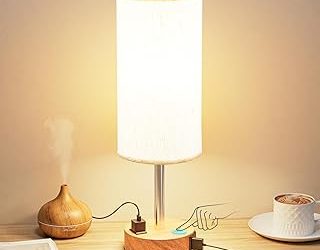
Dimmable Touch Bedside Lamp with USB A+C and AC Outlet
This is the most complete nightstand solution here: three-way touch dimming, both USB standards, and a pass-through outlet on a wood-grain metal base that actually has some heft. The 14″ height clears most headboards without glaring, and the fabric shade diffuses evenly rather than throwing a hot spot on the ceiling.
PoKat 23″ Ceramic Bedside Lamp
At 23 inches with a silver pole and glazed ceramic body, this reads as furniture rather than accessory — good for end tables and console runs where you want vertical presence. The ceramic base gives it genuine stability, and the standard socket means you can tune color temperature to match the rest of your room.
16.1″ Touch Table Lamp, 3-Way Dimmable
A straightforward black touch lamp that does the fundamentals well: three brightness stages, bulb included, corded with no battery nonsense. The compact 16.1″ profile suits small nightstands and dorm desks where the taller ceramic options would crowd everything else off the surface.
Industrial Desk Lamp with Glass Shade and USB-C
Fully dimmable rather than stepped, which matters if you read late and want to dial output down to a low glow. The glass shade over an exposed filament bulb gives it real workshop character, and the USB-C plus AC outlet combination makes it a legitimate home-office anchor.
EDISHINE Tripod Table Lamp, 14.2″
The splayed wooden tripod is the most structurally interesting design in this group and genuinely resists tipping better than a single-column base. Light brown wood with a linen beige shade suits nurseries and kid rooms, and the E26 base leaves the bulb choice entirely up to you.
Frequently Asked Questions
Do touch lamps need a special bulb?
For dimming, yes — the bulb must be dimmable, and if the lamp ships with one, match that spec when replacing it. Non-dimmable LEDs on a dimming circuit produce flicker, buzz, or refuse to reach low settings.
What bulb wattage is right for a nightstand?
Aim for 400 to 800 lumens, which is roughly a 5 to 9 watt LED. Anything brighter reads as task lighting and works against winding down. Check the lamp’s stated maximum wattage before going higher.
Are pass-through outlets safe for a phone charger?
Yes for phones, tablets, and small electronics. Do not run a space heater, hair dryer, or anything high-draw through a lamp base — those circuits are rated for low loads only, and the wiring gauge inside a lamp column is thin.
Can I replace a lamp shade with a different one?
Usually. Note whether the shade uses a spider fitting on a harp, an uno fitting that threads onto the socket, or a clip-on. Match the fitting type and the shade will swap in minutes.
Final Thoughts
If you want one lamp to handle bedside charging, reading, and ambient light, the Dimmable Touch Bedside Lamp with USB A+C and AC outlet is the practical pick. Choose the PoKat 23″ ceramic lamp when you want the fixture to carry visual weight in the room, and the Industrial Desk Lamp with glass shade if smooth full-range dimming and USB-C matter more than height. The aooshine 12.8″ mini lamp remains the honest budget option — an inline rocker switch and a cream fabric shade, nothing to break.