Every furniture project eventually hits the same wall: you need repeatable, dead-straight cuts, and your circular saw isn’t going to give them to you. Sheet goods wander, rip cuts drift, and by the time you’ve clamped a straightedge for the twelfth time you’ve lost an afternoon. The table saw solves that, but shopping for one is genuinely confusing. Marketing copy throws around amps and RPM like they’re the whole story, while the specs that actually decide whether you enjoy using the saw, fence accuracy, rip capacity, and how the thing handles dust, get buried in the fine print.
I’ve spent years building casework, tables, and shop furniture on jobsite saws, and the differences between them show up fast once you’re squaring up a cabinet side. This guide covers the saws worth your money in 2026, from rack-and-pinion workhorses to compact benchtop units that fit a one-car garage. Below you’ll find what to prioritize, honest notes on each saw, and answers to the questions that come up most.
Our top picks


As an Amazon Associate we earn from qualifying purchases at no extra cost to you.
🛒 Best Price Today on Amazon
Prime members get fast, free shipping on everything above, plus member-only deals. New members get a 30-day free trial — cancel anytime.
How to Choose a Table Saw (2026)
- Fence quality: This is the single biggest factor in cut accuracy. Rack-and-pinion fences track parallel to the blade automatically and stay locked; cheaper single-point fences need checking against the miter slot before every rip.
- Rip capacity: If you break down plywood, look for 24 inches minimum so you can rip a sheet in half. Around 32 inches lets you cut a full 4×8 sheet lengthwise with the offcut supported.
- Blade size and cut depth: A 10-inch blade clears roughly 3-1/8 inches at 90 degrees, enough for 4×4 stock and thick hardwood. An 8-1/4 inch saw trades some depth for real weight savings.
- Stand and portability: Rolling stands earn their keep if the saw moves between garage and driveway. If it lives on a bench permanently, skip the stand and put the money toward the fence.
- Dust and safety hardware: Check for a functional dust port, a riving knife rather than just a splitter, and an anti-kickback pawl setup you’ll actually leave installed instead of tossing in a drawer.
The Best Table Saws (2026) Reviewed
DEWALT DWE7491RS 10-Inch with Rolling Stand
The 32-1/2 inch rip capacity and rack-and-pinion fence make this the saw I recommend to anyone building furniture from sheet goods, because it handles a full plywood panel without an outfeed circus. The foldable rolling stand deploys in seconds and the fence returns to true repeatedly, which is what you’re really paying for.
SKIL TS6307-00 15 Amp 10-Inch Jobsite Saw
SKIL’s rack-and-pinion fence punches well above the price bracket, and the folding stand is sturdier than the weight suggests. Worth noting: the on-board dust collection is better than average for a jobsite saw, which matters if you’re working in an attached garage.
DEWALT DWE7485 8-1/4 Inch Compact Saw
The smart pick for tight shops, this one is light enough to lift onto a bench solo but keeps DEWALT’s rack-and-pinion fence and a usable 24-1/2 inch rip. The shallower cut depth is the tradeoff, so if you regularly cut 4×4 posts look elsewhere.
Evolution R10TS 10-Inch Jobsite Saw
Evolution includes a zero-clearance throat plate and a dado plate in the box, which is unusual and genuinely useful for clean crosscuts and joinery on shelving. The 26-inch rip and 3-3/8 inch depth cover most furniture work, and the fence holds its setting well.
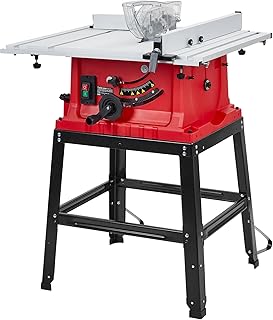
10-Inch 15 Amp Table Saw with Stand and Cover
The generous 36 x 25 inch tabletop gives you real support for wider panels, and the 5000 RPM motor doesn’t bog down in hardwood. Budget for a quality blade upgrade and plan on tuning the fence square before your first project.
Frequently Asked Questions
Do I need a cabinet saw for furniture building?
No. A well-tuned jobsite saw with a good fence and a sharp 40-tooth blade will produce joinery-ready cuts. Cabinet saws buy you mass, quieter operation, and better dust extraction, not fundamentally better accuracy.
What blade should I actually use?
Stock blades are almost always the weak link. A 40 to 50 tooth combination blade handles ripping and crosscutting well enough for most furniture work, and swapping it in will improve your cut quality more than spending another hundred dollars on the saw.
How important is the riving knife?
Very. It sits behind the blade and rises with it, keeping the kerf open so stock can’t pinch and kick back at you. Unlike a fixed splitter, it stays usable for non-through cuts, so there’s no excuse to remove it.
Can these saws cut aluminum or plastic?
Some are rated for non-ferrous metal and plastics with the correct blade, including the 15 amp multi-material models. Use a blade specified for the material, slow your feed rate, and never freehand it.
Final Thoughts
If you’re building furniture and want one saw that won’t hold you back, the DEWALT DWE7491RS is the straightforward answer: the rip capacity and fence accuracy pay off on every panel you cut. The SKIL TS6307-00 delivers most of that performance for meaningfully less money, and the compact DEWALT DWE7485 is the right call when shop space, not cut depth, is your real constraint.