Shopping for your first table saw means wading through a spec sheet arms race where every listing claims 15 amps and a 10-inch blade, yet the actual cutting experience varies wildly. The gap between a saw that tracks true through 3/4-inch plywood and one that wanders mid-rip usually comes down to fence design, tabletop flatness, and whether the trunnions hold their setting after a few dozen bevel changes. None of that shows up in the headline numbers.
I built this list around what matters once the saw is bolted together in your garage: how square the fence stays, how much rip capacity you actually get on the right side of the blade, and whether the stand survives being wheeled across a gravel driveway. Below are six budget-friendly options spanning roughly the $200 to $700 range, with notes on where each one earns its keep and where you’ll be compensating with jigs and patience.
Our top picks



As an Amazon Associate we earn from qualifying purchases at no extra cost to you.
🛒 Best Price Today on Amazon
Prime members get fast, free shipping on everything above, plus member-only deals. New members get a 30-day free trial — cancel anytime.
How to Choose an Inexpensive Table Saw (2026)
- Fence quality: This is the single component that separates frustrating saws from usable ones. Look for a rack-and-pinion system rather than a single-point lock, and check whether the fence can be shimmed square if it drifts out of alignment.
- Rip capacity: Ripping a 4×8 sheet in half lengthwise needs about 24 inches of capacity. Anything under 20 inches means you’ll be breaking sheet goods down with a circular saw and a straightedge first, which is workable but adds a step to every project.
- Tabletop flatness and surface area: Run a straightedge across the cast or stamped top before your first cut. Larger tables support workpieces better, but a flat small top beats a warped large one every time.
- Stand and mobility: Folding rolling stands are worth the premium if your saw lives in a corner between projects. Fixed leg stands are lighter and cheaper but mean lifting the whole assembly to reposition it.
- Dust collection and blade upgrade path: A 2-1/2 inch shroud port that accepts a shop vac keeps sightlines clear. Budget another $40 for a quality 40-tooth combination blade, since factory blades are almost always the weak link.
The Best Inexpensive Table Saw (2026)s Reviewed
DEWALT DWE7491RS 10-Inch with Rolling Stand
The 32-1/2 inch rip capacity and rack-and-pinion fence make this the reference point for jobsite saws, and the 4800 RPM motor pushes through hardwood without bogging. It sits at the top of the budget bracket, but the fence holds square across repeated adjustments in a way cheaper saws rarely match.
SKIL TS6307-00 Portable Jobsite Saw
SKIL’s rack-and-pinion fence delivers most of the DEWALT’s precision for meaningfully less money, and the folding stand deploys without wrestling. The trade-off is a smaller table and slightly rougher fit and finish, though neither affects cut accuracy once you’ve dialed it in.
DOVAMAN DTS10A 10-Inch with Stand
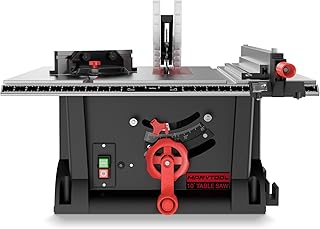
A copper-wound motor at 5300 RPM and 3.35 inches of cut depth at 90 degrees covers standard furniture stock comfortably, and the single-side extension adds useful support for wider panels. Expect to spend an hour truing the fence and checking blade alignment before your first real cut.
15-Amp Portable Compact Table Saw with 36T Blade
This is the pick for tight spaces and occasional use, with a 4600 RPM motor and benchtop footprint that stores on a shelf. The included 36-tooth blade handles construction lumber acceptably, though upgrading it transforms the cut quality on plywood and hardwood.
10-Inch Jobsite Table Saw with Stand and Push Stick
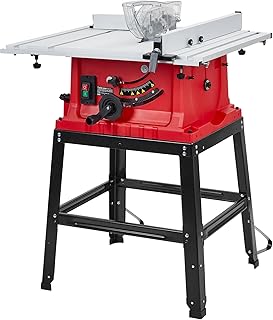
At 5000 RPM with a 3-11/32 inch maximum depth and an included angle stop, this covers the fundamentals for cabinet parts and shop fixtures. The push stick and stand come in the box, which is genuinely convenient at this price, but treat the fence as a starting point rather than a finished tool.
Frequently Asked Questions
Can a budget table saw handle hardwood?
Yes, with the right blade and a slower feed rate. A 15-amp motor has enough power for 3/4-inch oak or maple; the limiting factor is usually the blade, so swap in a 40-tooth carbide combination blade before assuming the saw is underpowered.
Do I need a riving knife or is a splitter enough?
A riving knife rises and falls with the blade and stays close behind it, making it substantially better at preventing kickback. Every saw here ships with one, and it should stay installed for all through-cuts.
How flat does the tabletop need to be?
Within about 0.010 inches across the surface is fine for furniture work. Small dips near the throat plate are common on stamped tops and can be worked around with an auxiliary sled or zero-clearance insert.
Is a contractor saw worth the upgrade over a jobsite model?
If you’re building furniture weekly, the added mass and cast-iron top dampen vibration noticeably and improve cut consistency. For weekend projects and occasional sheet goods, a well-tuned jobsite saw does the same work for a third of the cost and floor space.
Final Thoughts
The DEWALT DWE7491RS remains the benchmark if your budget stretches to it, delivering fence accuracy and rip capacity that hold up under regular furniture work. The SKIL TS6307-00 captures most of that capability for noticeably less, making it the value sweet spot for a first serious saw, while the DOVAMAN DTS10A is a reasonable entry point if you’re willing to invest setup time in exchange for the lowest cost of entry.