Anyone who has spent a Saturday morning dragging a pressure washer wand back and forth across a patio knows the frustration: the fan tip covers ground but leaves a hazy film, and the 0-degree pencil jet cuts fast but takes three hours to finish a slab. A turbo nozzle splits the difference by spinning a zero-degree stream in a tight cone, so you get the bite of a pinpoint jet with the sweep of a wide pattern. The catch is that these tips are sold as a wall of near-identical stainless cylinders, and picking the wrong orifice size will either starve your pump or leave you wondering why nothing came clean.
This guide sorts through the turbo nozzles worth bolting onto your wand in 2026, with a focus on what actually matters at the workbench: orifice sizing, bearing quality, hot-water tolerance, and whether the kit gives you enough spare tips to justify the shelf space. Whether you are stripping algae off a deck before refinishing it, prepping concrete for a sealer, or cleaning up outdoor furniture frames at the start of the season, there is a tip here that fits.
Our top picks
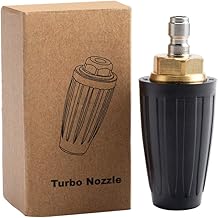


As an Amazon Associate we earn from qualifying purchases at no extra cost to you.
🛒 Best Price Today on Amazon
Prime members get fast, free shipping on everything above, plus member-only deals. New members get a 30-day free trial — cancel anytime.
How to Choose a Turbo Nozzle Pressure Washer (2026)
- Match the orifice to your machine: Orifice size, not PSI, determines flow. A 4.0 orifice needs roughly 4 GPM to build pressure, so pairing it with a 2 GPM electric washer will feel weak. Small electrics generally want a 2.5 to 3.0 orifice; gas units in the 3.5 to 4 GPM range take a 4.0.
- Check the pressure ceiling honestly: Ratings like 4000 or 4500 PSI are maximums the housing can survive, not output. Buy a nozzle rated at or above your pump’s peak so the ceramic seat and bearing are not living at their limit every time you pull the trigger.
- Look for a serviceable ceramic core: The spinning cone comes from a ceramic insert riding in a seat. Nozzles with hardened stainless housings and replaceable internals last seasons longer than sealed budget units that grind themselves out after a dozen hours.
- Decide if you need hot water capability: If you run a hot-water rig or feed warm water for grease and mildew, confirm the temperature rating. Cold-only nozzles will soften seals and lose their spin pattern above about 140°F.
- Consider a kit versus a single tip: A standalone turbo tip is fine if you already own a full color-coded set. If you are building from scratch, a combo pack with a 6-in-1 selector or a spread of fan tips saves fumbling with quick-connect couplers mid-job.
The Best Turbo Nozzle Pressure Washer (2026)s Reviewed
Simpson 80144 Turbo Nozzle, 4500 PSI
Simpson builds this one for professional-grade gas machines, with a 4500 PSI ceiling and genuine hot-water tolerance up to 212°F, which puts it a class above most consumer tips. The oscillating jet clears driveways and stamped concrete noticeably faster than a 25-degree fan, and the build quality justifies the premium if you use a washer regularly.
AURORA CAR Turbo Nozzle, 4000 PSI
A straightforward 4.0-orifice tip aimed at gas washers pushing around 4 GPM, with a solid quick-connect stem and a consistent spin pattern on brick, concrete, and vinyl. It is a sensible one-and-done replacement when a stock turbo tip finally chatters itself apart.
Tool Daily Stainless Steel Turbo Nozzle, 3600 PSI
The 3.0 orifice makes this the safer pick for mid-range gas units and stronger electrics, and the stainless body holds up well to being knocked around a truck bed. It is gentle enough for wood decking when you back off to a sensible standoff distance, which not every turbo tip manages.
AURORA CAR Turbo Nozzle & 6-in-1 Quick Changeover
Pairing a 4000 PSI turbo tip with a six-position selector nozzle covers nearly every task without swapping hardware at the coupler, a real convenience when you are working off a ladder. Best value here if you are outfitting a new washer rather than replacing a single worn tip.
Stainless Steel 360° Rotating Turbo Nozzle, 3.0 GPM
A no-nonsense 3.0 GPM tip that suits car and equipment washing, where the rotating cone lifts road grime without the paint risk of a stationary zero-degree jet. Keep the wand moving and hold roughly a foot back on automotive surfaces.
Frequently Asked Questions
Will a turbo nozzle damage wood or paint?
It can. Turbo tips concentrate energy, so on cedar decking, painted siding, or vehicle panels, increase your standoff distance to 12 to 18 inches and test in an inconspicuous corner first.
Why does my new turbo nozzle feel weaker than my fan tip?
Almost always an orifice mismatch. An oversized orifice bleeds pressure because your pump cannot supply the flow that tip expects, so drop down one size.
How long should a turbo nozzle last?
Homeowner use typically yields several seasons. The ceramic core and bearing are the wear points, and a rattling or wobbling spray pattern means it is time to replace.
Do I need a kit or just one tip?
If you already own standard fan nozzles, a single turbo tip is enough. Kits make more sense for a new washer or as a shared set in a garage.
Final Thoughts
For serious weekend work on concrete and hardscape, the Simpson 80144 earns its price with real hot-water capability and a 4500 PSI housing. The AURORA CAR 6-in-1 combo is the smartest starting point for anyone building a nozzle collection from nothing, and the Tool Daily 3600 PSI stainless tip is the safest match for mid-range machines and mixed surfaces like decking and outdoor furniture frames.