Key takeaways
- Blade size versus bench space: A 10-inch saw handles most furniture stock and takes up meaningfully less depth against a wall. Step up to 12-inch only if you’re regularly crosscutting wide shelving or 4x material, since the larger saws need more clearance behind the fence and eat more of your shop footprint.
- Single versus dual bevel: Single-bevel saws tilt one direction, so you flip the workpiece for opposing angles. Dual-bevel tilts both ways, which saves real time on crown molding and mitered case corners where every flipped piece is a chance to lose your reference face.
- Cut line reference system: Lasers need calibration and wash out under shop lights. LED shadow systems cast the blade’s actual silhouette, which stays accurate regardless of blade swap or kerf width. Either works, but the shadow approach removes a step from your setup routine.
- Fence height and detent quality: Tall fences support crown stock standing up. Test the miter detents if you can: a good one seats with a firm click and resists over-travel. Sloppy detents mean you’re chasing angles with a square on every cut.
- Dust port geometry: No miter saw captures everything, but a port angled to catch the blade’s exhaust stream and sized to standard 2.5-inch hose makes shop-vac hookup painless. Skip the bundled cloth bag and plan on a vacuum or cyclone from day one.
Every furniture project eventually runs into the same wall: a crosscut that has to be dead-on. Sliding compound miter saws are the tool that gets you there, but the shopping experience is a mess. Listings pile on specs like RPM figures and blade tooth counts without telling you whether the fence will actually hold square after six months in a garage that swings from 40°F to 90°F. Meanwhile the price spread runs from budget imports to job-site staples, and the difference isn’t always obvious from a product page.
This guide sorts through the 2026 lineup with a workshop-first lens. I’ve weighted the things that matter once sawdust starts flying: how much the head deflects under load, whether the detents click into place or drift past them, how the dust collection actually performs, and what your realistic crosscut capacity is on wide boards. Below you’ll find the picks, followed by a buying framework and reviews of the standouts.
Our top picks




As an Amazon Associate we earn from qualifying purchases at no extra cost to you. Ratings are shown as listed on Amazon.
🛒 Best Price Today on Amazon
Prime members get fast, free shipping on everything above, plus member-only deals. New members get a 30-day free trial — cancel anytime.
How to Choose a 10 Sliding Compound Miter Saw (2026)
- Blade size versus bench space: A 10-inch saw handles most furniture stock and takes up meaningfully less depth against a wall. Step up to 12-inch only if you’re regularly crosscutting wide shelving or 4x material, since the larger saws need more clearance behind the fence and eat more of your shop footprint.
- Single versus dual bevel: Single-bevel saws tilt one direction, so you flip the workpiece for opposing angles. Dual-bevel tilts both ways, which saves real time on crown molding and mitered case corners where every flipped piece is a chance to lose your reference face.
- Cut line reference system: Lasers need calibration and wash out under shop lights. LED shadow systems cast the blade’s actual silhouette, which stays accurate regardless of blade swap or kerf width. Either works, but the shadow approach removes a step from your setup routine.
- Fence height and detent quality: Tall fences support crown stock standing up. Test the miter detents if you can: a good one seats with a firm click and resists over-travel. Sloppy detents mean you’re chasing angles with a square on every cut.
- Dust port geometry: No miter saw captures everything, but a port angled to catch the blade’s exhaust stream and sized to standard 2.5-inch hose makes shop-vac hookup painless. Skip the bundled cloth bag and plan on a vacuum or cyclone from day one.
The Best 10 Sliding Compound Miter Saw (2026)s Reviewed
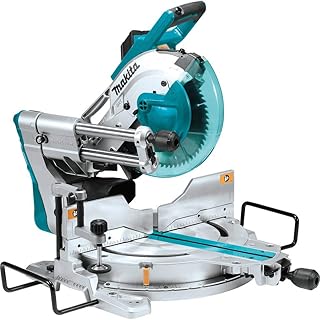
Makita LS1019L 10″ Dual-Bevel Slider
The rail-forward design lets this saw sit flush against a wall, which is a genuine win in a crowded shop, and the dual-bevel action combined with Makita’s fence tolerances makes it the pick for anyone building casework where compound angles need to close tight. Cut quality out of the box is excellent, and the six linear ball bearings keep slide action smooth long past the break-in period.
DEWALT DWS780 12″ Double Bevel
The XPS shadow light is the standout feature here: no calibration, no batteries, and the cut line updates automatically when you change blades. Paired with a 12-inch blade and generous crosscut capacity, this is the saw I’d choose for dimensioning wide panels and rough stock before it hits the bench.
DEWALT DWS779 12″ Double Bevel
Mechanically close to the DWS780 minus the shadow light, the DWS779 delivers the same 3,800 RPM motor and increased crosscut capacity for less money. If you’re comfortable working to a pencil line or already own a good aftermarket laser, this is the better value in DEWALT’s slider range.
DOVAMAN Updated 10-Inch Sliding Miter Saw
The dual-speed motor is the differentiator: drop to 3,200 RPM for aluminum and PVC, run 5,000 for hardwood. Three included TCT blades and nine positive stops make this a sensible entry point for a mixed-material hobby shop, and the ambidextrous handle is a nice touch for left-handed users.
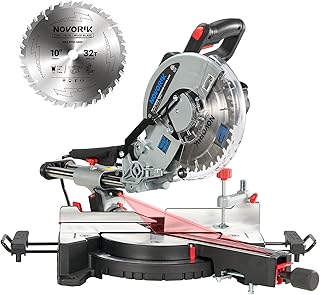
NOVORIK Single Bevel Compound Slider
A straightforward 15-amp single-bevel saw that covers the fundamentals without padding the price. The 4,000 RPM motor has enough torque for repeated cuts in oak and maple, making it a reasonable first slider for someone building out a garage workshop on a budget.
Frequently Asked Questions
Do I need a sliding saw, or will a standard compound miter saw work?
If you build furniture, get the slider. A non-sliding 10-inch saw tops out around 5.5 inches of crosscut, which won’t clear a standard 1×8 shelf board. The sliding rails roughly double that reach.
How often should I check calibration?
Verify 90° and 45° stops with a machinist square after transporting the saw and roughly every 20 hours of use. Shop temperature swings and vibration both nudge fences out of true, and a half-degree error compounds badly across a four-corner assembly.
Is the included blade worth keeping?
Use it for rough work and construction lumber, then buy a 60- to 80-tooth crosscut blade for finish cuts. Stock blades typically run 24 to 40 teeth, which leaves tearout you’ll spend time sanding out.
Can these saws cut metal?
Non-ferrous only, and only with the right blade and lower RPM. Aluminum and brass are fine with a negative-hook blade and cutting wax. Steel will destroy a woodworking blade and throw hot chips.
Final Thoughts
For furniture work where joint accuracy drives everything, the Makita LS1019L earns its price through fence precision and a footprint that respects small shops. If capacity matters more than compactness, the DEWALT DWS780 pairs 12-inch reach with the most practical cut-line system on the market, while the DWS779 delivers nearly identical performance for the maker who’d rather put the savings toward a better blade and a dust collector.