The nozzle is the cheapest part of your pressure washer setup and the one that decides whether a job takes twenty minutes or two hours. Most machines ship with a couple of generic tips, one of which is usually too aggressive for anything you actually care about, and after a season of being dropped on concrete and left out in the rain, the orifices wear oval and your spray pattern turns into a sad fan. Meanwhile the wrong tip on the wrong surface leaves permanent lap marks in cedar decking or strips paint off siding you just wanted rinsed.
This guide is written from the perspective of someone who has stripped a deck, resealed a driveway, and washed more vehicles than is reasonable. Below you’ll find the nozzle sets and turbo tips that hold up to real use, how to match a degree rating to a surface without gambling on your own siding, and answers to the questions that come up once you start swapping tips mid-job. Whether you’re maintaining outdoor furniture, prepping wood for stain, or trying to get years of algae off a patio, the right tip in your hand matters more than another 500 PSI at the pump.
Our top picks


As an Amazon Associate we earn from qualifying purchases at no extra cost to you.
🛒 Best Price Today on Amazon
Prime members get fast, free shipping on everything above, plus member-only deals. New members get a 30-day free trial — cancel anytime.
How to Choose a Pressure Washer Nozzles (2026)
- Match PSI headroom to your machine: A nozzle rated 4000 PSI on a 2000 PSI washer is perfectly fine, but the reverse will fail. Check your pump’s rating and buy tips rated at or above it, with a little margin for the pressure spikes that happen when you release the trigger.
- Get the GPM and orifice size right: Orifice size, not PSI, controls how your machine actually behaves. A 2.5 GPM tip on a 4.0 GPM machine chokes the pump and drives pressure up dangerously; an oversized tip on a small unit gives you a limp, useless stream. Find your washer’s flow rate first, then buy to match.
- Understand the degree spread: 0° is a pinpoint blaster for rust and stubborn spots on concrete only, 15° handles paint prep and heavy grime, 25° is the everyday workhorse, 40° is your safe rinse for siding, cars, and finished furniture. The black soap tip runs at low pressure to draw detergent through the siphon.
- Add a turbo tip for large flat areas: A rotating or oscillating nozzle spins a 0° stream in a cone, giving you zero-degree cutting power spread across a wider path. On driveways and patios this genuinely halves your time compared to a fixed 25°.
- Look for stainless internals and a real holder: Brass or plated bodies with stainless orifices resist wear far longer than cheap plated steel. A nozzle holder that clips to your wand or belt sounds like a small thing until you’ve spent ten minutes hunting a black tip in dark mulch.
The Best Pressure Washer Nozzles (2026)s Reviewed
Tool Daily 5-Pack Nozzle Tips, 1/4″ Quick Connect
This is the sensible baseline set: five tips covering 0°, 15°, 25°, 40°, and soap, sized for 2.5 GPM machines and rated to 4000 PSI. The quick-connect collars seat cleanly without the sticky, half-locked feeling you get from loose-tolerance knockoffs, and at this price you can keep a spare set in the truck.
Simpson 80144 Turbo Nozzle, 4500 PSI
The one to buy if you’re doing serious flatwork. Simpson’s oscillating jet is rated to 4500 PSI and hot water up to 212°F, which matters for degreasing garage floors, and it genuinely cuts driveway and patio time close to in half compared to sweeping with a fixed tip. Build quality is a clear step above generic turbos, and it shows after a full season.
Twinkle Star Nozzle Tips Set, 1/4″ (2.5 GPM)
A well-machined multi-degree set that has become the default recommendation for a reason: the color coding is accurate, the orifices are consistent tip to tip, and the fittings don’t leak at the coupler. A solid choice if your machine sits in the common 2.0 to 2.8 GPM range.
Hourleey 7-Piece Nozzle Set with Holder
Seven tips instead of five gives you intermediate angles for dialing in wood and painted surfaces where the jump from 25° to 40° is too coarse. The included belt-mount holder is the real selling point, since it keeps every tip within reach and stops you from leaving one in the grass.
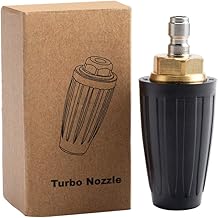
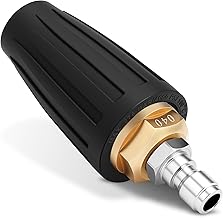
AURORA CAR Turbo Nozzle, 4.0 GPM
Built for higher-flow machines with a 4.0 orifice and a 4000 PSI ceiling, this rotating nozzle chews through brick, concrete, and stained vinyl. If your washer pushes near 4 GPM, this is the correctly sized turbo option, and the Yupjlia 360° rotating tip is a close alternative with the same spec sheet.
Frequently Asked Questions
Which nozzle is safe for outdoor furniture and finished wood?
Use the 40° white tip, hold the wand at least 12 inches back, and keep it moving. Anything narrower risks fuzzing the grain on teak or acacia and cutting into powder-coated aluminum. Test on the underside first.
Do I really need the 0° red tip?
Rarely. It concentrates all your flow into a pencil-thin stream that will etch concrete, gouge wood, and lift paint in a single pass. Keep it for spot-blasting rust stains on masonry and reach for a turbo nozzle instead when you want power over area.
How do I know when a nozzle is worn out?
Watch your pressure gauge and your spray shape. A worn orifice drops working pressure and produces a ragged, uneven fan with gaps in it. Nozzles are consumables, so replace the set every season or two under regular use.
Will a turbo nozzle work with my detergent?
No. Turbo tips run at full pressure, which defeats the low-pressure siphon that pulls soap. Apply detergent with the black soap tip, let it dwell, then switch to the turbo for the rinse and scrub pass.
Final Thoughts
For most homeowners, pairing the Twinkle Star or Tool Daily five-piece set with the Simpson 80144 turbo covers essentially every job around the house, from rinsing patio furniture to stripping a season of grime off the driveway. If your machine runs at higher flow, size up to the AURORA CAR turbo instead so the orifice matches your pump. Buy the set, label your holder, and stop guessing which tip is in the wand.