Key takeaways
- Measure the real clearance, not the listed number: Manufacturers quote wall clearance at the frame, but baseboard trim, floor vents, and outlet covers all steal an inch or two. Chalk the footprint on your floor, add the stated clearance, then add another inch of margin before you commit.
- Check the doorway path before the room: A 113-inch sectional arrives in sections, but an 80-inch RV sofa often does not. Measure your narrowest hallway turn and stairwell landing diagonally, and confirm whether the back panel detaches with clips or is stapled on permanently.
- Power versus manual is a wiring decision: Power recliners need a grounded outlet within cord reach and draw current continuously in standby. In an RV running off house batteries, that matters. Manual handles never fail electrically, but they demand more clearance at the side for the lever arm.
- Inspect the frame material in the spec sheet: Look for kiln-dried hardwood or welded steel at the stress points, not particleboard corner blocks. Sinuous spring decks hold up better under a reclining track than webbing, and metal-to-metal joints should use bolts, not staples.
- Weigh the extras honestly: USB ports, cup holders, and drop-down tables are genuinely useful, but each one is another failure point and another reason the console eats seat width. Decide which two you’ll actually use every week and treat the rest as bonus.
What's inside
Anyone who has measured a room twice and still ended up with a recliner jammed against the baseboard knows the frustration. Standard reclining sofas need eight to twelve inches of clearance behind them to open, which in a 12-foot living room or a 90-inch RV slide-out is space you simply don’t have. Wall huggers solve this with a different mechanism: instead of pivoting the backrest rearward, the seat glides forward on a track, so the frame reclines fully with as little as three inches of breathing room. The tradeoff is a shorter, more upright recline angle and a mechanism with more moving parts, which means build quality matters more than it does on a conventional frame.
I’ve spent a fair amount of time under these frames with a flashlight and a socket wrench, and the differences between a sofa that lasts a decade and one that squeaks in year two come down to the steel gauge, the motor housing, and how the track is anchored to the deck. This guide covers six wall huggers for 2026 across the range you’ll actually encounter shopping: compact RV loveseats, mid-priced living room three-seaters, and a full leather sectional. Below you’ll find the picks, the specs that predict longevity, and answers to the questions that come up after the box is open and the packaging is on the curb.
As an Amazon Associate we earn from qualifying purchases.


🛒 Best Price Today on Amazon
Prime members get fast, free shipping on everything above, plus member-only deals. New members get a 30-day free trial — cancel anytime.
How to Choose a Wall Hugger Reclining Sofa (2026)
- Measure the real clearance, not the listed number: Manufacturers quote wall clearance at the frame, but baseboard trim, floor vents, and outlet covers all steal an inch or two. Chalk the footprint on your floor, add the stated clearance, then add another inch of margin before you commit.
- Check the doorway path before the room: A 113-inch sectional arrives in sections, but an 80-inch RV sofa often does not. Measure your narrowest hallway turn and stairwell landing diagonally, and confirm whether the back panel detaches with clips or is stapled on permanently.
- Power versus manual is a wiring decision: Power recliners need a grounded outlet within cord reach and draw current continuously in standby. In an RV running off house batteries, that matters. Manual handles never fail electrically, but they demand more clearance at the side for the lever arm.
- Inspect the frame material in the spec sheet: Look for kiln-dried hardwood or welded steel at the stress points, not particleboard corner blocks. Sinuous spring decks hold up better under a reclining track than webbing, and metal-to-metal joints should use bolts, not staples.
- Weigh the extras honestly: USB ports, cup holders, and drop-down tables are genuinely useful, but each one is another failure point and another reason the console eats seat width. Decide which two you’ll actually use every week and treat the rest as bonus.
The Best Wall Hugger Reclining Sofa (2026)s Reviewed
Ashley Draycoll Wall Hugger Reclining Sofa
The textured chenille and attached bustle back give this one a finished living room look that most reclining sofas miss, and Ashley’s frame construction is consistent enough that replacement parts are easy to source years later. It’s a manual recliner, so there’s nothing to plug in and nothing electrical to fail.
KEIKI 113″ L-Shaped Leather Reclining Sectional
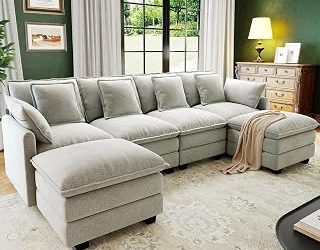
Genuine leather over a powered frame with independently adjustable backrest and footrest is a lot of engineering in one piece, and the right-side chaise makes it work in rooms where a symmetrical sectional wouldn’t fit. Plan the delivery route carefully, since the sections are heavy and the leather scuffs against a door jamb.
RecPro Charles 80″ RV Reclining Sofa
RecPro builds specifically for the RV market, and it shows in the shallower depth and lighter frame weight compared to residential equivalents. The oatmeal cloth hides dust from open windows better than dark upholstery, which is a small thing until you’re wiping it down every weekend.
Zero Wall Hugger Power Reclining Sofa
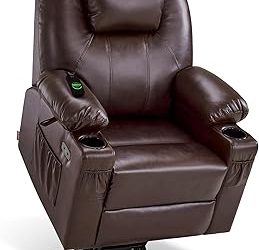
The adjustable headrest is the standout here, letting taller sitters actually rest their neck instead of pushing it forward. Drop-down table and built-in outlets make it a practical anchor for a media room, though the console does narrow the middle seat noticeably.
RV Loveseat Recliner with USB and Massage
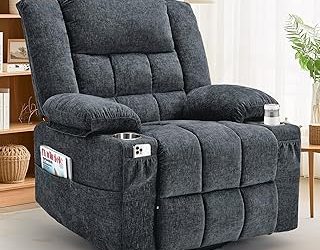
A 150-degree recline in a wall-hugging loveseat is aggressive for the footprint, and the massage motors are a genuine extra rather than a gimmick on long trips. Velvet fabric holds up to daily use but shows pet hair, so factor that in if you travel with animals.
Frequently Asked Questions
How much space does a wall hugger actually need behind it?
Most designs need three to six inches, versus eight to twelve for a conventional recliner. Manual models typically need less than power models, since power mechanisms house a motor and gearbox at the rear of the frame.
Do wall huggers recline as far as standard recliners?
Generally not. The forward-gliding mechanism trades a few degrees of layback for the space savings, so expect a more upright final position unless the model specifically advertises 150 degrees or more.
Can I install one of these in an RV myself?
Yes, and it’s a reasonable weekend job. Remove the existing furniture, locate the floor blocking or add plywood backing, and through-bolt the base rather than relying on screws into thin subfloor. Check for wiring and plumbing runs before you drill anything.
Are the power mechanisms repairable?
Usually. Most use a standard linear actuator and a two-button switch, both of which are replaceable parts you can swap with a screwdriver. Ask the manufacturer for a parts diagram before you buy, since that’s a good signal of how long they intend to support the model.
Final Thoughts
For most living rooms, the Ashley Draycoll is the sensible default: manual mechanism, no electronics to fail, and upholstery that reads as furniture rather than a gadget. If you want power and a headrest that adjusts, the Zero Wall Hugger delivers more adjustability for the money, and RV owners should start with the RecPro Charles, since it’s built to the dimensions and weight limits that actually apply in a coach.