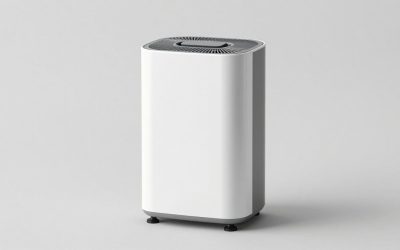
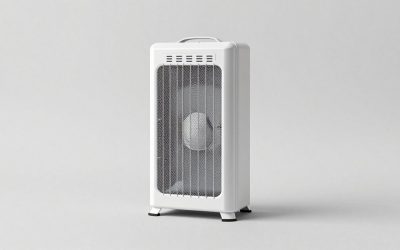
why is my dehumidifier icing up: A lightly frosted coil does not automatically mean a refrigerant leak. Modern compressor units may deliberately pause compressor while fan runs to melt frost; however below 41°F (5°C) is a manufacturer guidance limit for many GE/Frigidaire devices, not every model.
Quick Answer: A compressor dehumidifier can ice up when the room is too cold, airflow is restricted by a clogged filter or nearby objects, or the frost-control cycle cannot keep up. Frigidaire and GE note that around or below 41°F (5°C) frosting becomes more likely. Light temporary frost may be normal; let the unit use its defrost cycle, clean accessible filters and restore clearance. Persistent thick ice or repeated error codes calls for authorized service.
Never scrape ice from the refrigeration coil or open a refrigerant cabinet. Repeated heavy icing requires manufacturer guidance or qualified repair.
As an Amazon Associate we earn from qualifying purchases.
By DIY Ideas 4 Home Editorial Team
Why This Happens: Causes and Warning Signs
Each line below ties a real-world decision to a visible outcome and an explicit limit. Start with the first check that fits the symptom rather than treating the whole list as required repairs.
| Decision point | Owner action | Result to check | Stop or exception |
|---|---|---|---|
| Measure room temperature and note frost | Read ambient air temperature near the dehumidifier without touching coils. | Compare it with the model operating range; GE and Frigidaire cite around 41°F for certain compressor models. | Do not treat 41°F as a universal rating. |
| Allow normal defrost to work | Observe whether the compressor pauses while the fan runs on an automatic defrost cycle. | Light frost that melts may be expected on that model. | Do not scrape or chip ice from a refrigeration coil. |
| Clear only external airflow restrictions | Check the washable filter if specified, air inlet and clearance around the cabinet. | Look for improved airflow and reduced recurring ice. | Stop before opening the sealed refrigeration system. |
| Escalate repeated heavy icing | Turn off and contact support when heavy ice repeats despite suitable room conditions and normal maintenance. | Report ambient temperature, humidity, model and any error code. | Refrigerant handling, sealed coil repairs and electrical work are not DIY tasks. |
Light transient frost versus persistent heavy ice
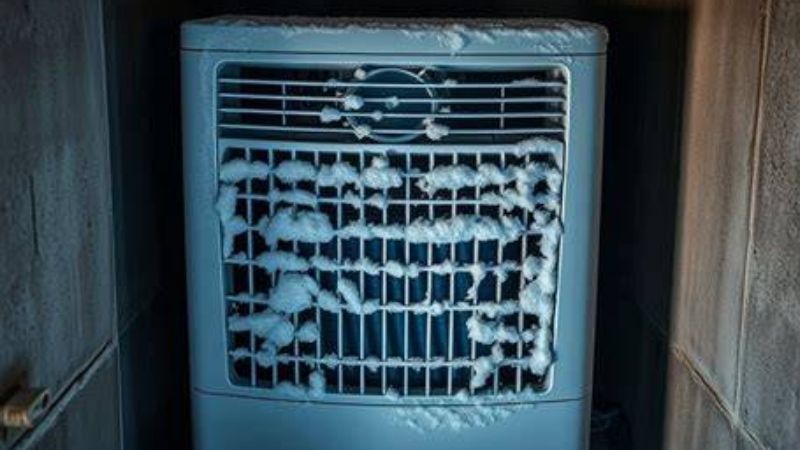
Frigidaire notes that a thin layer of frost can appear in otherwise normal conditions; evaporator temperature approaches freezing.
A dehumidifier can develop frost because its cold coil meets moisture in room air, but a persistent coating of ice is not the same as the light frost a model may manage during normal defrost operation. Before touching anything, note the room temperature, visible condition, and what the display or fan is doing. Check whether the model is rated for the basement’s actual operating temperature. A cold basement can make ordinary moisture removal more difficult, and some machines have specific lower-temperature limits. Do not borrow a temperature cutoff from a different brand and assume the same compressor controls apply.
Cold basement: ambient reading near/below 41°F
GE explains that below 41°F ambient temperature frost can accumulate on the dehumidifying coils; this lowers efficiency.
Auto-defrost can explain why the fan keeps running while the compressor is temporarily off. In supported models this may be intended behavior, not proof that the motor is failing. Consult the manual to learn what the indicator means and whether the unit is supposed to resume normal collection after the coil warms. Avoid forcing a restart every time the fan sound changes. If a solid block of ice remains, grows, or returns quickly despite suitable ambient conditions and clear airflow, stop and seek manufacturer guidance. The purpose of defrost is to protect normal operation, not to make persistent freezing acceptable.
What auto-defrost does: compressor OFF, fan ON
GE explains that frost-control unit stops compressor while fan runs, then compressor restarts automatically after coils defrost.
Restricted airflow is a sensible owner-level check. Look for a dust-loaded accessible filter, blocked inlet, obstructed outlet, or a unit pushed too close to stored boxes or a wall. Clean only the user-serviceable parts the manual permits, then restore the recommended clearance. Do not remove the cabinet to inspect evaporator coils or reach a fan behind an electrical cover. Ice, condensation, and live electrical parts make that an unsuitable place for casual probing. If the filter is clean and the room is warm enough for the model, persistent ice may need technical evaluation rather than repeated cleaning.
How to check frost without opening the sealed cabinet
Turn off and contact support when heavy ice repeats despite suitable room conditions and normal maintenance.
Room too cold for the exact model
GE explains that for typical units below 41°F operation can be unsatisfactory; some labeled low-temperature models differ and manual wins.
How to Interpret the Evidence
Compressor-based moisture removal relies on cold evaporator surfaces; cold rooms and restricted air movement can promote frost.
Automatic defrost often cycles compressor off while fan runs; this can be an intended protection feature.
Persistent heavy icing with good airflow and acceptable temperature may need qualified servicing, not consumer refrigerant handling.
How to Check the Problem Safely
Begin with observable conditions and proceed only through permitted user controls. A safety alarm, damaged part, live connection or inaccessible component ends the do-it-yourself path.
Step 1: measure room temperature and note frost
Read ambient air temperature near the dehumidifier without touching coils. Compare it with the model operating range; GE and Frigidaire cite around 41°F for certain compressor models.
Do not treat 41°F as a universal rating.
ENERGY STAR notes that capacity in pints/day is a test-condition rating; colder real basements have less moisture to extract than typical test conditions.
A safe observation period can separate a temporary event from a continuing failure. After following the manufacturer’s shutdown or defrost instructions, allow the unit to return to its approved operating condition and observe whether water collection resumes. Keep the bucket and drain path correctly positioned and monitor the displayed humidity. Do not chip ice away with a screwdriver, direct intense heat into the unit, or pour hot water onto a coil. Those shortcuts can damage components and move water into places where it does not belong. If the casing leaks, the power connection is damaged, or the appliance behaves abnormally, discontinue use.
Step 2: allow normal defrost to work
Observe whether the compressor pauses while the fan runs on an automatic defrost cycle. Light frost that melts may be expected on that model.
Do not scrape or chip ice from a refrigeration coil.
Make the next service conversation specific: share the exact model, measured ambient temperature, humidity setting, when the ice appeared, and whether the fan continued to run. Include a photograph taken without opening the housing. A repeated freeze under appropriate conditions can have several causes, including issues that involve sealed refrigeration parts, and those are not homeowner cleaning jobs. If the basement is simply below the unit’s stated temperature range, consider an appropriate moisture-control strategy for those conditions rather than making the dehumidifier run outside its documented limits.
Step 3: clear only external airflow restrictions
Check the washable filter if specified, air inlet and clearance around the cabinet. Look for improved airflow and reduced recurring ice.
Stop before opening the sealed refrigeration system.
Frigidaire notes that heavy frost merits checking airflow restrictions, cleaning filter, leaving clearance and reviewing display error codes.
Step 4: escalate repeated heavy icing
Turn off and contact support when heavy ice repeats despite suitable room conditions and normal maintenance. Report ambient temperature, humidity, model and any error code.
Refrigerant handling, sealed coil repairs and electrical work are not DIY tasks.
Frigidaire suggests changing CO (continuous) setpoint to a normal target range when heavy icing persists.
Products That Help
Useful supplies for the specific checks above can include Midea MAD50S1QWT dehumidifier and room thermometer. Confirm the exact size, device compatibility and applicable maintenance instructions first. Equipment and tools do not remove the need to stop for a safety fault.
When to Call a Pro
Stop before opening the sealed refrigeration system. Refrigerant handling, sealed coil repairs and electrical work are not DIY tasks.
Give the service provider the model number, the symptoms in time order, your observed operating conditions and any displayed fault code. Do not open sealed electrical, refrigerant or combustion components to collect this information.
Frequently Asked Questions
The answers below separate normal operation, owner-accessible checks and conditions that require manufacturer support or professional service.
Can I run my dehumidifier below 41°F?
Some GE and Frigidaire compressor models can frost or work poorly near or below 41°F. Confirm the exact unit rating; low-temperature-capable models differ.
Why does the fan run but compressor stop?
Automatic defrost may stop the compressor while leaving the fan running until frost melts. That can be normal if the unit resumes and does not accumulate heavy ice.
Should I scrape ice off a frozen coil?
No. Scraping or chipping can damage the refrigerant coil. Let an approved defrost operate; stop the unit for persistent heavy ice.
Can low refrigerant cause a dehumidifier to ice up?
It can be a possible service-related cause, but icing alone cannot prove a refrigerant problem. Check room temperature and airflow first, then use qualified service.
Final Thoughts
Read ambient air temperature near the dehumidifier without touching coils. Refrigerant handling, sealed coil repairs and electrical work are not DIY tasks.
More from Amazon
Programs that pair well with the guide above. Offers and eligibility are set by Amazon and may change.
A free business account with business pricing and bulk-buying tools for work, shop or home office.
Create a business accountFree shipping on eligible items, Prime Video and more. Eligible new members can start with a free trial.
Start a Prime free trialAudiobooks and podcasts to listen to on the go. Eligible new members can start with a free trial.
Try Audible freeAd-free music streaming. Eligible new subscribers can start with a free trial.
Try Music Unlimited freeAs an Amazon Associate we earn from qualifying purchases.