Key takeaways
- Piece count over 150 with only 1/4 and 3/8 drives. The count is padded with bits and hex keys.
- Steel not specified as chrome vanadium. Expect soft sockets that round fasteners.
- Ratchet tooth count not listed. Assume 36 or fewer, which is unusable in tight spaces.
- Missing 16 mm, 18 mm, or anything above 19 mm. Common gaps that force a separate purchase.
- Sizes not marked on the sockets. You will spend more time reading the case than turning bolts.
- Combination wrenches replaced by a single adjustable wrench. Not a mechanics set.
- “Lifetime warranty” with claims only through the online seller. It lasts as long as the listing does.
- Blow-molded case with no individual socket retention. Every piece ends up loose in the bottom.
The piece count on the box is the first trap. A 230-piece set and a 121-piece set can contain nearly the same number of useful sockets; the difference is 60 hex keys, 40 screwdriver bits, and a handful of spare accessories that pad the number. The second trap is SAE-heavy sets sold to people who own only metric cars. The third is a ratchet with a coarse 36-tooth mechanism that needs a 10-degree swing to catch, which does not fit anywhere under a modern hood. A mechanics tool set is really three socket sets, three ratchets, a set of combination wrenches, and a case; judge each of those parts on its own and ignore the number in the product title.
Decide These 3 Things First
1. Metric, SAE, or both? Every car sold in the United States since the mid-1990s uses metric fasteners. If your fleet is cars, motorcycles, and bicycles built in this century, a metric-heavy set is correct and the SAE half of a combined kit will gather dust. If you also work on older domestic trucks, trailers, lawn equipment, or household plumbing and hardware, you want both, and a combined set is cheaper than two.
Our top picks


As an Amazon Associate we earn from qualifying purchases at no extra cost to you.
2. Which drive sizes do you need? A 1/4-inch drive handles fasteners to about 14 mm and 40 ft-lb: trim, sensors, battery terminals. A 3/8-inch drive covers 8 to 22 mm and up to about 100 ft-lb: most engine, brake, and suspension work. A 1/2-inch drive is for lug nuts, caliper brackets, and axle hardware above 100 ft-lb. A set with only 1/4 and 3/8 is fine for engine bay and interior work; if brakes and wheels are on your list, you need all three.
3. How will you store and carry it? Blow-molded cases keep every piece in a labeled slot but crack at the hinges after a few years and are 18 to 22 inches wide. Stackable hard cases with latches that connect to a modular tool box system cost more and survive being thrown in a truck. If the set will live in a tool chest drawer, the case matters far less than socket rails and labeling.
Socket Coverage: Sizes, Depths, and Points
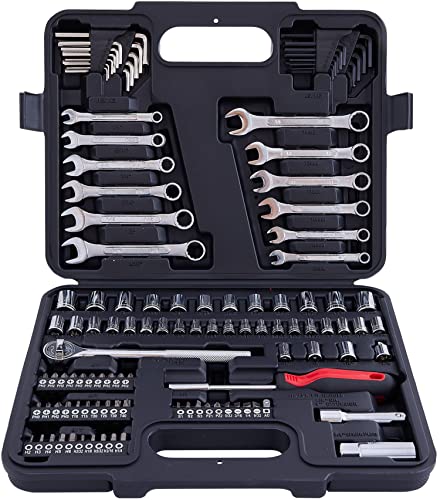
Count the sockets in the range you will use, not the total pieces. A complete metric set has 4 to 14 mm in 1/4-inch drive, 8 to 22 mm in 3/8-inch drive, and 10 to 24 mm in 1/2-inch drive, with deep sockets (2 to 2.5 inches long) duplicating the 8 to 19 mm range in at least 3/8 drive. Gaps are common in budget sets: 16 mm and 18 mm are often missing, and so is anything above 19 mm in 1/2 drive. Six-point sockets grip the flats of a fastener and are far less likely to round a rusted nut than 12-point; a good set is 6-point throughout or offers 6-point in the sizes that see the most torque. A set such as the MECHMAX 121-piece with 1/4- and 3/8-inch drives (about $50) is representative of a two-drive starter set: adequate for engine bay work but with no 1/2-inch drive for wheels. The CRAFTSMAN 230-piece set with 1/4-, 3/8-, and 1/2-inch drives in SAE and metric (about $129) is the three-drive class; roughly 90 to 110 of those pieces are sockets, extensions, and wrenches you will actually use on a vehicle.
Steel and Finish
Sockets and wrenches should be chrome vanadium (Cr-V) steel with a polished or satin chrome finish. Cr-V holds its shape under torque and resists corrosion in a damp garage. Carbon steel with a black oxide finish is used on impact sockets, which is correct for an impact wrench but not what you want on a ratchet set because they are thicker-walled. Avoid unspecified “alloy steel” or “heat-treated steel” on sets under $40; the sockets are often soft enough to round on the first stuck bolt. Marking matters as much as steel: sizes should be stamped and ideally laser-etched in high contrast so you can read 12 mm from 13 mm in a dim wheel well. Sets where the sizes are only molded into the case tray are a daily annoyance.
Ratchet Quality
The ratchet is the tool you will touch most, and it is where budget sets economize. Tooth count determines the swing arc needed to engage the next tooth: 36 teeth need 10 degrees, 72 teeth need 5 degrees, 90 teeth need 4 degrees, and 120-tooth ratchets need 3 degrees. For work in a modern engine bay, 72 teeth is the minimum worth having; 90 or 120 is better. The reversing lever should be a thumb switch you can flick one-handed, and the head should have a quick-release button that ejects the socket. Handle length is usually 5 to 6 inches for 1/4 drive, 8 to 9 inches for 3/8, and 10 to 11 inches for 1/2; a set that includes a flex-head or a stubby ratchet in 3/8 drive adds real value. Check whether the ratchet is rebuildable with an available repair kit; on premium sets it is, and on budget sets it is disposable.
Wrenches and Accessories
A mechanics set should include combination wrenches (open end on one side, box end on the other) from 8 to 19 mm in metric and 5/16 to 3/4 inch in SAE, with a 12-point box end offset 15 degrees so it clears obstructions. Sets that substitute a handful of stubby wrenches or skip 16 and 18 mm are cutting corners. Extensions of 3 and 6 inches in 3/8 drive and 5 and 10 inches in 1/2 drive, a universal joint in 3/8, and adapters between drive sizes are the accessories that get used. Hex keys, Torx bits, and screwdriver bits are welcome but do not count them as a reason to buy a set. Small specialty tools are cheap to add separately; a 4- to 10-piece hook and pick set for O-rings and seals runs $7 to $8, and a good set of pliers or a pry bar is $15 to $30 each.
Case and Organization
A case is not a detail. Blow-molded cases, standard on sets under $150, weigh 12 to 25 pounds loaded and measure roughly 19 by 13 by 4 inches for a 200-piece set. Look for individual slots that grip each socket so they do not fall out when the case is tilted, metal or reinforced hinges, and latches that do not pop open when dropped. Stackable modular cases with a carry handle and side latches are the upgrade; they are about the same footprint but 2 to 3 inches taller and attach to matching tool boxes. Whatever the style, sizes should be printed on the case next to each slot, and there should be a few empty slots for tools you add later.
Price Tiers and Warranty
At $40 to $70, expect 100 to 150 pieces in 1/4 and 3/8 drive, 36- to 72-tooth ratchets, Cr-V or unspecified steel, a blow-molded case, and a 1-year or “lifetime” warranty handled by the seller. At $100 to $180, sets grow to 200 to 300 pieces with all three drives, 72- to 90-tooth ratchets, full combination wrench sets, and a manufacturer lifetime warranty on hand tools that you can exercise at a retail counter. At $250 to $500, sets move to 120-tooth ratchets, stackable cases, more complete deep socket coverage, and sometimes a second set of impact sockets. In 2026, the $100 to $180 tier is where a home mechanic gets the most for the money; the tools in it will outlast the car.
Delivery and Setup
A 200-piece set ships in a box of 20 to 30 pounds; open it and inventory every piece against the manual before the return window closes, because missing sockets in a factory-sealed case are common. Wipe the sockets with a rag; many arrive with a preservative film. Snap every socket into its slot and confirm none fall out when the case is held vertical. If a ratchet feels gritty or skips under hand pressure on day one, return the set; it will not improve.
Spec Checklist
| Spec | Budget ($40 to $70) | Mid ($100 to $180) | Premium ($250 to $500) |
|---|---|---|---|
| Drive sizes | 1/4 and 3/8 in | 1/4, 3/8, and 1/2 in | 1/4, 3/8, and 1/2 in |
| Metric socket range | 4 to 19 mm, gaps common | 4 to 24 mm, shallow and deep | 4 to 27 mm, shallow and deep in all drives |
| Socket points | Mixed 6 and 12 | 6-point in high-torque sizes | 6-point throughout |
| Steel | Cr-V or unspecified | Cr-V, polished chrome | Cr-V or Cr-Mo, polished or satin |
| Ratchet teeth | 36 to 72 | 72 to 90 | 90 to 120, rebuildable |
| Combination wrenches | Few or stubby only | 8 to 19 mm plus SAE | 6 to 24 mm plus SAE, some ratcheting |
| Extensions and U-joints | 1 to 2 extensions | 4 to 6 extensions, 1 to 2 U-joints | Full set plus wobble extensions |
| Case | Blow-molded, plastic hinges | Blow-molded reinforced or stackable | Stackable modular or tool chest drawers |
| Loaded weight | 8 to 15 lb | 15 to 30 lb | 30 to 50 lb |
| Warranty | 1 year or seller-backed lifetime | Manufacturer lifetime, retail exchange | Manufacturer lifetime, no receipt required |
Red Flags
- Piece count over 150 with only 1/4 and 3/8 drives. The count is padded with bits and hex keys.
- Steel not specified as chrome vanadium. Expect soft sockets that round fasteners.
- Ratchet tooth count not listed. Assume 36 or fewer, which is unusable in tight spaces.
- Missing 16 mm, 18 mm, or anything above 19 mm. Common gaps that force a separate purchase.
- Sizes not marked on the sockets. You will spend more time reading the case than turning bolts.
- Combination wrenches replaced by a single adjustable wrench. Not a mechanics set.
- “Lifetime warranty” with claims only through the online seller. It lasts as long as the listing does.
- Blow-molded case with no individual socket retention. Every piece ends up loose in the bottom.
FAQ
How many pieces should a mechanics tool set have?
Between 100 and 250 is the useful range, but the number itself is misleading. Look for at least 40 to 60 sockets covering 4 to 24 mm in shallow and deep lengths across 1/4-, 3/8-, and 1/2-inch drives, 10 to 14 combination wrenches, three ratchets, and 6 to 10 extensions and adapters. Beyond that, extra pieces are usually bits and hex keys.
Is a 1/2-inch drive necessary in a mechanics tool set?
Yes if you will touch wheels or brakes. Lug nuts at 80 to 140 ft-lb and caliper bracket bolts at 80 to 130 ft-lb are beyond what a 3/8-inch ratchet should be asked to do. If your work is limited to engine bay and interior, a 1/4- and 3/8-inch set is enough and costs roughly half as much.
What ratchet tooth count is best?
72 teeth is the practical minimum, needing a 5-degree swing to engage. 90- and 120-tooth ratchets at 4 and 3 degrees are noticeably better in cramped engine bays. Below 72 teeth, you will find fasteners you simply cannot turn without removing something else first.
Should I buy a big set or build a collection piece by piece?
A mid-tier set at $100 to $180 is almost always cheaper than assembling the same coverage individually, and it comes organized. Build piece by piece only for specialty items the set will not include: a torque wrench, impact sockets, a breaker bar, pick sets, and pliers. Those five additions turn a good set into a complete home garage.