Key takeaways
- Compare plywood face and back appearance, visible surfaces and separate core requirements with a cabinet-panel selection worksheet.
What's inside
- Start with the supplier’s actual grading system
- Map what will actually be seen
- Distinguish a permitted feature from an unwanted look
- A visible-back example
- Keep construction questions on their own track
- Evaluate the intended finish on appropriate material
- Write an order description that survives a handover
- Start with the supplier’s actual grading system
- Map what will actually be seen
- Distinguish a permitted feature from an unwanted look
- A visible-back example
- Keep construction questions on their own track
- Evaluate the intended finish on appropriate material
- Write an order description that survives a handover
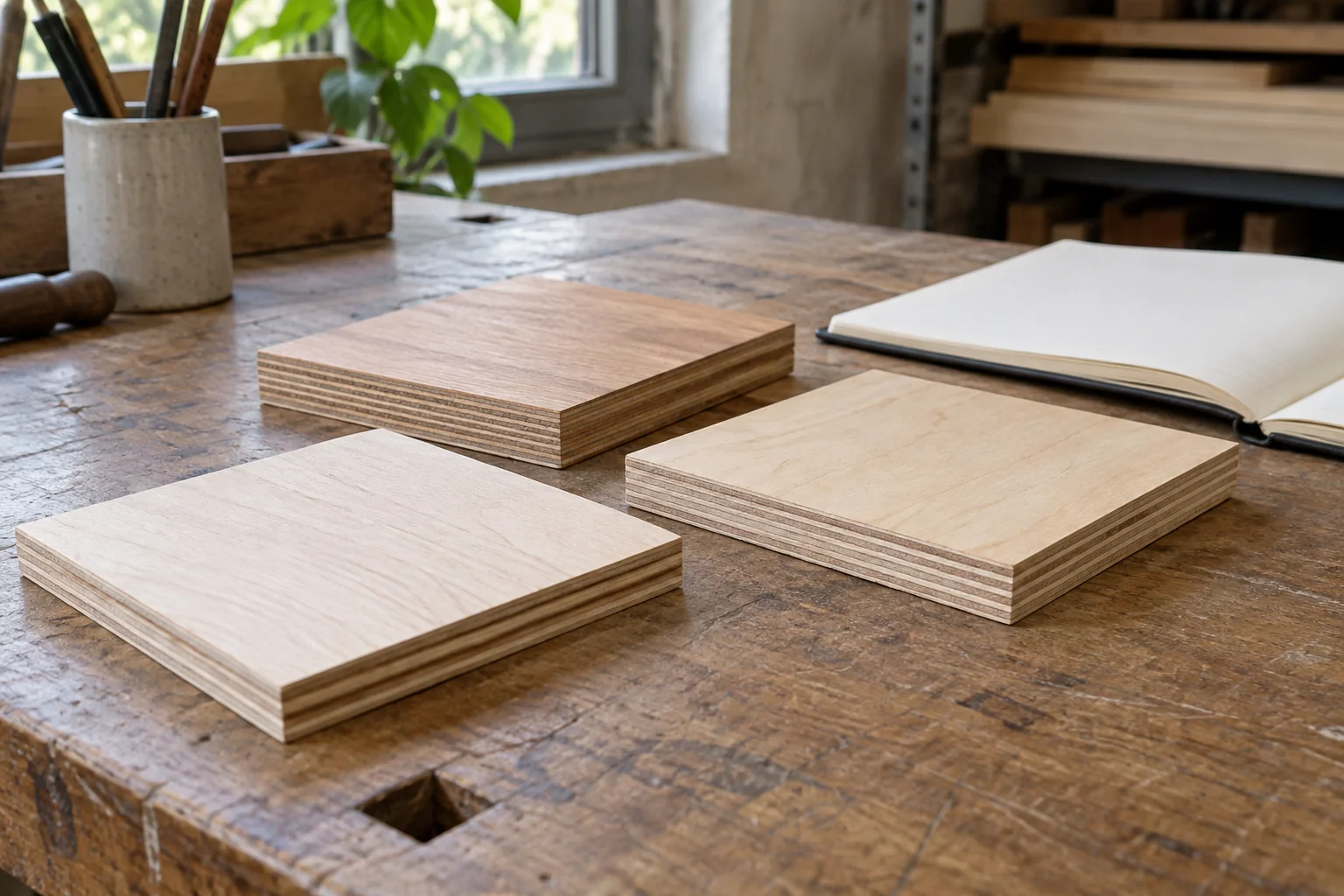
Compare plywood face grades by identifying the grading system, the appearance of both sides and which surfaces will remain visible in your cabinet. A premium-looking face does not by itself establish the panel’s core construction, load capacity, moisture suitability or finish compatibility. Keep those specifications in separate fields rather than treating one grade label as a complete material specification.
Start with the supplier’s actual grading system
Ask for the complete panel description, including manufacturer, face species, grade notation, core and thickness. Similar-looking letters on panels from different product families may not describe identical rules. Do not translate one supplier’s label into another system without a published explanation or a clear response from the supplier.
Columbia Forest Products explains a letter-and-number system for hardwood plywood face and back appearance. Its explanation also separates the decorative faces from the panel core. Use that distinction when asking questions; do not apply one brief manufacturer’s guide as a universal decoder for every plywood panel sold in a store.
Map what will actually be seen
Draw the cabinet in its normal location and mark each visible surface. An outside end panel may have one obvious show face, while an open cabinet side can expose both faces. A back that is hidden against a wall in one design may be visible through an open shelf in another.
Include exposed edges in a different color or column. The appearance grade of the broad face does not tell you how the layered edge will look or which edge treatment the design requires. Likewise, opening a door may reveal a back face that the closed-cabinet sketch overlooked.
| Comparison field | Candidate A | Candidate B |
|---|---|---|
| Exact panel identity | Maker and complete description | Maker and complete description |
| Grade system | Supplier’s definition or guide | Supplier’s definition or guide |
| Front appearance | Allowed and observed features | Allowed and observed features |
| Back appearance | Suitability for visible interior | Suitability for visible interior |
| Core and thickness | Separate documented specification | Separate documented specification |
| Finish and edges | Planned treatment and open questions | Planned treatment and open questions |
Distinguish a permitted feature from an unwanted look
A natural color variation or repaired area may be permitted by the grade yet not suit your chosen visible location. Record that as an appearance preference, not automatically as a defective panel. Conversely, a pleasing sample does not override the range of features allowed in the actual order.
Ask what the grade permits and whether you can inspect the sheets or obtain a representative sample before buying. If matching several adjacent panels matters, explain that separately. A grade can describe permitted appearance without guaranteeing that every sheet has the same color, figure or arrangement.
A visible-back example
Consider a fictional wall cabinet with an exposed right end and open shelves inside. The buyer first chooses a panel because its front sample looks suitable. The visibility map then shows that the reverse side will also form an interior surface seen through the open front.
The buyer asks for the back grade and its allowed features before accepting the order. A less costly back could still be appropriate, but “hidden side” is no longer an accurate description. The decision depends on the actual cabinet layout and the agreed appearance, not simply on buying the highest front grade available.
Now imagine the design changes to a freestanding cabinet with a visible rear. Update the visibility map and material requirement rather than assuming the original selection still answers the new brief. These examples describe purchasing decisions, not a structural cabinet design or a grading certification.
Keep construction questions on their own track
Confirm that the core, thickness and intended application meet the project designer’s material requirements. Do not infer shelf span, fastener holding or resistance to moisture from a clean decorative face. A cabinet may need different material choices for sides, doors and shelves even when you want a coordinated appearance.
Ask about actual thickness where hardware or joinery requires it. Nominal dimensions and the appearance label do not settle every fit question. Keep the design and hardware instructions available when discussing substitutions with the supplier; a nicer-looking face is not permission to change the rest of the construction.
Evaluate the intended finish on appropriate material
Use the panel and finish manufacturers’ directions for any sample preparation. If a test sample is appropriate, identify its source and intended face so it remains meaningful to the order. A small offcut can help you judge a finish’s appearance, but it cannot represent every natural variation in a whole sheet.
Do not sand aggressively to erase a permitted feature or assume a decorative veneer has the same refinishing allowance as solid wood. Ask about the surface construction and approved preparation. Save the approved sample and notes rather than relying on a photograph taken under different lighting.
Write an order description that survives a handover
The final record should name the panel, grading system, front and back requirements, core, thickness and any agreed selection or matching arrangement. Attach the visibility map and identify unresolved points before material is cut.
On receipt, compare labels and visible features with that record using the seller’s process for discrepancies. This makes the grade useful as part of a complete specification, while preserving the distinction between an attractive surface, a suitable construction and the exact appearance your cabinet requires.