Key takeaways
- Match a utility knife to its documented blade family and refill code, keeping width, format and pack quantity separate before buying a replacement.
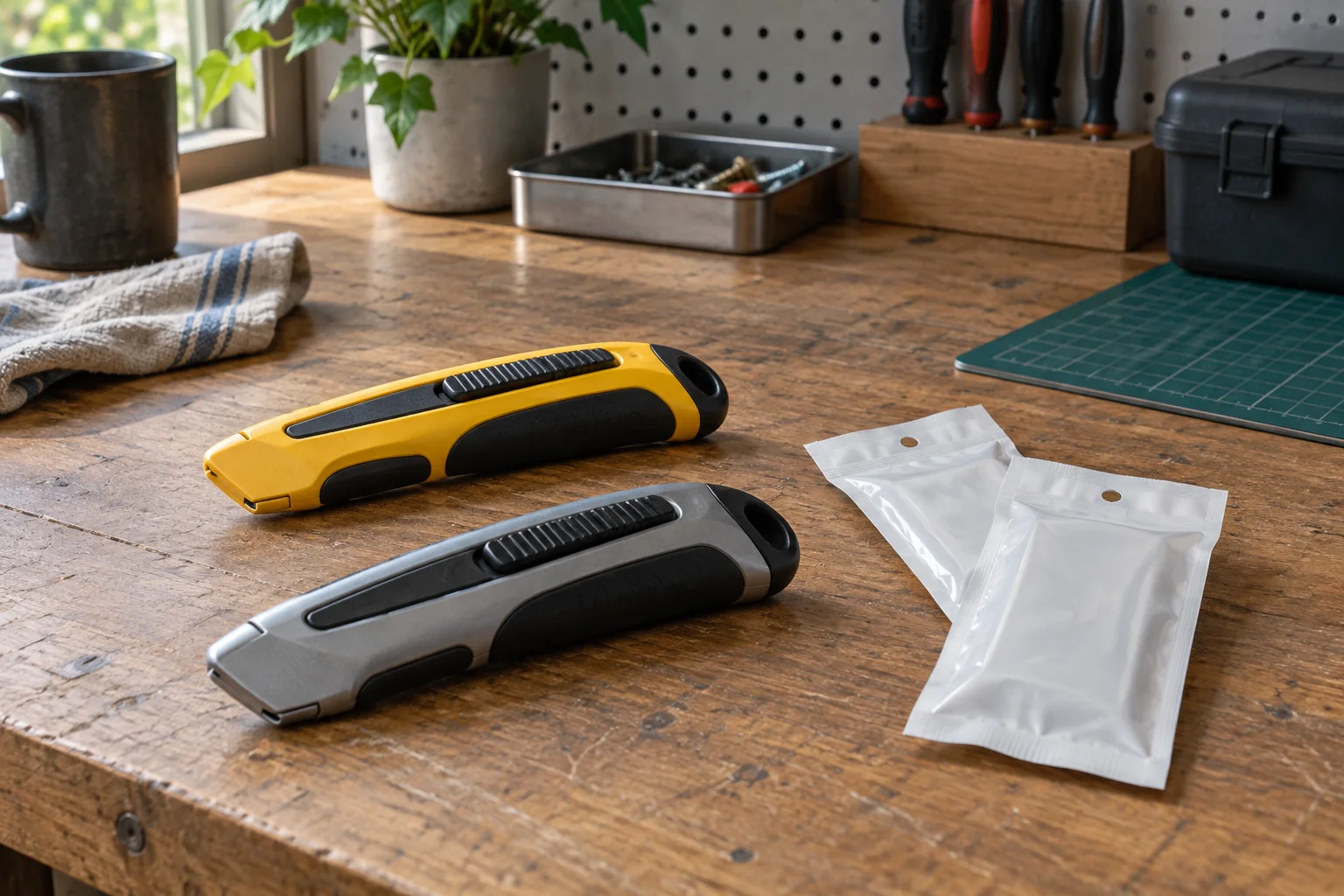
Identify a replacement utility-knife blade by matching the exact knife model to the manufacturer’s stated blade family and part code. The words “utility blade” describe several different formats. A similar outline in a shop photograph is a useful clue, but it is not confirmation that a blade belongs in your knife.
Keep the existing blade enclosed or retracted as the knife’s instructions require while gathering information. This is a purchasing and identification guide, not a blade-changing procedure. Do not remove a sharp blade just to compare it with a screen image or try several loose blades in the holder.
Start with the knife, not the refill packet
Record the brand and model from the accessible handle markings, packaging, receipt or manual. Include any suffix or version shown. A product-family name can cover multiple knives, and a retailer’s short title may omit the detail that distinguishes their refill requirements.
If the model is unreadable, photograph the closed tool and its accessible markings for the manufacturer. Explain that you need the correct replacement-blade reference. Keep uncertainty visible instead of choosing the most common blade and treating a tentative visual match as an identification.
Separate the major formats
OLFA’s blade guide separates snap-off blades, rotary blades and other purpose-made utility blades. Within its snap-off range it identifies several widths, including 9, 12.5, 18 and 25 millimeters. Those distinctions illustrate why a generic category name does not specify one interchangeable refill.
A segmented strip and an unsegmented blade are different formats even if both are sold beside utility knives. A hooked cutting edge is another feature to identify rather than a reason to assume a familiar holder accepts it. Use the knife’s approved-blade list to resolve the actual combination.
Do not use a blade’s advertised material, coating or claimed sharpness as a substitute for format confirmation. A premium version in the wrong family remains the wrong purchase. Check any stated restrictions for the exact knife before comparing optional grades within an approved family.
| Field | Knife evidence | Refill evidence |
|---|---|---|
| Identity | Brand, full model and version | Manufacturer and blade part code |
| Format | Specified replacement family | Named family on the sealed packet |
| Dimensions | Only dimensions the maker specifies | Corresponding stated values |
| Compatibility | Manual or maker’s approved list | Matching listing or maker confirmation |
| Uncertainty | Missing code or unclear version | Question to resolve before purchase |
Read the code and the pack quantity separately
A listing can display the blade family, individual blade code and package quantity in different places. Compare the selected option in the cart with the manufacturer’s reference. A thumbnail showing several packets may represent a multipack or simply several available options.
Keep the package description intact in your note. For segmented blades, distinguish the number of complete blades from the number of cutting segments described by the seller. Do not assume that a large number on the listing refers to complete refill strips.
If two sellers use different product codes, check whether one is a retailer’s stock number rather than the manufacturer’s blade number. Ask for the latter when needed. Matching a shop’s inventory code to another shop’s unrelated number creates a false difference as easily as a false match.
A fictional same-width comparison
Imagine a buyer who has identified a knife but sees two refill packets with the same stated width. One packet names the blade family listed in the knife’s manual. The other shows a similar strip but provides no compatibility information. The buyer records the first as documented and the second as unresolved.
The useful result is not that the second blade is definitely incompatible. It is that width alone has not established compatibility. The buyer sends the knife model and the second packet’s manufacturer code to support before considering it. No trial insertion or alteration is needed to answer the purchasing question.
These are invented products for explaining the decision. Do not transfer their situation to a real knife whose instructions name a different family or prohibit a particular blade style. The actual maker’s documentation controls the choice.
Keep the refill identifiable after buying
Retain the original protective packaging and readable blade information, following its storage instructions. A loose sharp refill in a mixed hardware drawer is harder to identify and handle appropriately. Do not combine lookalike refills under a handwritten “spare blades” label that loses their individual codes.
Keep the confirmed blade reference with the knife’s manual or inventory entry. Record the source of the compatibility confirmation, including the model and date. That turns the next purchase into a reference check rather than another visual guessing exercise.
Use a stop point when evidence is incomplete
If the blade packet, knife instructions and seller description disagree, pause the purchase and ask the manufacturer which information applies. Do not file, bend, break or otherwise modify a blade to make a suspected match fit. Replacement is not permission to alter the holder or bypass its retention mechanism.
Once the correct refill is confirmed, follow the knife’s own replacement and disposal instructions. Identification is complete when you can connect the actual knife to a documented blade reference, not when a sharp piece merely appears to fit inside the handle.