Key takeaways
- Check towing limits first. Use the tractor manufacturer’s limits for towing and tongue load, and account for slopes, braking, and ground conditions. A cart rated for 1,500 pounds does not mean your tractor can safely pull that load.
- Confirm the hitch connection. Many yard carts use a pin-style hitch, but hole sizes and drawbar arrangements vary. Measure the tractor’s attachment point and verify pin diameter, height, and clearance before buying.
- Size tires for the route. Small tires can work on smooth lawns and paths; larger tires are more forgiving in ruts and over roots. For soft ground, tire width and pressure matter too. Avoid assuming that larger diameter alone prevents sinking.
- Leave room to turn. A long cart can cut inside the tractor’s path on tight turns. A wide cart may catch on gates or trees. Measure the narrowest passage and allow extra width for steering corrections.
- Think about storage and assembly. A heavy steel cart may be difficult to move into a shed before it is assembled. Check package dimensions and assembly instructions, and plan to assemble it on level ground with enough space to tip the bed safely.
Best Dump Carts for Tractors and Heavy Yard Work
The best dump carts for tractors are steel, 1,000–1,500-pound carts with a bed sized for your tractor, tires suited to your terrain, and a hitch that matches your tractor’s connection. For loose soil or mulch, prioritize bed volume and a steep dump angle; for gravel or firewood, prioritize payload rating, a reinforced frame, and tires that can handle the added weight.
Choose by the work, not just the advertised capacity
A cart’s capacity can mean bed volume, maximum payload, or both. These are different limits: a 12-cubic-foot bed may hold plenty of mulch but still exceed its weight rating when filled with wet soil. Gravel reaches the payload limit particularly quickly. Check the manual for both the maximum load and any restrictions on towing speed, slopes, or use with a particular tractor.
Our top picks
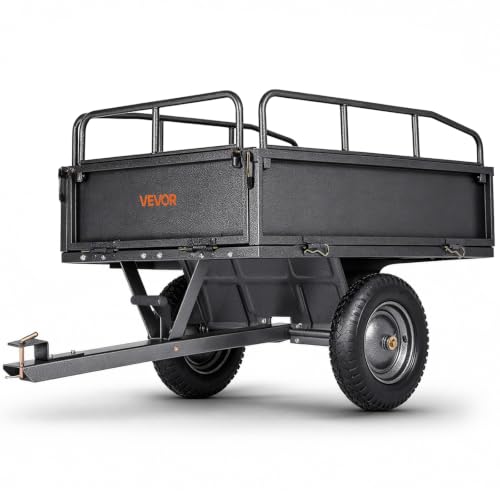
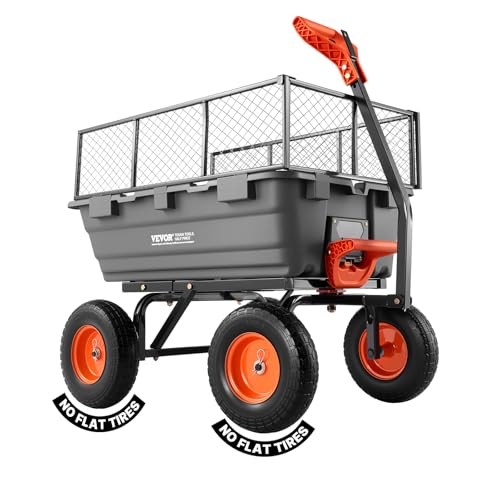


As an Amazon Associate we earn from qualifying purchases at no extra cost to you. Ratings are shown as listed on Amazon.
| Typical job | Useful bed capacity | Payload target | Prioritize |
|---|---|---|---|
| Mulch and leaves | 10–15 cu. ft. | 500–1,000 lb | Large bed, low loading height, easy-release dump |
| Garden soil and compost | 8–12 cu. ft. | 1,000 lb or more | Strong floor, adequate payload, steep dump angle |
| Gravel and stone | 6–10 cu. ft. | At least 1,000 lb, subject to tractor limits | Reinforced bed and frame, conservative loading |
| Firewood and bulky debris | 12–16 cu. ft. | 750–1,200 lb | Removable or folding sides, durable tires |
These are selection ranges, not safe fill amounts. Material weight varies with moisture, density, and how tightly it packs. A full bed of gravel can weigh far more than a full bed of dry mulch.
Best cart type for each situation
For frequent gravel or heavy soil: welded steel, high payload
Choose a steel cart with a stated payload around 1,000 pounds or higher, a reinforced underframe, and a bed that tips without twisting. A smaller bed can be the safer and more efficient choice: you can move heavy material in controlled loads instead of risking an overloaded tractor or cart. Look for a release that can be operated from the tractor seat, but confirm the bed locks securely in transport.
Steel is generally the practical choice for abrasion and concentrated loads. Its trade-offs are weight, possible rust at chipped paint or welds, and greater effort when moving the cart by hand. A powder-coated finish helps protect the surface, but it is not rust-proof; rinse off fertilizer and damp soil, and touch up exposed steel.
For mulch, leaves, and general property work: larger-volume cart
A 10–15-cubic-foot cart suits many routine jobs where volume matters more than carrying dense material. Molded-poly beds resist rust and are easy to rinse, making them convenient for mulch, leaves, and compost. However, a plastic bed can flex or crack under impact, especially in cold weather or when heavy material lands on one spot. Check the maker’s load rating and whether the floor is supported beneath it.
For firewood and awkward loads: removable-side utility cart
Folding or removable sides make it easier to load logs and unload branches, but they add latches and joints that need inspection. Check the inside bed dimensions—not only cubic footage—to make sure your common log lengths fit. A cart with a wider footprint can be more stable with a tall, uneven load, though it may be harder to maneuver through gates.
Specification checks that affect real-world performance
| Feature | What to look for | Why it matters |
|---|---|---|
| Payload rating | Published maximum in pounds; compare with the tractor manual | The cart, hitch, tractor, and terrain all limit safe towing |
| Dump angle | About 45° or more for loose material, if the maker specifies it | A shallow tip may leave wet soil or mulch stuck in the bed |
| Tire diameter | Roughly 13–16 inches for uneven yard terrain | Larger wheels generally roll more easily over ruts and roots |
| Tire construction | Pneumatic for cushioning; flat-free for puncture resistance | Air-filled tires can go flat; solid tires can ride harshly under load |
| Hitch | Pin-style or clevis connection compatible with the tractor | A mismatched hitch may require an approved adapter or prevent secure attachment |
| Bed clearance | Compare bed width and overall cart width with gates and storage space | Wide carts can be awkward in narrow paths and sheds |
Dump angle alone does not guarantee a clean unload. Bed texture, load moisture, tailgate design, and how the cart is parked all matter. If you routinely haul sticky clay or wet compost, favor a bed that tips high and has a smooth, easily cleaned surface.
Match the cart to the tractor and terrain
- Check towing limits first. Use the tractor manufacturer’s limits for towing and tongue load, and account for slopes, braking, and ground conditions. A cart rated for 1,500 pounds does not mean your tractor can safely pull that load.
- Confirm the hitch connection. Many yard carts use a pin-style hitch, but hole sizes and drawbar arrangements vary. Measure the tractor’s attachment point and verify pin diameter, height, and clearance before buying.
- Size tires for the route. Small tires can work on smooth lawns and paths; larger tires are more forgiving in ruts and over roots. For soft ground, tire width and pressure matter too. Avoid assuming that larger diameter alone prevents sinking.
- Leave room to turn. A long cart can cut inside the tractor’s path on tight turns. A wide cart may catch on gates or trees. Measure the narrowest passage and allow extra width for steering corrections.
- Think about storage and assembly. A heavy steel cart may be difficult to move into a shed before it is assembled. Check package dimensions and assembly instructions, and plan to assemble it on level ground with enough space to tip the bed safely.
Steel versus molded plastic: the practical trade-off
| Construction | Best suited to | Advantages | Watch-outs |
|---|---|---|---|
| Painted or powder-coated steel | Gravel, soil, firewood, frequent heavy use | Rigid support and good resistance to dents from heavy loads | Chips and scratches can rust; heavier to maneuver |
| Molded plastic or poly | Mulch, leaves, compost, damp yard debris | Won’t rust and is easy to wash | Can flex or crack from impact, cold, or point loading |
For either material, inspect the axle supports, bed-to-frame connections, wheel bearings, and dump latch. These components take repeated stress. Keep loads centered, avoid dropping rocks into an empty bed, and clean corrosive material from the cart after use.
Quick picks by yard situation
- Mostly mulch and leaves: choose a roomy poly cart with a verified payload rating and a simple, secure dump latch.
- Gravel, stone, or wet soil: choose a smaller steel cart with a high payload rating and a reinforced frame; make multiple trips rather than filling by volume.
- Mixed terrain: look for larger pneumatic tires if punctures are manageable, or flat-free tires if maintenance-free operation matters more than ride comfort.
- Firewood and bulky debris: choose a cart with removable sides and dimensions that suit your load, while checking that the frame rating covers the weight—not just the volume.
As a broad market guide, basic yard carts are often around $100–$300, while heavier-duty models commonly fall around $300–$700 or more, depending on capacity, construction, tires, and dump mechanism. Compare the included hitch and replacement-part availability as well as the price. The right cart is the one whose payload, connection, and dimensions fit both your tractor and your heaviest regular job—not simply the one with the biggest bed.