Key takeaways
- For soft annual growth, a 0.5–0.75-inch capacity is usually sufficient.
- For mature privet, laurel, or similar dense hedges, look closer to 0.75–1 inch and prioritize motor torque.
- For branches larger than the stated capacity, use bypass loppers or a pruning saw before shaping the hedge.
- Do not force a stalled blade; repeated jams increase strain on the motor, gearbox, and battery.
The best pole hedge trimmers are the STIHL HLA 56 for balanced cordless value, the EGO Power+ 56V Power+ pole hedge trimmer for demanding thick growth, and a corded model for the lowest-cost option when an outdoor outlet is nearby.
A pole hedge trimmer is most useful when a normal hedge trimmer cannot reach the top or rear face of a hedge without a ladder. The right choice depends less on maximum advertised reach than on how comfortably you can control the tool at full extension. Shaft length, head angle, cutting capacity, total weight, battery runtime, and whether you already own compatible batteries all matter.
Our top picks
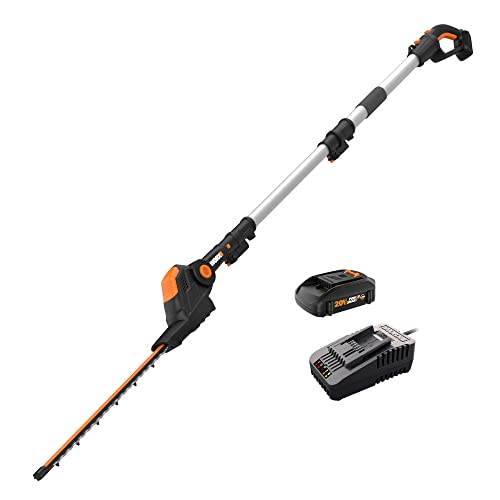


As an Amazon Associate we earn from qualifying purchases at no extra cost to you. Ratings are shown as listed on Amazon.
Best pole hedge trimmers by situation
| Situation | Best choice | Why it fits | Watch out for |
|---|---|---|---|
| Most homeowners | STIHL HLA 56 | Moderate weight, adjustable head, telescoping shaft, and a practical cordless system | Battery and charger may cost extra; it is not intended for very large woody branches |
| Thick, tall or neglected hedges | EGO Power+ 56V pole hedge trimmer | Strong cutting performance and a larger battery ecosystem for longer jobs | Higher purchase price and more weight when fitted with a large battery |
| Occasional trimming near an outlet | Corded electric pole hedge trimmer | Low upfront cost, consistent power, and no charging delay | Extension-cord management limits movement and reach |
| Existing DeWalt 20V MAX owner | DeWalt 20V MAX articulating pole hedge trimmer | Uses batteries you may already own and stores relatively easily | Compact batteries can run out quickly in dense hedges |
| Existing Ryobi 40V owner | Ryobi 40V Expand-It or comparable 40V pole trimmer | Good value when the battery system is already in your shed | Check the exact model’s shaft, head adjustment, and attachment compatibility |
Head-to-head comparison of the important specifications
| Category | Practical target | Why the number matters |
|---|---|---|
| Working reach | 8–10 feet for most residential hedges; up to about 12 feet for taller boundaries | Reach is measured from your hands and body position, not just the shaft. Longer is not always easier to control. |
| Adjustable shaft | Approximately 7–9 feet extended | A telescoping shaft lets you trim different heights without holding an unnecessarily long tool. |
| Head adjustment | At least 90 degrees of usable adjustment, with several lockable positions | Angling the blade makes the top and vertical sides easier to cut without twisting your wrists. |
| Blade length | 18–24 inches | Longer blades cover more hedge per pass; shorter blades are easier to control around corners and narrow gaps. |
| Cutting capacity | About 0.7–1 inch for regular hedge maintenance | Capacity refers to the maximum branch diameter the manufacturer expects the blade to handle, not a guarantee of effortless cutting. |
| Tool weight | Under 10 pounds ready to cut is comfortable for many users; 10–13 pounds requires frequent breaks | Weight becomes much more demanding when the tool is held above shoulder height. |
| Battery runtime | Approximately 30–60 minutes of intermittent trimming | Runtime varies with branch thickness, blade length, battery size, and whether the motor is constantly loaded. |
What makes the leading choices different?
STIHL HLA 56: the balanced homeowner pick
The STIHL HLA 56 is a sensible choice for a typical suburban hedge that is too tall for a handheld trimmer but does not require professional-duty cutting every week. Its cordless design avoids dragging a cable through shrubs, and its adjustable cutting head is useful for both the hedge top and the vertical face. The telescoping shaft helps a shorter user reach a hedge without standing on a ladder.
It is best suited to green stems and routine maintenance rather than old, hard branches. Expect a complete tool-and-battery purchase to fall into a mid-range market price, commonly around $300–$600 depending on the battery, charger, and retailer package. STIHL’s battery system is a stronger value if you already own compatible tools.
EGO Power+: the power-and-runtime option
EGO’s 56V pole hedge trimmers appeal to owners with long property lines, dense growth, or several cordless outdoor tools. Their higher-voltage platform can deliver strong cutting performance, while larger battery choices reduce interruptions on extended jobs. The trade-off is that a high-capacity battery adds noticeable weight behind your hands, exactly where it creates leverage against your shoulders.
Choose this type when performance and battery sharing matter more than the lightest possible tool. A complete kit is commonly in the roughly $400–$700 range. For a small hedge, the additional capacity may be unnecessary.
DeWalt 20V MAX: useful for existing battery owners
A DeWalt 20V MAX articulating pole hedge trimmer makes particular sense when your garage already contains 20V MAX batteries and chargers. The system is convenient for small and medium jobs, and compact batteries can keep the tool manageable. However, a small battery may provide less runtime in thick growth than a larger 40V or 56V platform.
Do not select it solely because the bare tool looks inexpensive. Add the cost of a battery and charger if you are entering the system from scratch. For one or two modest hedges, the total remains reasonable; for a large boundary, carrying spare batteries is more practical.
Corded electric models: best value when the layout cooperates
Corded pole hedge trimmers usually offer the lowest purchase price, often about $100–$250, and they maintain steady power for as long as you can safely work. They are a strong choice for a small yard with an outdoor receptacle close to the hedge.
The limitation is not merely inconvenience. An extension cord must remain behind the cutting area, away from wet ground and foot traffic, and it can snag on shrubs or furniture stored outdoors. A corded model may be cheaper than cordless ownership, but it is poor value if the hedge is separated from the outlet by a long path, gate, or driveway.
Reach, balance, and head adjustment matter more than maximum height
Manufacturers may advertise a reach of 10 feet or more, but safe control depends on your own height, arm position, and the tool’s balance. For a 6-foot user, a trimmer with an 8-foot extended shaft may already reach the top of a 9–10-foot hedge when the blade is angled correctly. Holding a longer shaft overhead can turn a manageable tool into a shoulder workout.
Look for a shaft that can be shortened for side trimming. A fixed extra-long pole is awkward near fences, windows, and low branches. A pivoting head is equally important: one setting should let the blade face upward for the hedge top, while another should place it nearly vertical for the side. Lockable positions are preferable to a head that slowly shifts under vibration.
Cutting capacity: maintenance trimmer or rough-growth tool?
Most pole hedge trimmers are designed for maintenance, not for replacing a chainsaw or pruning saw. A stated capacity of 0.75 inch does not mean every 0.75-inch branch will cut cleanly, especially when the wood is dry, bent, or hidden deep inside the hedge.
- For soft annual growth, a 0.5–0.75-inch capacity is usually sufficient.
- For mature privet, laurel, or similar dense hedges, look closer to 0.75–1 inch and prioritize motor torque.
- For branches larger than the stated capacity, use bypass loppers or a pruning saw before shaping the hedge.
- Do not force a stalled blade; repeated jams increase strain on the motor, gearbox, and battery.
Battery versus corded value
Cordless is worth paying more for when you trim several separate sections, work far from the house, or already own the matching battery platform. It also eliminates the risk of cutting an extension cord. A 2.0–2.5Ah battery often keeps the tool lighter, while a 4.0–5.0Ah battery generally offers longer runtime at the cost of additional weight.
Corded remains the economical answer for a compact property. A 50–100-foot outdoor-rated extension cord may cost less than a replacement battery, and there is no battery aging to manage. Keep the cord behind you, use a ground-fault-protected outlet, and stop work in wet or stormy conditions.
How to trim a tall hedge without a ladder
- Inspect the hedge for wire, fencing, stones, and branches thicker than the tool’s capacity.
- Set the shaft to the shortest length that reaches the work area and lock every adjustment.
- Fit eye protection, hearing protection, sturdy footwear, and gloves; keep children and pets away.
- Start with the top, using controlled sweeps rather than pushing the blade deep into the hedge.
- Trim the sides with the blade angled slightly inward toward the base so the hedge is wider at the bottom than the top.
- Release the trigger before moving between sections, clearing debris, or changing the head angle.
- Use loppers or a saw for oversized woody stems instead of leaning, stretching, or climbing.
Final buying recommendation
Choose the STIHL HLA 56 for a balanced all-round cordless tool, an EGO Power+ model for longer or tougher work, and a corded electric pole trimmer when low cost and uninterrupted runtime matter more than mobility. Whichever type you choose, prioritize a manageable ready-to-use weight, a telescoping shaft, a firmly locking adjustable head, and a cutting capacity suited to your hedge—not the highest reach figure printed on the box.