Key takeaways
- Digital thermostat offers 41 to 95 degree F adjustment.
- Seventy-degree oscillation distributes air beyond one fixed direction.
- Published US manual describes tip-over and overheat responses.
A ceramic space heater is most useful when you need supplemental heat near a desk, chair, or frequently used room, not when you expect one plug-in appliance to replace your home’s heating system. The six models here all offer a manufacturer-rated 1,500-watt maximum, but their controls, airflow, footprints, and shutdown protections differ substantially. For safe placement, the U.S. Consumer Product Safety Commission’s 2026 winter guidance says to keep portable heaters at least 3 feet from combustibles and plug them directly into a wall outlet.
Quick Verdict: For most buyers, the Dreo Atom One DR-HSH004 is the Best Overall pick because its digital 41 to 95 degree F thermostat, 70-degree oscillation, and 1 to 12-hour timer give more control than basic dial heaters. Our rankings use published US product pages and manuals as of October 2026, not in-house testing. Check the current selling price and exact model before buying.
As an Amazon Associate we earn from qualifying purchases.
By DIY Ideas 4 Home Editorial Team
6 Ceramic Space Heaters Reviewed
We compared six identifiable US-market models using the makers’ product pages, operating instructions, and physical specifications, supplemented by US retailer listings where necessary. Each supplies up to 1,500 watts, so the meaningful differences are how heat is directed, how easily it is controlled, how much space the unit occupies, and which safety features its documentation describes. In October 2026, prices for these six listings ran from $32.98 to $79.99; sale prices and availability can change without notice. We prioritized products with documented tip-over and overheat protection instead of assuming every ceramic heater includes both.
| Product | Best For | Key Spec | Listed Price (as of October 2026) | Watch Out For |
|---|---|---|---|---|
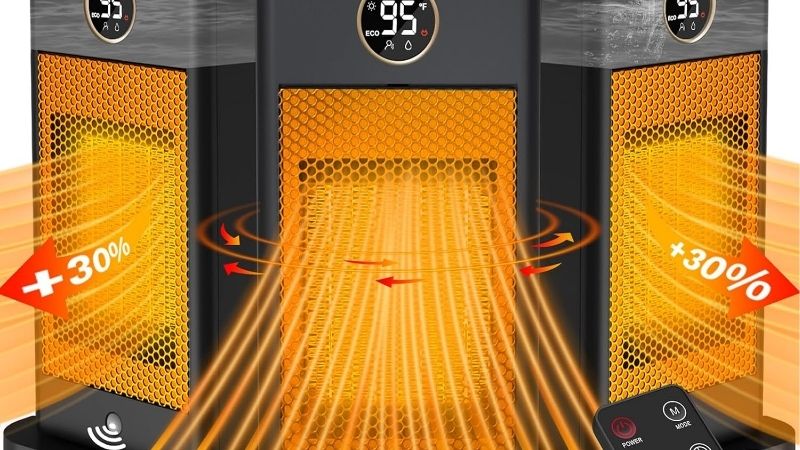
| Dreo Atom One DR-HSH004 | Best Overall | 1,500 W; 41 to 95 F digital setting; 70-degree oscillation | $49.99 (Dreo) | Display and remote add setup steps |
| Lasko 754201 | Best for Simple Controls | 1,500 W high; 900 W low; tip-over switch | $49.99 (Lasko) | No oscillation or timer |
| DeLonghi HFX30C15.W | Best for Easy Carrying | 1,500 W high; 750 W low; 2.87 lb | $54.95 (DeLonghi) | Mechanical dial, not a temperature display |
| Pelonis CH1001 | Best Budget | 1,500/900/700 W; 9.1 in tall | $32.98 (Home Depot) | No timer or remote |
| Vornado VC-01 EH1-0220-06 | Best for Directed Airflow | 1,500 W; 15-degree tilt; 2 modes | $79.99 (Vornado) | Tilts manually; does not oscillate |
| Honeywell HCE210B | Best for Compact Desks | 1,500 W high; 900 W low; 2.8 lb | $49.95 (Honeywell Store) | No fan-only function |
Dreo Atom One DR-HSH004: Best Overall
Best For: People who want remote temperature adjustments and a compact heater that spreads warmth across a seating area.
The Atom One earns the lead because it combines a precise thermostat with oscillation without requiring a tall tower housing. Compared with the Lasko 754201’s rotary dial, its temperature display makes it easier to repeat a setting after the room warms up. You pay for electronics that a basic heater does not need, however, and the remote is another item to keep track of.
Dreo’s product page for the Atom One specifies a 1,500-watt maximum on US 120-volt power, a digital thermostat adjustable from 41 to 95 degrees F, and 70-degree oscillation. Its 1 to 12-hour off timer and manufacturer-stated 37.5 dB sound level are useful features, but the noise figure is not directly comparable with other brands lacking matching measurement conditions. Dreo listed the Atom One for $49.99 in October 2026; the DR-HSH004 US user manual documents tip-over and overheat responses.
The unit measures 6.7 by 5.5 by 10.3 inches and weighs 3.8 pounds, according to Dreo’s specifications; its 6-foot cord allows a short reach to a properly placed outlet. The removable dust filter needs periodic cleaning, which adds one small maintenance task not present on a filterless compact design. The manufacturer’s published features do not make the front grille safe to touch while heating, so handle it only after shutoff and cooling.
Pros:
- Digital thermostat offers 41 to 95 degree F adjustment.
- Seventy-degree oscillation distributes air beyond one fixed direction.
- Published US manual describes tip-over and overheat responses.
Cons:
- Remote and display offer more controls than dial-only buyers need.
- Intake filter needs attention during dusty heating seasons.
Who Should Buy It: Choose the Atom One for repeated thermostat adjustments from a chair; choose the Lasko 754201 if you prefer knobs without a remote.
Lasko 754201: Best for Simple Controls
Best For: Home-office users who value two heat choices, a straightforward dial, and documented tip-over protection.
For a room where the occupant stays in one place, complicated scheduling can be less useful than a control you can operate without reading a display. The 754201 is a deliberate contrast to the Dreo: it offers the same rated maximum heat with manual selections and a smaller number of things to configure. Its lack of oscillation means you should point the grille toward the occupied area rather than expect moving airflow.
Lasko’s product page for the 754201 states high heat of 1,500 watts, low heat of 900 watts, and a fan-only selection. The company’s listing specifies an adjustable thermostat, tip-over switch, overheat protection, and cool-touch housing, with ETL listing reported by Lasko. Its $49.99 posted October 2026 price puts it near the Atom One, so the reason to buy it is simpler operation, not an assumed heating-efficiency advantage.
Lasko lists a 9.2-inch height, 7-inch width, 6-inch depth, and 2.93-pound product weight, along with a 6-foot cord and 3-year warranty. Those proportions make it practical beside a workstation when the clearances in its manual can be maintained. The manufacturer rates coverage at 100 square feet, but that estimate depends on drafts and insulation rather than guaranteeing a fixed room temperature. There is no scheduled off timer to replace remembering to switch it off.
Pros:
- 900-watt low mode offers a reduced heat-output option.
- Three-year warranty is stated on Lasko’s product page.
- Tip-over protection accompanies the 1,500-watt high setting.
Cons:
- Fixed airflow cannot sweep a broader seating arrangement.
- Thermostat dial does not show an exact temperature target.
Who Should Buy It: Buy the 754201 for no-fuss supplemental heat near a workstation; use the Dreo Atom One when oscillation and timed shutoff matter more.
DeLonghi HFX30C15.W: Best for Easy Carrying
Best For: Buyers who move one lightweight heater between different occupied rooms during the day.
The Capsule makes sense when carrying convenience is a bigger priority than digital automation. Its designed-in handle and unusually low maker-listed weight distinguish it from the larger-feeling Vornado VC-01. It also provides a genuine 750-watt low setting, making it useful for milder days when full power would be excessive. Its thermostat is mechanical, so selecting a precise displayed temperature is not possible.
DeLonghi’s product page for the HFX30C15.W lists 1,500 watts on high and 750 watts on low from a 120-volt supply, plus a fan-only setting. The brand describes thermal shutoff, an internal tip-over switch, and a thermal fuse as part of its overheat protection arrangement. A standby anti-freeze function is described as activating below roughly 41 degrees F, but that is not permission to leave a portable heater unattended. The company’s US listing showed $54.95 in October 2026.
DeLonghi publishes dimensions of 4 by 7.5 by 11 inches and a 2.87-pound weight, with a 2-year included warranty on its product listing. The upper carrying handle is particularly handy when the unit is cool and unplugged. Because the housing is tall relative to one of its dimensions, use the prescribed firm, level surface and avoid traffic paths where the cord could be snagged. The lower setting can reduce electrical draw, though it also delivers less heat.
Pros:
- 2.87-pound body is manageable to reposition after cooling.
- 750-watt low setting suits less demanding heating periods.
- Manufacturer documents a separate internal tip-over switch.
Cons:
- No digital degree-by-degree thermostat readout is provided.
- Anti-freeze function is not a substitute for monitored home heating.
Who Should Buy It: Select the HFX30C15.W if you regularly relocate a heater; choose the Honeywell HCE210B when a fixed desk footprint is more important.
Pelonis CH1001: Best Budget
Best For: Cost-conscious shoppers who need basic ceramic heat and can manage a rotary thermostat themselves.
Pelonis keeps the entry price low without dropping the central safety features shoppers should look for. Against the similarly sized Honeywell, the CH1001 offers an additional 700-watt heating choice and a fan-only setting; it asks the buyer to give up timer and remote convenience. This is a sensible trade when you only heat an occupied spot intermittently, and can shut the heater off as soon as you leave.
Pelonis’s CH1001 product page records three heating levels of 700, 900, and 1,500 watts, an adjustable rotary thermostat, a tip-over switch, and overheat shutoff. It also lists ETL status, although buyers should confirm the marking on the exact unit rather than infer certification across a brand. The Home Depot listing for model CH1001 showed $32.98 in October 2026, materially below the $49.99 Dreo Atom One and making Best Budget a price-supported label.
The manufacturer’s dimension sheet puts this model at 9.1 inches tall, 4.8 inches wide, and 6.5 inches deep, with a 72.05-inch cord. Pelonis quotes an estimated heated area of 161 square feet, which should not be read as an independently measured capacity. A simple housing may be easier to wipe down, but open air passages still accumulate dust; the CH1001 user manual should govern cleaning intervals and permissible surfaces.
Pros:
- $32.98 retailer price undercuts other picks in this set.
- Three heat selections include a distinct 700-watt step.
- Pelonis states tip-over and overheat shutdown are included.
Cons:
- Rotary adjustment provides no readout of room temperature.
- There is no built-in timer to end an afternoon session.
Who Should Buy It: Choose the CH1001 to minimize purchase cost while retaining basic protections; pick the Vornado VC-01 if directed-air modes are worth a higher price.
Vornado VC-01 EH1-0220-06: Best for Directed Airflow
Best For: Readers who want to aim airflow toward themselves or shift to broader circulation without moving the entire appliance.
Vornado approaches personal warmth differently from the rotating-front Dreo. A manually tilting outlet and separate personal and whole-room airflow modes make the VC-01 useful when a favorite chair and the rest of a room call for different air patterns. It does not rotate automatically, and its higher acquisition price needs to be justified by the direction control and warranty rather than a claim that 1,500 watts produces more heat.
Vornado’s product page for the VC-01 advertises personal and whole-room modes with low and high selections, a 15-degree manual tilt, and a 2-, 4-, or 8-hour timer. The company identifies tip-over protection, two-stage automatic shutoff, and a cool-touch case, and supports the product with a 5-year satisfaction guarantee. The US listing for the black VC-01, retailer model EH1-0220-06, showed $79.99 in October 2026. Lowe’s product specification identifies the maximum 1,500-watt output.
Target’s VC-01 product specifications list a 5.87-inch height, 9.69-inch width, 7-inch depth, and about 4 pounds of weight for the corresponding US version. The 72-inch cord listed by Lowe’s is useful only if the wall outlet is positioned away from furniture and foot traffic. Its reusable pre-filter will need cleaning, a consideration for homes where lint collects quickly. The grille still requires caution despite the manufacturer’s cool-touch case description.
Pros:
- Fifteen-degree tilt can redirect heat toward a seated user.
- Separate personal and whole-room modes change airflow behavior.
- Five-year manufacturer guarantee covers the stated eligible purchaser.
Cons:
- $79.99 is a considerable premium over the Pelonis CH1001.
- Manual tilt cannot sweep from side to side automatically.
Who Should Buy It: Purchase the VC-01 when aiming warmed air is your priority; choose the Dreo Atom One if automatic oscillation is more useful.
Honeywell HCE210B: Best for Compact Desks
Best For: Shoppers with limited tabletop depth who want a small traditional heater without an app or remote.
Honeywell’s rounded UberHeat 5 is intended to sit close to a working area without occupying the height of a tower. Compared with the DeLonghi Capsule, it sacrifices the fan-only mode and carrying emphasis in exchange for a compact tabletop design. It offers enough controls for a work session but little beyond a high-low heat switch and a thermostat dial, which can be a benefit for households wanting fewer settings.
Honeywell’s product page for the HCE210B, alongside its US store listing, specifies a 1,500-watt high mode, a 900-watt low mode, an adjustable manual thermostat, tip-over protection, and two layers of overheat protection. Honeywell Plugged In’s UberHeat 5 product page confirms the corresponding HCE210 series and clarifies that this is a fan-driven ceramic heater. Its posted price was $49.95 in October 2026, but it does not have a separate cool-air fan mode. Honeywell’s description also identifies a 3-year limited warranty.
The black HCE210B measures 8.5 by 4.5 by 8.86 inches and weighs 2.8 pounds according to Honeywell Store product details. Even with a small unit, a narrow desk crowded by paper or cords is not an acceptable heater location: the owner’s manual should determine permitted orientation and clearance. The manual controls also mean it cannot shut itself off after a specified number of hours as a timer-equipped model can.
Pros:
- 2.8-pound weight eases movement after safe cooling and unplugging.
- 900-watt low option provides less heat than maximum power.
- Dual overheat safeguards are described in the Honeywell documentation.
Cons:
- No fan-only option for warmer seasons is included.
- Basic manual controls lack a scheduled shutdown feature.
Who Should Buy It: Pick the HCE210B for a small, clear tabletop zone; choose the Pelonis CH1001 for a lower listed price and more output steps.
How to Choose a Ceramic Space Heater
The heaters in this comparison share the same 1,500-watt maximum, which is approximately the output available from a typical US plug-in resistance heater. They do not create different amounts of heat simply because one is called premium or uses a digital panel. Choose instead by available circuit capacity, protective functions, where the warm air needs to go, and whether the price buys a control you will actually use. The US Department of Energy’s guidance on electric resistance heating supports treating electricity consumed as heat produced, rather than relying on broad efficiency claims.
Match Wattage to the Room and Electrical Circuit
All six models reach 1,500 watts at maximum, which draws about 12.5 amps at 120 volts. That can represent a substantial load on a common 15-amp household circuit, particularly when computers, printers, or other appliances share it. Do not assume that multiple empty-looking receptacles mean separate circuits. If a breaker trips, disconnect the heater and address the electrical load rather than defeating the protective device.
A lower setting reduces both immediate power consumption and available heat. The Pelonis CH1001 offers a 700-watt step, while DeLonghi lists 750 watts for the Capsule and Honeywell offers 900 watts for the HCE210B. These are helpful distinctions on days when you need less heat, not proof that one technology transforms electricity more efficiently. Room size claims also depend on ceiling height, air leakage, and insulation, so start with the space actually occupied.
Demand the Right Tip-Over and Overheat Protections
Every pick here has maker documentation describing both tip-over and overheat protection, though these features do not eliminate fire or burn risks. For example, Lasko’s 754201 listing states a tip-over switch as well as overheat protection; DeLonghi describes an internal tip-over switch and thermal fuse in the HFX30C15.W. The exact product label and current safety notice matter more than a general claim about a brand. Check the model number against CPSC recall announcements at the time of purchase.
The CPSC’s February 2026 heater guidance recommends at least 3 feet of separation from drapes, bedding, furniture, and other combustible materials. Plug the unit directly into a wall outlet, never a power strip or extension cord, and turn it off before sleeping or leaving the room. If the plug becomes unusually hot, the cord is damaged, or the heater smells abnormal, stop using it and follow the maker’s safety directions. Do not use an ordinary indoor heater in a bathroom or another wet location unless its manual explicitly permits that setting.
Compare Air Direction and Thermostat Controls
The right air pattern depends on whether heat is aimed at one person or spread across adjacent seats. Dreo’s Atom One sweeps through 70 degrees, while Vornado’s VC-01 changes its direction with a 15-degree manual tilt and two airflow modes. Neither arrangement guarantees uniform heat in an open-plan area. A compact nonoscillating heater such as the Lasko 754201 is easier to justify when your chair stays in front of it and the manufacturer’s placement instructions can be met.
Digital settings are useful when you want a repeatable temperature target: Dreo prints a 41 to 95 degree F adjustment range on its product page. The other mechanical-dial models let you choose a comfort level but do not provide the same numeric selection. Their thermostats sense conditions near the heater, which may differ from the temperature across the room. If the unit cycles before your occupied spot is warm, first check whether furniture blocks the inlet or warm outlet instead of immediately increasing the setting.
Check Footprint, Upkeep, and Real Purchase Price
Measure where the appliance can stand with the necessary clearances, not simply the tabletop’s outside dimensions. The Vornado VC-01 is 9.69 inches wide in the corresponding US retail specification, whereas the Pelonis CH1001 is 4.8 inches wide. Neither figure includes the empty space needed around a hot appliance. A 6-foot cord should reach a wall outlet without running beneath a rug, through a doorway, or across a walking route.
The $32.98 Pelonis listing is the low purchase-cost option here, while the $79.99 Vornado spends more of your budget on airflow modes and a five-year guarantee. Ask whether washable filters, electronic timers, or remote controls will make you use the heater more sensibly. Clean air inlets as the specific manual directs and keep proof of purchase for warranty claims. Before clicking Check Price, compare the model ID, seller, included accessories, and return terms, because similar-looking heaters can have materially different safeguards.
Frequently Asked Questions
Real operating costs and day-to-day maintenance often matter after the initial purchase, especially if a ceramic heater will be used through an entire winter. These answers address common questions that are not settled by the model comparison alone.
How Much Does a 1,500-Watt Heater Cost to Run?
At an assumed electricity rate of 17 cents per kilowatt-hour, continuous operation at 1,500 watts costs roughly 26 cents per hour. Four hours at that full output would cost about $1.02, before taxes or utility-specific charges. A thermostat that cycles the heating element off reduces actual energy use, so the same heater may cost less during a mild afternoon than on a very cold day. Check your electric bill for the price per kilowatt-hour rather than treating this illustrative rate as a national average.
Does Ceramic Heating Remove Moisture From the Air?
No. An electric ceramic heater does not extract water from indoor air the way a dehumidifier does. Warming the air can lower its relative humidity even when the amount of water vapor is unchanged, so the room may feel drier in winter. A hygrometer can help you distinguish low relative humidity from an actual change in moisture content. Avoid adding moisture indiscriminately, especially when windows already show condensation.
Why Does a Heater Smell Dusty When First Turned On?
A mild dusty smell after storage can come from settled particles warming on or near the heater’s internal surfaces. Turn it off, unplug it, allow it to cool, and clean accessible vents only as the owner manual directs. A strong burning-plastic odor, smoke, damaged cord, or persistent abnormal smell is different: stop using the heater and contact the manufacturer or a qualified service professional. Do not open a heater’s powered housing to investigate.
Can a Ceramic Heater Be Connected to a Smart Plug?
Do not assume a general-purpose smart plug is suitable for a high-current portable heater. Even if an accessory advertises a sufficient wattage, the appliance manufacturer may prohibit switching or unattended operation through external timers and controls. Follow the heater’s operating instructions and the CPSC’s advice to connect it directly to the wall receptacle. For scheduling, select a model with a manufacturer-provided timer, and still switch it off before sleeping or leaving.
Final Thoughts
For a ceramic space heater used while you are awake and occupying the room, the Dreo Atom One DR-HSH004 is our Best Overall purchase choice: the adjustable digital thermostat and oscillation justify its roughly $50 maker-listed price when those functions will be used. If you only need a short burst of warmth at one desk, the $32.98 Pelonis CH1001 can be a more economical decision without sacrificing documented tip-over protection. Before ordering either model, make sure a suitably located wall outlet and the required clearance actually exist in your room, then check the current price, matching model number, and CPSC recall information.