Key takeaways
- Wide top opening permits better access during daily cleaning.
- Brand specifies 26 to 28 dB operation for low-distraction use.
- 2.5-liter reservoir provides up to 25 hours at minimum setting.
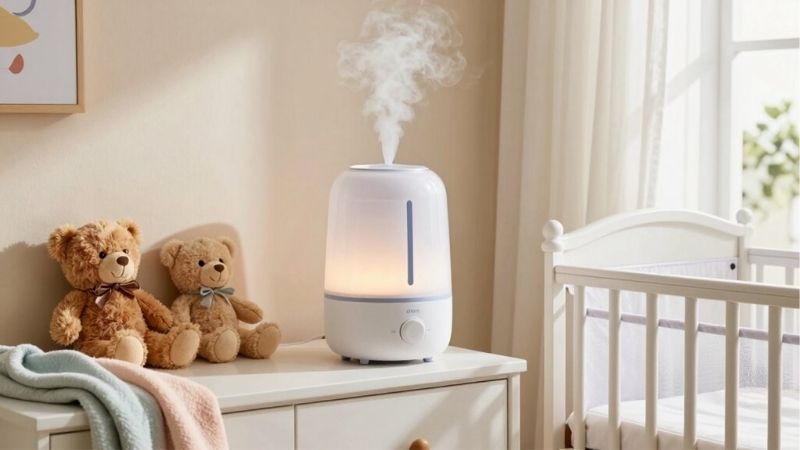
A nursery humidifier is worth considering when a baby’s room is genuinely dry, but the easy-to-clean tank and safe placement matter more than glowing lights or a headline runtime. The American Academy of Pediatrics’ HealthyChildren guidance recommends cool mist rather than hot steam around children to avoid scalds. Keep the appliance beyond a child’s reach, direct moisture away from the crib, and use a separate hygrometer so comfort never turns into damp bedding.
Quick Verdict: The Levoit Classic 160 is our Best Overall pick for a modest nursery: its 2.5-liter top-fill tank, unobtrusive controls and published low-noise specification suit daily care. Choose the Canopy Nursery Humidifier 2.0 when limiting visible mineral dust is worth an ongoing filter expense. These are editorial selections based on published manufacturer and retailer specifications as of October 2026, not in-house testing. Check current prices and model details before ordering.
As an Amazon Associate we earn from qualifying purchases.
By DIY Ideas 4 Home Editorial Team
The Best Nursery Humidifiers Reviewed
We compared specific cool-output appliances using the makers’ product pages, manuals and named U.S. retailer listings, with cleaning access, overnight output, refill effort and nursery-specific controls carrying the most weight. The price spread is substantial: the Levoit Classic 160 has a $39.99 regular maker price, while Canopy lists its nursery-specific unit at $159 before optional filter subscriptions as of October 2026. The EPA’s April 2022 humidifier-care guidance is an essential counterweight to marketing claims: standing water, minerals and excessive humidity all change how suitable an appliance is for a child’s room.
| Product | Best For | Key Spec | Listed Price (as of October 2026) | Watch Out For |
|---|---|---|---|---|
| Levoit Classic 160 | Best Overall: simple nightly care | 2.5 L; up to 25 hours on low; 26 to 28 dB stated | $39.99 regular maker price | Ultrasonic mineral dust; no automatic humidistat |
| Canopy Nursery Humidifier 2.0 | Best For filtered evaporation | 2.5 L; up to 36 hours; evaporative filter | $159 one-time maker price | Replacement-filter cost and fan noise |
| Frida Baby 3-in-1 Humidifier 100001988 | Best For top-fill with nightlight | Up to 60 hours on low; cool mist; dual outlet | $44.99 maker price | Diffuser feature is unnecessary for a newborn |
| Crane Drop 4-in-1, White 88676356 | Best For a separate sound setting | 1 gallon; up to 24 hours; 3 sound selections | $54.99 Target listing | Large body and more controls to manage |
| Honeywell MistMate HUL520 | Best For small shelf space | 0.5 gallon; up to 18 hours; filter-free | No official list price | Small tank may need frequent refills |
| Vicks Mini Filter-Free VUL520W | Best For visible water-level checks | 0.5 gallon; up to 20 hours; translucent tank | No official list price | Optional scented pad is not a nursery necessity |
Levoit Classic 160: Best Overall
Best For: Parents who want straightforward moisture control with fewer settings to adjust during middle-of-the-night visits.
The Classic 160 wins by making a daily chore manageable: the top-fill opening is broad, the dial is immediate, and its lights can stay off. Unlike Frida’s multifunction machine or Crane’s sound-equipped option, this product focuses on the humidifier itself. The limitation is important: a knob adjusts output, not a target percentage, so a room hygrometer remains part of the setup.
Levoit’s Classic 160 product specifications name a 2.5-liter tank and manufacturer-stated output of 100 mL/hour at minimum and 190 mL/hour at maximum, each with an indicated tolerance of plus or minus 20 percent under the specified conditions. The brand describes up to 25 hours on minimum and up to 11 hours on maximum, with maximum-setting noise below 28 dB. Its official store shows a $39.99 regular price as of October 2026, though sale prices change.
The same Levoit Classic 160 product page specifies a body 6.38 inches deep by 7.12 inches wide by 10.14 inches high, weighing 2.16 pounds, and a 120-volt power supply. Those dimensions help you choose a stable, elevated surface without putting the cord near crib rails. The appliance shuts off when empty, but its accessible water-contact surfaces still need routine washing and full drying before storage. Levoit advertises a two-year limited warranty; inspect its terms for exclusions.
Pros:
- Wide top opening permits better access during daily cleaning.
- Brand specifies 26 to 28 dB operation for low-distraction use.
- 2.5-liter reservoir provides up to 25 hours at minimum setting.
Cons:
- No target-humidity setting; a separate hygrometer is useful.
- Ultrasonic aerosol can distribute minerals when filled with hard tap water.
Who Should Buy It: Choose this for a standard baby room with simple routines; consider Canopy Nursery Humidifier 2.0 if evaporative filtration matters more than upfront cost.
Canopy Nursery Humidifier 2.0: Best For Filtered Vapor
Best For: Families who prioritize less visible mineral residue and are comfortable replacing a wick-like filter on schedule.
Canopy is the distinctive alternative because it evaporates water through a filter rather than producing a visible ultrasonic plume. That helps distinguish nursery air moisture from tiny aerosolized water droplets, a meaningful choice in homes where white dust has been an annoyance. It does not make the appliance maintenance-free, nor does its antimicrobial marketing mean that the humidifier disinfects room air.
Canopy’s Nursery Humidifier 2.0 product listing describes a 2.5-liter tank, up to 36 hours of operation and an estimated coverage area of 500 square feet. Its one-time purchase price is $159 as of October 2026; the maker also advertises a $149 purchase with a filter subscription, with recurring filter charges. The official description emphasizes dishwasher-safe components and dry-run operation between refills, while its treatment claims are limited to microbial growth inside the unit or filter.
Canopy’s personalized Nursery 2.0 product page lists an approximately 10-by-7-by-8.5-inch body at about 3 pounds and includes a USB-C power cable. The model adds a nursery-oriented light and sound environment, but replacement filters are part of ownership rather than a one-time purchase. Parents should compare the ongoing replacement schedule and the availability of compatible filters before choosing the premium unit. Its manufacturer advertises a one-year warranty and a 60-day U.S. return window.
Pros:
- Filtered evaporation avoids a direct visible ultrasonic spray at furnishings.
- Maker claims a 36-hour maximum interval with the 2.5-liter tank.
- Dishwasher-safe removable parts can simplify routine wash days.
Cons:
- The $159 unit carries additional replacement-filter expenses.
- A fan-based system is a different sound profile than a quiet ultrasonic knob model.
Who Should Buy It: Pick Canopy when easy removable-part washing and evaporative output matter; choose Levoit Classic 160 for much lower upfront cost.
Frida Baby 3-in-1 100001988: Best For Nightlight
Best For: Parents who want an optional nightlight alongside a top-fill appliance without purchasing a separate bedside lamp.
Frida’s latest 3-in-1 design keeps the essentials accessible: a carrying handle, a wide opening and an adjustable dual-mist spout. Its optional light may be handy for a quick diaper change, although caregivers who want a completely dark room can simply avoid using it. The built-in scent option should not drive the nursery buying decision; babies do not need added fragrances, and pediatric guidance should lead any discussion of aromatherapy around young children.
The Frida 3-in-1 Humidifier official U.S. product page lists a $44.99 price, up to 60 hours of use on its lowest conditions, a claimed room area up to 320 square feet and automatic shutoff on low water. Target’s listing for the current white version identifies a 0.66-gallon tank, comparable to about 2.5 liters. These are marketing maximums, not a promise that a particular room will remain at the correct humidity for 60 hours.
Target’s model-specific product specifications give overall dimensions of 9.6 inches high, wide and deep, and a 4.36-pound item weight for the 3-in-1 Humidifier, UPC 810028776630. The removable tank and large mouth will matter more in week four than on unboxing day, because every surface that stays wet needs attention. The manufacturer advertises a low-water indicator and two outlet directions; point both away from the crib and painted walls.
Pros:
- Official model offers two mist outlets for directional adjustments.
- Top-fill mouth and handle support frequent water changes.
- $44.99 direct price includes the optional nightlight function.
Cons:
- Long maximum runtime may tempt owners to leave water standing.
- A diffuser component adds an unnecessary decision for infant care.
Who Should Buy It: Select Frida for an adjustable light and straightforward refilling; pick Vicks Mini Filter-Free VUL520W if a visible water gauge is more useful.
Crane Drop 4-in-1: Best For Sleep-Sound Options
Best For: Families replacing a separate tabletop white-noise unit who still want cool-mist humidity control.
Crane offers a genuinely different compromise: sound options and adjustable mist in one larger object, reducing the number of devices that need a home on a dresser. It includes three selectable sound environments, while the light can be operated independently. Parents who already own a sound machine may find the added electronics unnecessary, especially when simple cleaning is their first concern.
The Target listing for Crane’s white 4-in-1 Drop, TCIN 88676356 and UPC 818767012330, identifies white noise, rain and ocean-wave options. It specifies a 1-gallon top-fill tank, three mist settings, up to 24 hours per fill and automatic empty-tank shutoff. The same U.S. retailer lists the white unit at $54.99 as of October 2026; this is a retailer price, not a manufacturer MSRP, and actual availability may vary.
Target’s model-specific specifications place the unit at 13.4 inches high by 8.6 inches wide and deep, weighing 4.25 pounds, with a one-year limited warranty. That height can interfere with shelving under wall cabinets, and a full 1-gallon tank can be heavy to move safely. Its removable mist chamber and top opening improve cleaning access, but sound and lighting controls should be checked for their setting persistence after a power interruption.
Pros:
- Three sound selections offer a built-in alternative to separate audio equipment.
- One-gallon top-fill tank has a hand-accessible opening.
- Retailer lists automatic shutoff and three mist settings.
Cons:
- 13.4-inch height needs more vertical clearance than compact models.
- Sound features add complexity without improving actual humidity measurement.
Who Should Buy It: Buy Crane if a dedicated sound selection is useful; choose Honeywell MistMate HUL520 for a less complicated compact humidifier.
Honeywell MistMate HUL520: Best For Compact Placement
Best For: A small nursery with limited adult-height furniture and no need for accessory lighting or scent pads.
Honeywell’s MistMate is deliberately sparse: there are no filter purchases, its moisture setting is variable and its tank is small enough for sink filling without handling a gallon. This may suit a nursery where a large humidifier would crowd the only safe, stable shelf. It will not offer the long refill interval of the Canopy or Frida products, and the absence of a built-in hygrometer means moisture still needs measuring.
The Honeywell Plugged In product details and MistMate HUL520 owner’s manual identify a 0.5-gallon tank, up to 18 hours of runtime, a wide tank opening and automatic shutoff. The same manufacturer page describes it as designed for small rooms. Honeywell does not publish a direct list price on that page; for orientation, a U.S. Walmart listing for the black HUL520B showed approximately $49.99 in October 2026, subject to seller and color differences.
Honeywell specifies dimensions of 8.15 inches wide by 8.90 inches high by 8.57 inches long for HUL520. That footprint can fit a more modest tabletop while keeping the nozzle directed away from bedding. Filter-free does not mean mineral-free: with hard water, the ultrasonic system can still leave deposits and produce fine mineral particles. Honeywell’s manual advises inspecting the nebulizer if mist output declines and cleaning away mineral deposits as instructed.
Pros:
- Eight-inch-class footprint suits a restricted elevated placement.
- Wide tank opening helps reach interior water-contact surfaces.
- Half-gallon tank avoids the lifting weight of a gallon vessel.
Cons:
- Maker specifies only up to 18 hours between refills.
- No direct manufacturer price is published for comparison.
Who Should Buy It: Choose the HUL520 when a small platform is your constraint; move up to Crane Drop 4-in-1 if longer operation and built-in audio are priorities.
Vicks Mini VUL520W: Best For Checking Water at a Glance
Best For: Caregivers who prefer seeing the remaining tank water instead of waiting for an empty-tank light.
The Vicks Mini’s translucent reservoir is a practical feature during early morning care: one look can show whether another refill is due. Unlike the Honeywell’s similarly sized tank, this model draws attention to visible water level as a design feature. Its VapoPad compatibility may appeal to adults, but that is not a reason to use scented products around an infant without clinician guidance; run plain-water humidification if you choose this model for a nursery.
The Vicks Humidifiers Mini Filter Free Cool Mist Humidifier product page and VUL520 owner’s manual name a 0.5-gallon tank, up to 20 hours of operation, a small-room application and a filter-free ultrasonic design. The specific VUL520W white configuration appears on a Walmart business listing with the same half-gallon capacity. Vicks does not show an official direct list price on its model page; Walmart’s listing showed $45.12 as a retailer reference in October 2026, and seller prices can differ.
Vicks’ published unit size for the VUL520 line is 8.11 by 9.40 inches, a relatively modest placement profile for a counter or high shelf. The manufacturer also specifies an automatic empty-tank stop and variable output control. A translucent tank makes water visible but does not prevent bacterial growth; drain, wipe and refill it daily even when the remaining water looks clear. Avoid aiming the outlet at curtains or the crib mattress.
Pros:
- Translucent half-gallon tank makes remaining water easy to see.
- Up to 20-hour manufacturer runtime offers a full-night margin on low.
- Variable adjustment and empty-tank shutoff keep operation uncomplicated.
Cons:
- VapoPad feature is not a benefit to assume for newborns.
- Official site does not provide a direct MSRP for VUL520W.
Who Should Buy It: Take Vicks if visual water-level checks matter; choose Frida Baby 3-in-1 100001988 if a separate optional nightlight is worth adding.
How to Choose a Humidifier for a Nursery
The selection starts with the baby’s actual sleep space, not with a box claiming to cover a large house. Check the available stable surface, the cord’s path and the room’s current relative humidity before ranking reservoir sizes. A humidifier that dampens the crib or rests where little hands can grab it is a poor purchase regardless of its advertised quiet mode.
Prioritize Cool Output and Reach-Safe Positioning
HealthyChildren, from the American Academy of Pediatrics, advises a cool-mist humidifier or vaporizer to avoid burn risks associated with hot water and steam, and recommends keeping the appliance out of a child’s reach. Elevated does not automatically mean safe: a narrow stand can tip, and a dangling cord can become accessible as a baby starts standing. Keep the unit securely positioned and route its cord so it cannot be pulled into the crib or across walkways.
Cool output does not eliminate every hazard. Electricity and water still need separation, and wet floors or fabrics can support unwanted growth. Aim a rotating outlet into open air, not directly over the crib, baby monitor, carpet or wallpaper; prevent condensation on nearby glass and furniture. Never place a running unit inside a crib, on a crib rail or at the child’s sleeping level.
Match Tank Capacity to Daily Water Changes
A half-gallon reservoir may be easier to carry and wash than a gallon tank, but it can require more refills in a heated winter bedroom. The Levoit Classic 160’s published 2.5 liters and the Honeywell HUL520’s 0.5 gallon therefore serve different practical needs. Runtime claims are usually based on low settings and may shorten as output rises; a long label claim is not permission to use yesterday’s standing water.
The EPA’s April 2022 Use and Care of Home Humidifiers guidance recommends emptying portable tanks, drying contacting surfaces and refilling every day. It also recommends cleaning portable humidifiers every third day to reduce microorganisms and scale. Verify the appliance’s own cleaning steps because accessible hinges, a narrow neck, an ultrasonic transducer and an evaporative wick require different treatment. Plan these chores as part of the purchase, not after symptoms or smells appear.
Measure Actual Humidity, Not Room-Size Claims
The EPA recommends avoiding indoor relative humidity above 50 percent when using a humidifier; its broader indoor-air guidance describes roughly 30 to 50 percent as a preferred range. That is a measurement goal, not a guarantee that every child needs a machine all winter. A basic hygrometer placed away from the immediate mist stream is more informative than advertised coverage in square feet, which varies with doors, heating and ventilation.
A unit with a true adjustable humidity target reduces the burden of repeated knob changes, but even electronic readouts should be cross-checked with a separate monitor. During October heating season and onward, a room with dry air after the furnace runs may need supplemental moisture while a well-insulated bedroom may not. If windows begin collecting water, lower output and inspect the room for hidden wet surfaces.
Budget for Distilled Water, Cleaning and Filters
Ultrasonic equipment disperses fine water droplets, and the EPA warns those droplets can carry minerals and microorganisms if the unit is not cared for properly. Distilled or other low-mineral water can reduce visible residue and mineral emission. A filter-free label saves replacement-cartridge purchases but does not cancel the need for cleaning; a filter-based Canopy involves an additional recurring part even though it avoids the same visible ultrasonic mechanism.
Compare prices over one heating season rather than only at checkout. For example, the $39.99 regular Levoit price leaves more room in the budget for distilled water and an inexpensive hygrometer than the $159 Canopy unit, while Canopy buyers must also count replacement filters. Do not put essential oils, vapor additives or fragrances into a baby’s humidifier simply because a product supports them; ask the pediatrician before introducing scents around an infant, and follow the exact manual if using any additive for an older child.
Frequently Asked Questions
These four questions cover decisions that remain after comparing features: when to run the appliance, whether the child should smell added vapors, what mineral residue means and how long to continue a nightly routine.
Should a nursery humidifier run when the room is already comfortable?
No. Use a hygrometer and humidify in response to measured dry air, not as a permanent background activity. The EPA warns against relative humidity above 50 percent and points to condensation as a sign to reduce output. A moderate room already within the recommended range does not benefit from automatically adding more moisture.
Are essential oils or menthol pads appropriate for a newborn?
Do not assume so. A humidifier’s compatible scent tray or diffuser says what the appliance can operate with, not what is appropriate for an infant. For a newborn or a child with breathing concerns, avoid fragrances unless the child’s clinician specifically approves the product and intended use. Follow the device manual because pouring oil into the water reservoir can also damage models not designed for it.
Does white dust prove the humidifier has mold in it?
No. With an ultrasonic model, white dust often reflects dissolved minerals dispersed from hard water; the EPA describes how humidifiers can release those minerals into room air. Mold or bacterial contamination is a separate possibility requiring preventive care, not something that can be diagnosed from white dust alone. Empty the tank every day, wash as instructed and try distilled water to reduce minerals.
Can a humidifier stay on all night in a baby’s room?
Only if its manufacturer permits unattended night operation, the unit is positioned securely beyond reach and the actual room humidity stays in range. Automatic empty-tank shutoff is helpful but is not an automatic humidity controller. Recheck conditions as seasons and heating schedules change; if the windows or bedding become damp, reduce or stop misting regardless of how much water remains.
Final Thoughts
The Levoit Classic 160 is our Best Overall nursery humidifier because its refill and cleaning access, 2.5-liter tank and simple light-free operation favor the routine a caregiver must repeat; households troubled by mineral deposits should look first at the filtered Canopy Nursery Humidifier 2.0 instead. Before ordering either one, identify a stable placement beyond the child’s reach and confirm that the cord can be safely routed there. Check the current model listing, warranty and ongoing water or filter expense before buying.