Key takeaways
- Native 160 by 120 grid, 19,200 thermal pixels
- Alarms span minus 4 to 752 degrees Fahrenheit
- Standalone unit needs no phone
A thermal leak detector comes in two very different forms: a simple spot scanner that compares one surface temperature against another, and a true thermal camera that maps a whole wall, so the right pick depends on whether you want a quick reading or a picture of the cold spot.
Quick Verdict: For most homeowners, the Klein Tools TI250 is the pick because it is a standalone camera with a native 160 by 120 sensor, which is 19,200 real thermal pixels, at a mid range price. If you only need cheap spot checks, the BLACK and DECKER TLD100 flags a warm or cold patch for about a third of the cost. This is an editorial pick based on published specifications as of October 2026, not in-house testing. Check the current price and confirm the native sensor resolution on the listing before you buy.
As an Amazon Associate we earn from qualifying purchases.
By DIY Ideas 4 Home Editorial Team
The Best Thermal Leak Detectors Reviewed
We selected these six based on published specifications and manufacturer documentation rather than in-house testing, separating native sensor resolution from marketing enhanced images and keeping spot tools distinct from cameras, as of October 2026. Prices here run from about 55 dollars for a spot scanner to 529 dollars for a wireless imager.
| Product | Best For | Key Spec | Listed Price (as of October 2026) | Watch Out For |
|---|---|---|---|---|
| Klein Tools TI250 | Standalone camera value | 160 by 120 native, 19,200 pixels | $314.38 | Palette cannot add real detail |
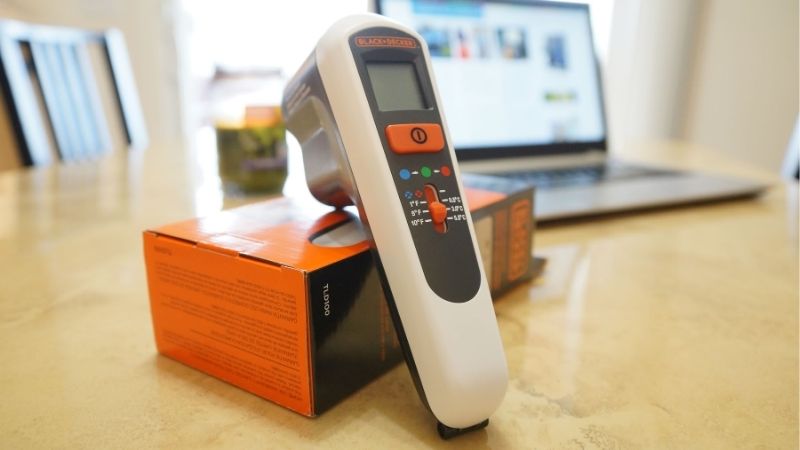
| BLACK+DECKER TLD100 | Cheap spot checks | Spot scan, 1, 5, 10 degree thresholds | $54.95 | No saved image |
| TOPDON TC001 Max | Phone based inspection | USB-C, iOS, Android, Windows | $309.00 | Native pixels not published |
| FLIR TG165-X | Handheld with MSX edges | 80 by 60 native, 4,800 pixels | $399.00 | Low native pixels for the price |
| FLIR ONE Pro | Compact phone camera | 160 by 120 native, about 1 hour run | $349.00 | Short battery life |
| FLIR Edge Pro | Wireless mobile imaging | 160 by 120 native, wireless | $529.00 | Premium price, same native grid |
Klein Tools TI250: Best Overall Standalone Camera
Best For: Homeowners who want a self contained imager that maps a whole wall without tethering to a phone.
It wins this group because it delivers the highest native resolution available here in a unit that needs no phone, which is what separates a usable thermal map from a single point reading. The FLIR TG165-X costs more yet carries a lower native grid.
Klein’s product page lists a native 160 by 120 sensor, which is 19,200 real thermal pixels, and adjustable temperature alarms spanning minus 4 degrees Fahrenheit to 752 degrees, with the camera priced at $314.38 as of October 2026.
The TI250 reads out on a display that measures 2.4 inches, bright enough for attic corners, though a color palette cannot invent detail the sensor did not capture, and useful contrast still depends on a real indoor to outdoor temperature gap.
Pros:
- Native 160 by 120 grid, 19,200 thermal pixels
- Alarms span minus 4 to 752 degrees Fahrenheit
- Standalone unit needs no phone
Cons:
- Costs more than a basic spot thermometer
- Contrast depends on indoor to outdoor difference
Who Should Buy It: Buy this for a standalone thermal map; if you only want a quick warm or cold flag, the BLACK and DECKER TLD100 is far cheaper.
BLACK+DECKER TLD100: Best for Cheap Spot Checks
Best For: First time users who want to walk a room and flag drafty spots without buying a camera.
This is a spot comparator, not an imager, so it answers one question cheaply: is this patch warmer or colder than a reference. That narrow job is exactly why it costs a fraction of the cameras, and why it cannot show an insulation gap across a wall.
BLACK and DECKER’s product manual describes a spot infrared scanner with selectable difference thresholds of 1, 5 and 10 degrees and 9 volt power, with the tool listed at $54.95 as of October 2026.
The TLD100 measures about 9.953 inches tall and weighs 0.956 pound, a wand shaped body for one handed sweeps, and reflective window glass or shiny metal can still throw off a surface reading, so treat results as hints.
Pros:
- Selectable 1, 5 and 10 degree thresholds
- One handed 9 volt wand design
- Lowest price in this comparison
Cons:
- Reads one spot with no saved image
- Shiny surfaces give unreliable readings
Who Should Buy It: Pick this for an inexpensive first pass; when you need an actual thermal picture, the Klein Tools TI250 maps the whole surface.
TOPDON TC001 Max: Best for Phone Based Inspection
Best For: People who already carry a compatible USB-C phone and want imaging without a second screen.
Its draw is turning a phone into the display and processor, which keeps the hardware small and the price just under the standalone cameras. The catch is that its native sensor resolution is not published, so it cannot be ranked on that axis.
TOPDON’s product page lists USB-C operation across iOS, Android and Windows and a dual lens design, with the TC001 Max priced at $309.00 as of October 2026.
TOPDON lists a shipped package measuring 71 by 42 by 14 millimeters and a device weight of about 30 grams, so it rides in a pocket, but it only works with a compatible port and app, and an enhanced on screen image is not the same as native resolution.
Pros:
- Runs on iOS, Android and Windows
- USB-C tethered, pocket sized hardware
- Lower price than the standalone cameras
Cons:
- Native sensor pixel count not published
- Needs a compatible phone port and app
Who Should Buy It: Choose this if you want a phone based tool; for a published native grid you can rank, the FLIR ONE Pro states 160 by 120.
FLIR TG165-X: Best Handheld With MSX Edges
Best For: Users who value crisp edge overlays and onboard image storage over raw pixel count.
It leans on MSX, which stamps visible light edges onto the thermal frame so a scene is easier to read. That overlay is the selling point, but it is not extra thermal resolution, and the native grid here is the smallest in the group.
FLIR’s product documentation lists an 80 by 60 native sensor, which is 4,800 thermal pixels, a range of minus 13 degrees Fahrenheit to 572 degrees and storage for up to 50,000 images, with the TG165-X priced at $399.00 as of October 2026.
The TG165-X shows its scene on a screen that measures 2.4 inches across the back, and while the picture looks sharp thanks to edge overlays, the underlying 4,800 pixels sit below the cheaper Klein unit, so judge it on native detail.
Pros:
- MSX overlays add visible edge context
- Stores up to 50,000 images onboard
- Range reaches minus 13 to 572 degrees
Cons:
- Only 4,800 native thermal pixels
- Priced above the higher resolution TI250
Who Should Buy It: Get this for edge rich images and storage; for more native pixels at a lower price, the Klein Tools TI250 is the stronger buy.
FLIR ONE Pro: Best Compact Phone Camera
Best For: Phone users who want a genuine 160 by 120 native sensor in the smallest possible accessory.
It pairs a published native grid with a plug in form, so unlike the TOPDON you can actually compare its resolution against the standalone cameras. Its weak point is runtime, since a small accessory battery lasts only about an hour.
FLIR’s product listing states a 160 by 120 native sensor, which is 19,200 thermal pixels, a nominal range of minus 4 degrees Fahrenheit to 752 degrees and roughly one hour of camera operating time, with the accessory priced at $349.00 as of October 2026.
The ONE Pro measures 2.7 inches tall and 1.3 inches wide, small enough to clip onto a phone, but you must match the exact USB-C variant and keep it charged, since the short runtime interrupts long inspections.
Pros:
- Native 160 by 120 grid, 19,200 pixels
- Pocket accessory measuring 2.7 inches tall
- Published range of minus 4 to 752 degrees
Cons:
- About one hour of operating time
- Must match the correct USB-C variant
Who Should Buy It: Buy this for a true native grid on a phone; if you would rather not tether at all, the Klein Tools TI250 is standalone.
FLIR Edge Pro: Best for Wireless Mobile Imaging
Best For: Inspectors who want to roam without a cable and view the thermal feed on a paired phone.
It removes the physical tether by streaming to a phone wirelessly, which is handy on ladders and in tight runs. The cost is literal: it is the priciest unit here for the same native grid several cheaper options already provide.
FLIR’s product listing, where it is sold as the ONE Edge Pro, states a 160 by 120 native sensor and roughly 2.5 hours of battery runtime with a wireless phone connection, priced at $529.00 as of October 2026.
The Edge Pro measures about 5.9 inches long and 1.5 inches wide and weighs 153 grams, a compact wireless puck, though it still needs a supported phone and app, and its native grid matches far cheaper cameras in this roundup.
Pros:
- Wireless streaming to a paired phone
- About 2.5 hours of battery runtime
- Native 160 by 120 thermal grid
Cons:
- Most expensive unit for the same grid
- Still depends on a supported phone app
Who Should Buy It: Choose this for cable free roaming; if budget matters more than going wireless, the Klein Tools TI250 is a cheaper standalone with the same native grid.
How to Choose a Thermal Leak Detector
The decision turns on whether you need a picture or a point reading, how much native resolution you will use and how the tool is powered, not on a single score. These criteria sort the field.
Instrument Type and Native Resolution
A spot scanner compares two surface temperatures, while a thermal camera builds an image from a sensor grid such as 80 by 60 or 160 by 120. More native pixels localize a defect better, but an enhanced or super resolution image is not the same as native pixels, so read the native number before you compare cameras.
Measurement Range and Honest Comparisons
Ranges here span from minus 13 degrees Fahrenheit to 752 degrees depending on model, which is ample for an indoor envelope. Compare like with like: do not rank a phone accessory whose native grid is unpublished against cameras that state theirs, and do not read color alone as proof of poor insulation.
Power, Runtime and Image Storage
A standalone camera avoids draining your phone, while plug in accessories like the FLIR ONE Pro last only about an hour and the Edge Pro about 2.5 hours. If you document findings, favor onboard storage such as the TG165-X, which holds up to 50,000 images.
Safety and Realistic Expectations
Follow the manufacturer laser warnings and never point an aiming laser at anyone eyes. Do not open live electrical panels while chasing a hot spot; call a qualified electrician for electrical hazards. A thermal image alone does not confirm hazardous wiring or a plumbing leak, and reflective glass can mislead, so confirm findings another way.
Frequently Asked Questions
Here are the questions shoppers raise most before buying one of these tools.
What is the difference between a spot detector and a thermal camera?
A spot detector reads one surface at a time and signals whether it is warmer or colder than a reference, while a thermal camera maps a whole area from a sensor grid. The camera localizes a draft or missing insulation; the spot tool only flags that something is off.
Can a thermal camera see air drafts in a window?
Not directly. Infrared shows surface temperature patterns, not moving air, so a draft appears only as a cooled surface where cold air has chilled it. You often need a contrast between indoor and outdoor temperatures for the pattern to show at all.
How much native resolution is useful at home?
For envelope checks a native 160 by 120 grid, which is 19,200 pixels, maps most walls clearly, while 80 by 60 is coarser. Ignore enhanced pixel claims and read the native sensor number, since that is what sets real detail.
Why does shiny glass read oddly on infrared?
Reflective and low emissivity surfaces bounce back surrounding infrared, so the tool reports a misleading surface temperature. Aim at matte surfaces where possible and treat readings on glass or bright metal with caution.
Final Thoughts
Weighed on native resolution and convenience, the Klein Tools TI250 remains the pick because it delivers a 160 by 120 standalone camera at a mid range price, while bargain hunters can start with the BLACK and DECKER TLD100 and phone users can consider the FLIR ONE Pro; before ordering, confirm the native sensor grid and, for accessories, that your phone port and app are supported.