Learning how to protect plants from frost starts with identifying which plants cannot tolerate a cold night, then preventing exposed leaves and roots from losing heat too quickly. A breathable cover draped to the ground, reasonably moist soil, and a sheltered place for vulnerable containers often offer better protection than a last-minute spray. Expect to spend part of an afternoon preparing a small garden, depending on how many plants need attention.
Quick Answer: Check the overnight forecast and move tender potted plants to a protected location first. Before sunset, water dry soil if necessary, set supports around delicate foliage, and anchor frost cloth or a sheet all the way to the ground. Open or remove covers once daytime temperatures rise. A simple cover can help with brief light frost but cannot guarantee survival in a prolonged freeze.
As an Amazon Associate we earn from qualifying purchases.
By DIY Ideas 4 Home Editorial Team
Before You Start: Tools, Materials and Safety
A frost plan works only if the covering fits the plant and the expected cold. The National Weather Service’s May 2026 Grand Forks guidance identifies frost-advisory conditions around 33 to 36 degrees Fahrenheit and freeze conditions at 32 degrees Fahrenheit or lower. Local warning criteria can vary, and the forecast temperature is not necessarily the temperature right beside a leaf near the ground. Prepare for the vulnerable plants in your own yard rather than assuming every plant needs the same treatment.
| Tool or Material | Size or Spec | Why You Need It | Substitute |
|---|---|---|---|
| Breathable frost cloth | Wide enough to reach soil on all sides | Slows overnight heat loss around foliage | Lightweight sheet for a brief cold night |
| Hoops or plant stakes | Tall enough to clear tender shoots | Keeps fabric from rubbing fragile leaves | Stable tomato cage with padded top |
| Ground anchors | Landscape staples, bricks or boards | Closes gaps where warm air escapes | Loose soil on a cloth edge |
| Watering can or hose | Controlled flow onto soil, not leaves | Corrects dry root-zone conditions before cold | Hand watering for pots |
| Mulch | Plant-appropriate organic material | Reduces swings in soil temperature | Existing clean leaf mulch where suitable |
| Outdoor thermometer | Readable near the planting area | Helps identify colder low spots | Local forecast plus visual plant checks |
Identify Plants Most Likely to Be Injured
Tomatoes, peppers, basil, beans, and many flowering annuals are usually first in line for protection. The University of Minnesota Extension’s 2026 garden-timing guidance says a light frost around 32 degrees Fahrenheit can damage tender plants, while temperatures near 28 degrees Fahrenheit or below can kill many warm-season crops. Newly planted specimens and soft new growth after a warm spell also deserve attention. Cold-adapted kale, established hardy perennials, and dormant shrubs have different tolerances, so covering them automatically can waste material or trap unnecessary daytime heat.
Walk through the beds and identify what you can harvest, move, or cover. Fruit that is ready to pick may be safer indoors than attached to a frost-sensitive plant overnight. Look at low-lying corners, open windy borders, and raised planters, because exposure matters as much as the temperature shown on a weather app. If a plant is tropical or was recently moved outside from a warm room, do not treat a fabric blanket as a substitute for getting it into a suitable indoor temperature.
Choose Cloth That Matches the Cold
Breathable spunbonded row cover lets some light, rain, and air pass while holding part of the warmth coming from the soil. Utah State University Extension’s season-extension guidance reports that, depending on fabric grade and weather, air beneath a floating row cover may run about 2 to 10 degrees Fahrenheit warmer than the surrounding air. That is an observed range under particular conditions, not a guaranteed increase on every night. Heavier fabric often insulates more but admits less light, so choose according to expected temperatures and how long it will stay in place.
For emergency protection, clean bedsheets can work over a handful of plants. Use hoops for upright or brittle stems; a heavy, wet blanket resting on leaves can bend or break them. Clear plastic is not the first choice for direct draping. Plastic touching foliage can create cold-contact problems and may overheat an enclosed plant rapidly after sunrise. If a plastic tunnel is necessary, keep it supported above foliage and plan to ventilate it promptly.
Know When a Cover Is Not Enough
A cloth tent gets much of its benefit from the warmth stored in the ground. University of Georgia Extension’s freeze-protection guidance notes that covers are less effective after cold, cloudy days, when the soil has collected less daytime heat. Repeated nights well below freezing, strong winds, and dry exposed roots can overwhelm passive protection. Move valuable container plants inside a garage or another space that remains suitable for the plant; an unheated building is not automatically frost-free.
Avoid heating a covered bed with a flame, charcoal, or an improvised electrical setup. Those additions bring fire, exhaust, and electric-shock risks that are not justified for a home garden. Also avoid spraying water over plants throughout a freeze as a casual do-it-yourself method. Commercial irrigation-based frost protection depends on precise rates and continuous operation; stopping at the wrong moment can increase injury. Focus on sheltered placement, dry-leaf covers, and reasonable soil moisture instead.
How to Protect Plants From Frost Step by Step
Work through these steps while there is still daylight. The order matters: relocate movable plants, use the soil’s stored warmth, and then build a cover that stays closed near ground level. A well-fastened tent is more useful than expensive fabric left flapping in the wind. Keep a second-night plan ready if the forecast shows another cold morning.
Step 1: Check the Forecast and Your Yard
Start with the hourly forecast, including the time of the overnight low, wind speed, and the temperature expected after sunrise. Compare a local forecast with a thermometer in a sheltered low spot when possible. Cold air can settle downhill, while a bed by a wall may experience different conditions from a wide-open lawn. These microclimates help decide whether the basil by the fence needs a cover before the hardier herbs near the house.
The National Weather Service’s May 2026 guidance for parts of the northern Plains distinguishes a frost advisory in the middle 30s from a freeze warning at 32 degrees Fahrenheit or lower. Those are warning thresholds, not a promise that leaves remain unharmed above freezing. Treat an alert as time to inspect the most sensitive plants. Confirm the actual warning criteria for your county, because growing-season definitions differ across weather offices.
Step 2: Bring Vulnerable Pots Under Shelter
Carry tender potted plants to a suitable porch, enclosed entry, greenhouse, or indoor area before dealing with in-ground beds. Root balls in above-ground pots lose warmth from their sides as well as their tops. University of Georgia Extension’s winter landscape guidance emphasizes that container roots are especially exposed and recommends moving containers into protection or insulating and grouping them. A cluster of pots beside a wall is usually easier to shield than isolated containers scattered across the patio.
Check whether the destination itself is likely to freeze. An open porch can block wind without remaining warm enough for a tropical houseplant. Do not introduce pest-infested outdoor plants directly into a room full of healthy houseplants without examining foliage and soil. Large planters that cannot be moved can be grouped, shielded from wind, and wrapped around the container walls while leaving drainage unobstructed.
Step 3: Check Moisture Before Watering
Feel the soil a little below the surface. If it is dry and the ground is still workable, water the root zone early enough for excess surface moisture to settle before the temperature falls. University of Georgia Extension’s December 2024 frost-protection advice explains that drought stress can weaken plants, while moist soil helps store and release daytime warmth. The goal is evenly moist soil appropriate to the species, not mud or water standing around crowns.
If a container is already wet, skip additional watering. Saturated potting mix can suffocate roots, particularly where drainage is poor. Keep water directed toward the soil rather than leaving cold droplets on foliage late in the evening. Stop trying to water through frozen ground. A plant with normal winter dormancy and low water needs should not receive the same irrigation treatment as a leafy, actively growing vegetable.
Step 4: Insulate the Soil Around Roots
Inspect existing mulch around strawberries, recently planted perennials, and vulnerable shrubs. Reposition displaced material so the root zone has a consistent insulating layer without piling it against stems, trunks, or the plant crown. University of Georgia Extension’s winter landscape recommendations describe mulch as a way to limit heat loss and retain soil moisture. A clean organic mulch can buffer repeated changes in soil temperature even though it will not prevent all leaf damage above ground.
Keep the material appropriate for the planting. Dense wet piles pressed against succulent stems can invite decay, and burying the crown of a low-growing plant can create a separate problem. If you are protecting vegetables that will be harvested soon, use a clean mulch that will not contaminate edible portions. Frost fabric still needs to reach the ground beyond the foliage; a ring of mulch by itself does not enclose the warm air around tender leaves.
Step 5: Build Supports Around Fragile Growth
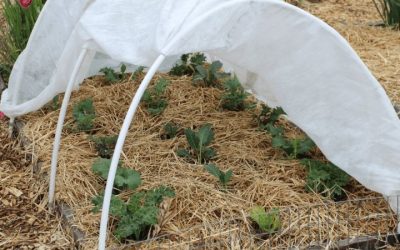
Push hoops, cages, or sturdy stakes into the soil outside the plant’s immediate root crown. Raise the support above tall leaves and flower stalks so cloth will rest on the frame rather than drag across them. Utah State University Extension’s guidance on row covers warns that rubbing in windy conditions can injure plants, and frost injury can occur where fabric touches leaves. Supports are especially useful over peppers, newly planted ornamentals, and plants with brittle stems.
Check that the frame cannot tip in a gust. Bend any exposed wire ends away from the fabric, and pad sharp cage corners so the cover does not tear. With low, sturdy crops, lightweight floating row cover may be placed directly over the foliage when the manufacturer permits it. The objective is to create a stable pocket of protected air, not a tight wrap around every leaf. If you have several plants in one bed, covering the whole bed as a group may be simpler than making separate tiny tents.
Step 6: Drape and Anchor the Cover
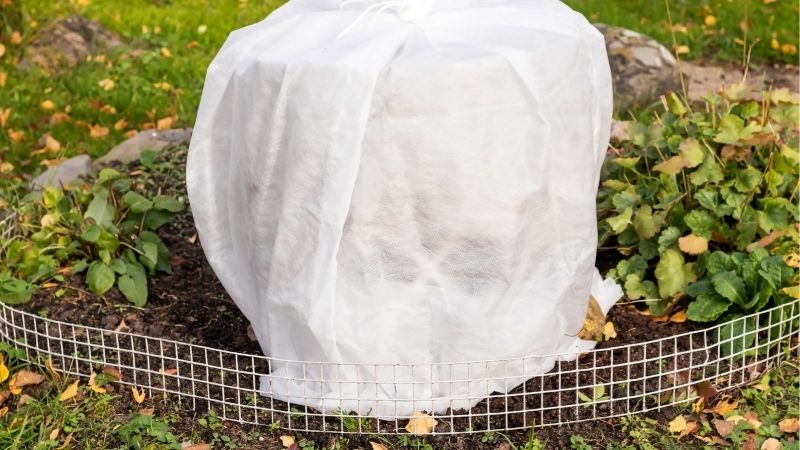
Lay frost cloth, a lightweight sheet, or a purpose-made plant blanket over the supports. Bring it down to the soil on all sides, then close the perimeter with landscape staples, boards, bricks, or soil without crushing irrigation tubing. The University of Georgia Extension bulletin on freeze protection recommends setting covers at least an hour before sundown when possible, so the system can hold onto warmth accumulated during the day. If you wait until the ground has cooled, the cover has less warmth to retain.
Look at the covered plant from ground level. Any large gap on a windy side allows warm air to escape and reduces the point of a blanket. Leave enough slack for leaves and stems to move without rubbing. Do not lash the material tightly to the trunk while leaving the soil exposed: a snug bundle around the top may block wind yet fails to trap much heat rising from the root zone. Check anchors before dark, particularly when overnight winds are expected.
Step 7: Ventilate, Remove, and Recheck
After sunrise, monitor the air temperature under the cover as well as the outdoor forecast. Remove a sheet when the risk has passed or at least open the enclosure as the day warms. University of Georgia Extension cautions that plastic can heat rapidly in sunlight, and Utah State University Extension reports that some plastic tunnels may become 25 to 30 degrees Fahrenheit warmer than outside on sunny days. Such a daytime increase can be harmful rather than helpful if the tunnel remains shut.
Breathable horticultural fleece may stay over suitable crops for longer than improvised plastic, but ventilation, light availability, plant growth, and the maker’s instructions still matter. Shake off collected water carefully so it does not pour onto fragile stems. Dry and fold reusable material before storing it. Inspect the forecast again that afternoon and replace the cover if another frost night is approaching. Do not treat one protected morning as the end of the cold period.
Products That Help
J&M Industries’ Agribon AG-19 Row Cover is a lightweight option for vegetable rows and low beds. The manufacturer’s Agribon specification lists a 0.55-ounce-per-square-yard polypropylene fabric and states that it can offer about 2 to 4 degrees Fahrenheit of frost protection under suitable conditions. Choose its sheet width to reach the ground without stretching it tight. For gardeners who expect a colder night, Gardener’s Supply GardenQuilt Cover, product 11955, uses 1.25-ounce fabric. The retailer states protection down to 24 degrees Fahrenheit and 79.3 percent light transmission, but that figure is a product claim rather than a universal survival temperature for every crop.
DeWitt N-Sulate 1.5 oz Plant Protection Fabric is another reusable permeable option, particularly for grouped bedding plants. DeWitt’s product specification identifies an NS12 10-by-12-foot retail size. Buy this style when one broad piece can cover multiple plants with its edges held against the soil; choose smaller sheets for scattered containers. These products help manage a temporary cold event, not replace moving tropical plants inside during severe or repeated freezes. Check current sizes and material details before purchasing.
Common Mistakes to Avoid
A cover that reaches only to the leaves leaves an open path for warmth to escape at the base. Likewise, a thick blanket pressed directly on soft shoots may trade frost damage for broken stems. A second common error is assuming that every forecast of 32 degrees Fahrenheit produces identical injury: plant species, prior acclimation, wind, soil conditions, and duration all influence the result. After the cold night, resist the urge to fertilize or aggressively prune at once. Soft new growth encouraged by a warm spell may face another frost before spring stabilizes.
Inspect wilted or blackened foliage over the following days, but wait until the danger of further freezes has passed before judging how much perennial woody growth is truly dead. University of Georgia Extension’s January 2026 ornamental winter-protection advice recommends delaying pruning while future cold events remain possible. Keep normal drainage and suitable soil moisture rather than applying a large dose of fertilizer to force recovery. Annual vegetables that have collapsed after a hard freeze may not recover, while a perennial can sometimes regrow from surviving roots or dormant buds.
Frequently Asked Questions
The right action depends on whether a plant is tender, the cold is brief, and the fabric remains anchored. These questions address situations a general step-by-step covering method cannot settle by itself.
Can Frost Damage Plants Above 32 Degrees?
Yes, it can. The forecast is usually an air-temperature measurement taken under standardized conditions, while a leaf can cool differently on a clear and calm night. The National Weather Service’s 2026 northern Plains guidance allows frost advisories when forecast air temperatures are in the 33 to 36 degrees Fahrenheit range. For a sensitive plant, don’t rely on a single whole-degree threshold. Look at the frost advisory and the plant’s location, then protect specimens that would be difficult to replace.
Is a Bedsheet Enough for a Cold Night?
A clean bedsheet can slow heat loss during a short, light frost when it covers the entire plant and reaches the soil. That does not make it equivalent to an insulated greenhouse. University of Georgia Extension’s December 2024 landscape guidance recommends cloth or cardboard as temporary protection, preferably supported so it does not crush foliage. Wet fabric becomes heavier, and open gaps can undo much of the benefit. If the weather calls for a prolonged freeze, move container plants indoors and consider more substantial structures for tender in-ground crops.
Can Tomatoes Survive a Hard Freeze Under Cloth?
Do not count on it. University of Minnesota Extension’s 2026 garden-timing guidance describes 28 degrees Fahrenheit or colder as a hard frost that can kill many warm-season crops. A row cover may improve conditions for a brief dip, but the outcome depends on the crop, the starting soil warmth, wind, and how long the temperature stays low. Pick ripe tomatoes before a serious freeze if a reliable harvest matters more than trying to extend a fading planting. Healthy cool-season crops deserve a different decision.
Should I Cut Off Leaves Right After Frost?
Wait if more freezes are possible, particularly on perennial shrubs and ornamentals. Damaged foliage can look worse immediately after thawing, and early pruning can expose living tissue or stimulate vulnerable new growth. University of Georgia Extension’s January 2026 guidance recommends waiting until further cold has passed before pruning injured ornamentals. Continue ordinary care, check whether stems remain flexible and buds show signs of life, and remove clearly dead material when seasonal conditions make assessment more reliable. For annual vegetables, replacement may be more practical than trying to revive collapsed tops.
Final Thoughts
Protect the plants that need help, not everything in the yard. This afternoon, check the forecast, bring susceptible containers to an appropriate sheltered spot, correct dry soil, and fasten a breathable cover around your most tender garden plants before sunset. Leave an air pocket over fragile foliage and secure every edge to the soil. For a small bed, check that Agribon AG-19 or a comparable sheet comes in a width that can reach the ground; for a longer cold spell, look at thicker fabric such as GardenQuilt but never rely on a product’s stated temperature rating as a guarantee. Check conditions again in daylight, ventilate the cover, and postpone damage pruning until the next freeze risk is past.