Key takeaways
- Decibel rating in context: Every 10 dB roughly doubles perceived loudness, so a 59 dB unit sounds noticeably softer than a 68 dB one, not marginally. Ratings are measured at roughly one meter in open air, so expect a few dB more in a hard-walled garage where sound bounces.
- CFM before tank size: Airflow at 90 PSI determines what tools you can run continuously. A finish nailer sips under 1 CFM, an HVLP spray gun wants 4 or more, and a die grinder will outrun almost any portable. Match the number to your thirstiest tool, not your most common one.
- Tank capacity for duty cycle: A larger tank doesn’t increase output, it just buys you longer stretches between motor cycles. One gallon is fine for intermittent nailing; 5 or 6 gallons keeps the motor from short-cycling during sustained work.
- Oil-free maintenance tradeoff: Oil-free pumps skip the drain-and-fill routine and run at any angle, which is why they dominate this category. The tradeoff is a shorter service life under heavy commercial use, though for weekend shop duty that ceiling is rarely reached.
- Weight and portability: Anything over 45 pounds stops being a carry-it-upstairs tool. Check for a real handle placed over the center of gravity, and note whether the regulator and gauges sit where a hose won’t snag them.
What's inside
Anyone who has fired up a pancake compressor in a two-car garage attached to a sleeping house knows the problem. A conventional direct-drive unit screams somewhere north of 90 decibels, which means the brad nailer sitting on your half-finished bookcase becomes a weekend-daylight-hours-only tool. That’s a real constraint when the shop is a corner of the basement and the finishing schedule runs on stolen evenings.
Quiet compressors solve this with slower-turning induction motors and oil-free dual-piston pumps that trade a little raw output for a dramatic drop in noise. This guide looks at six models in the 59 to 68 dB range, covering what tank size actually buys you, where CFM ratings get optimistic, and which units make sense for trim carpentry versus spray finishing versus topping off tires.
As an Amazon Associate we earn from qualifying purchases.


🛒 Best Price Today on Amazon
Prime members get fast, free shipping on everything above, plus member-only deals. New members get a 30-day free trial — cancel anytime.
How to Choose a/an Air Compressor Quiet (2026)
- Decibel rating in context: Every 10 dB roughly doubles perceived loudness, so a 59 dB unit sounds noticeably softer than a 68 dB one, not marginally. Ratings are measured at roughly one meter in open air, so expect a few dB more in a hard-walled garage where sound bounces.
- CFM before tank size: Airflow at 90 PSI determines what tools you can run continuously. A finish nailer sips under 1 CFM, an HVLP spray gun wants 4 or more, and a die grinder will outrun almost any portable. Match the number to your thirstiest tool, not your most common one.
- Tank capacity for duty cycle: A larger tank doesn’t increase output, it just buys you longer stretches between motor cycles. One gallon is fine for intermittent nailing; 5 or 6 gallons keeps the motor from short-cycling during sustained work.
- Oil-free maintenance tradeoff: Oil-free pumps skip the drain-and-fill routine and run at any angle, which is why they dominate this category. The tradeoff is a shorter service life under heavy commercial use, though for weekend shop duty that ceiling is rarely reached.
- Weight and portability: Anything over 45 pounds stops being a carry-it-upstairs tool. Check for a real handle placed over the center of gravity, and note whether the regulator and gauges sit where a hose won’t snag them.
The Best Air Compressor Quiet (2026)s Reviewed
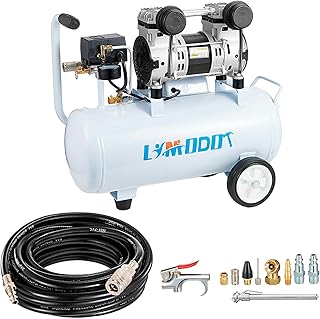
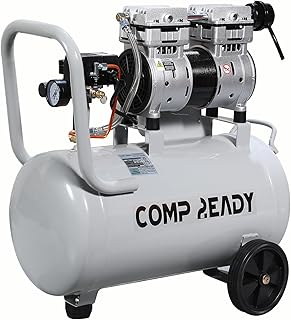
Ultra Quiet 6.4 Gallon, 2HP, 60 dB
The 6.71 CFM at 115 PSI rating paired with a 6.4-gallon tank makes this the only unit here I’d trust for continuous spray work, since it can actually keep up with a gravity-feed gun through a full cabinet door. It’s the heaviest of the group and wants a dedicated corner rather than a truck bed.
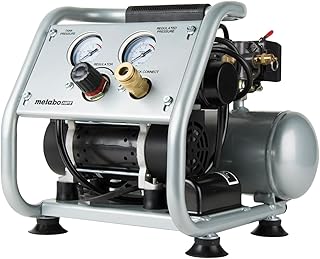
Metabo HPT EC28M, 1 Gallon, 59 dB
At 59 dB this is the quietest thing here, and the universal quick coupler means you’re not hunting for an adapter when you swap from brad nailer to blowgun. The single-gallon tank cycles often, so treat it as a trim and punch-list compressor rather than a shop workhorse.
Ultra Quiet 2.4 Gallon, 1.5HP, 60 dB
This is the sweet spot for most home shops: the same claimed 6.71 CFM output as its bigger sibling in a package light enough to move between the garage and a job site. Good choice if you run a framing nailer occasionally but mostly do finish work.
Quiet Oil-Free 5 Gallon, 68 dB
At 2.8 CFM at 90 PSI it handles nailers and tire work comfortably, and the included hose kit means you’re building on day one. The 68 dB rating is the loudest here, closer to a running dishwasher than a whisper.
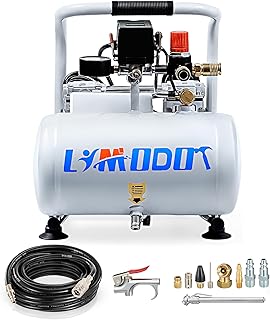
2 Gallon Portable, 0.75HP, 60 dB
The 1.7 CFM output limits this to intermittent tools, but at 60 dB and a genuinely portable footprint it’s a tidy answer for tire inflation, blowing out dust, and pin nailing. Skip it if spray finishing is anywhere in your plans.
Frequently Asked Questions
Can I run a spray gun on a quiet compressor?
Only on the larger-tank, higher-CFM models. An HVLP gun typically draws 4 to 6 CFM continuously, which rules out the 1- and 2-gallon units. The 6.4-gallon model is the safe bet.
Do oil-free pumps wear out faster?
Under commercial duty, yes. For a home shop running a few hundred hours a year, the Teflon-lined cylinders will typically outlast your interest in the project queue.
Why does my compressor sound louder than the rating?
Ratings are taken in open air at about one meter. Concrete floors and drywall reflect sound, so a rubber mat under the feet and a few feet of clearance from walls make a measurable difference.
How often should I drain the tank?
After every session. Condensate collects in the bottom and rusts steel tanks from the inside out, which is the most common way these units die prematurely.
Final Thoughts
For a shop that does everything, the 6.4-gallon Ultra Quiet unit is the most capable pick here and the only one comfortable with spray finishing. If you’re working in a finished basement or apartment, the Metabo HPT EC28M’s 59 dB rating and quick coupler make it the easiest to live with, while the 2.4-gallon Ultra Quiet splits the difference nicely for anyone who wants real airflow in a liftable package.