Anyone who has dragged a stiff rubber air hose across a garage floor in January knows the frustration. The thing coils like a spring, refuses to lie flat, kinks behind the workbench leg, and by the time you have wrestled it into position your brad nailer has lost half its enthusiasm. Worse, cheap hoses shed their fittings, leak at the swivel, and leave you chasing a hiss you can never quite locate. For furniture builders working with pin nailers, upholstery staplers, HVLP sprayers, and the occasional blowgun to clear sawdust off a glue-up, the hose is the weak link nobody budgets for.
This guide looks at air hoses through the lens of a shop where precision matters more than raw volume. We cover the three main hose materials worth your money, the fitting standards that will save you a trip back to the hardware store, and length-versus-diameter tradeoffs that actually affect tool performance. Then we review six hoses that hold up to daily bench work, from tight 25-footers for compact shops to a 100-foot run for anyone finishing pieces in the driveway.
Our top picks



As an Amazon Associate we earn from qualifying purchases at no extra cost to you.
🛒 Best Price Today on Amazon
Prime members get fast, free shipping on everything above, plus member-only deals. New members get a 30-day free trial — cancel anytime.
How to Choose a/an Air Hose For Air Compressor (2026)
- Material: Hybrid polymer stays limp in cold weather and remembers no coils, polyurethane is the lightest option for overhead trim work, and rubber handles abrasion best but weighs you down. For furniture shops, hybrid and PU cover almost every scenario.
- Inner diameter: A 1/4-inch ID moves plenty of air for nailers, staplers, and blowguns. Step up to 3/8-inch if you run a spray gun, sander, or anything with sustained CFM draw, since the wider bore cuts pressure drop over distance.
- Fittings and couplers: Solid brass fittings outlast plated steel and will not seize onto your tool. Confirm the coupler style matches your existing setup: Industrial (Milton M-style) is the most common in North America, but ARO and Automotive plugs are not interchangeable.
- Bend restrictors: These stiff collars at each end prevent the hose from folding right where it meets the fitting, which is where nearly every hose failure begins. Skip a hose that lacks them.
- Length and pressure rating: Match length to your shop layout rather than buying the longest option available; excess hose becomes a trip hazard and a coiling chore. A 300 PSI working rating gives comfortable margin over any portable compressor.
The Best Air Hose For Air Compressor (2026)s Reviewed
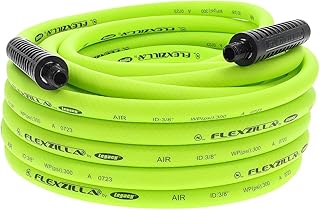
Flexzilla 3/8 in. x 50 ft. Hybrid Polymer Air Hose
Flexzilla set the benchmark for hybrid hose and the ZillaGreen jacket still lies dead flat on a cold concrete floor without a hint of memory coil. The 3/8-inch bore keeps a finish sprayer fed at full pressure across all 50 feet, and the bend restrictors have survived years of being yanked around table saw legs in our experience.
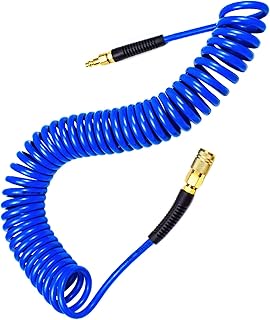
YOTOO Polyurethane Recoil Air Hose, 1/4″ x 25′
The recoil design shines in a tight shop where a straight hose would sprawl across your assembly table, retracting out of the way between cuts. At roughly a pound of working weight it is the easiest hose here to hold overhead while pinning crown molding or face frames.
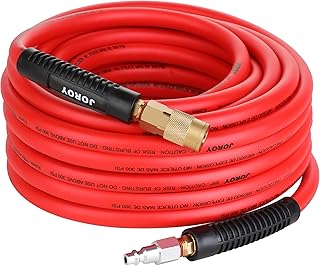
Hybrid Air Hose, 3/8-Inch x 50 Feet, 300 PSI
A strong value alternative to premium hybrid hose, with the same cold-weather flexibility and included brass coupler and plug so you are ready to connect out of the box. The jacket picks up shop grime a little more readily but resists kinking just as well.
Heavy Duty Hybrid Air Hose, 1/4 in x 25 ft, Black
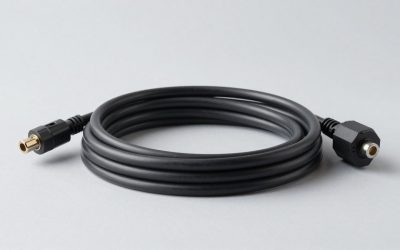
This is the hose to keep permanently attached to a bench-mounted stapler or brad nailer, where 25 feet is plenty and dragging weight is a non-issue. The solid brass male fittings thread cleanly and seal without tape fuss.
25FT Reinforced Polyurethane Braided Air Hose, 1/4 Inch
Braided reinforcement under the PU jacket gives this one noticeably better abrasion resistance than plain polyurethane, which matters if your hose lives on a floor covered in offcuts and screws. Quick connect fittings come installed, making it a genuine grab-and-go option.
Frequently Asked Questions
Does hose length reduce air pressure?
Yes, though less than most people fear. A 25-foot 1/4-inch hose loses only a few PSI at nailer flow rates, but a 100-foot run feeding a sander or spray gun can drop pressure noticeably. Going up to 3/8-inch ID largely solves it.
Is hybrid polymer better than rubber?
For indoor shop work, generally yes. Hybrid hose weighs far less, coils without memory, and stays flexible below freezing. Rubber still wins on abrasion resistance for construction sites and shops with rough, debris-heavy floors.
Do I need PTFE tape on the fittings?
On the NPT threads where a coupler screws into the hose fitting, yes, a few wraps prevent slow leaks. The quick-connect end itself seals with an O-ring and needs nothing.
What pressure rating should I look for?
A 300 PSI working pressure rating is standard and gives roughly a 2:1 margin over a typical 150 PSI portable compressor. Anything rated below 250 PSI is not worth the savings.
Final Thoughts
For most furniture shops, the Flexzilla 3/8 in. x 50 ft. is the hose worth spending on once and forgetting about, particularly if you spray finishes. If your bench work is nailers and staplers within a small footprint, the YOTOO recoil hose keeps your floor clear, while the 100-foot reinforced polyurethane hose is the right call for anyone finishing large pieces outdoors.