Key takeaways
- CFM at 90 PSI: This single number decides whether you can spray. An LVLP gun may run on 3–4 CFM, while a conventional HVLP gun wants 10–13. Match the compressor to the gun you already own, and give yourself 20–30% headroom so the motor isn’t running flat out.
- Tank volume: A bigger tank buys you recovery time, letting pressure stay flat while the motor catches up. Anything under 6 gallons will cycle constantly on a full panel; 13 gallons and up is far more comfortable for continuous work.
- Air quality and moisture control: Compressed air carries water and oil vapor, and both cause fisheyes. Budget for an inline water separator, a desiccant dryer at the gun, and drain the tank after every session. Oil-free pumps sidestep one contamination source entirely.
- Noise level: Painting sessions run long, and a 90 dBA direct-drive unit in an attached garage will make enemies. The 60–70 dBA range is quiet enough to hold a conversation next to, which matters more than you’d expect.
- Duty cycle and pump design: Look for compressors rated for extended run time rather than intermittent bursts. Slower-turning induction motors last longer and run cooler, which also means less condensate pushed into your air line.
What's inside
Spraying automotive paint is where most home compressors get exposed. You can inflate tires, drive brad nails, and blow sawdust off a workbench with almost anything that holds air, but a spray gun asks for something harder: a steady, uninterrupted stream of clean, dry air at a specific pressure for minutes at a time. Undersize the compressor and the motor never stops, tank pressure sags mid-panel, and you get the telltale signs of a starved gun — dry edges, mottled metallic, orange peel that no amount of wet sanding fully rescues.
This guide is written from the garage floor, not the spec sheet. We look at what CFM at 90 PSI actually means when you’re holding a trigger down, why duty cycle matters more than horsepower claims, and where a small airbrush rig genuinely makes sense versus where you need a real tank. Below are six options spanning full-panel refinishing to touch-up and custom graphics work, with notes on what each one is honestly good for.
As an Amazon Associate we earn from qualifying purchases.


🛒 Best Price Today on Amazon
Prime members get fast, free shipping on everything above, plus member-only deals. New members get a 30-day free trial — cancel anytime.
How to Choose a/an Air Compressor For Automotive Painting (2026)
- CFM at 90 PSI: This single number decides whether you can spray. An LVLP gun may run on 3–4 CFM, while a conventional HVLP gun wants 10–13. Match the compressor to the gun you already own, and give yourself 20–30% headroom so the motor isn’t running flat out.
- Tank volume: A bigger tank buys you recovery time, letting pressure stay flat while the motor catches up. Anything under 6 gallons will cycle constantly on a full panel; 13 gallons and up is far more comfortable for continuous work.
- Air quality and moisture control: Compressed air carries water and oil vapor, and both cause fisheyes. Budget for an inline water separator, a desiccant dryer at the gun, and drain the tank after every session. Oil-free pumps sidestep one contamination source entirely.
- Noise level: Painting sessions run long, and a 90 dBA direct-drive unit in an attached garage will make enemies. The 60–70 dBA range is quiet enough to hold a conversation next to, which matters more than you’d expect.
- Duty cycle and pump design: Look for compressors rated for extended run time rather than intermittent bursts. Slower-turning induction motors last longer and run cooler, which also means less condensate pushed into your air line.
The Best Air Compressor For Automotive Painting (2026)s Reviewed
California Air Tools 8010 PK with LVLP Spray Kit
Buying the compressor and a matched LVLP gun together removes the guesswork about whether your air supply can feed your gun, which is the most common mistake first-time painters make. At 60 dBA and 8 gallons, it handles bumpers, doors, and hoods comfortably, though you’ll want to work panel by panel rather than shooting a whole car in one pass.
Klutch 29-Gallon Vertical Compressor
The 29-gallon vertical tank and 5.1 CFM output make this the most capable pick here for sustained spraying, and the footprint is surprisingly manageable for a small shop. The accessible tank drain is a genuinely thoughtful detail, since the compressors people neglect to drain are the ones that rust out from the inside.
California Air Tools CAT-4610AC Twin Tank
Aluminum twin tanks keep this one light enough to carry up steps and immune to internal rust, which suits mobile touch-up and spot repair work. At 4.6 gallons it’s undersized for full-panel refinishing, but for blending, jambs, and small parts it’s a quiet, tidy performer.
VEVOR 13-Gallon Compressor
A 13-gallon tank paired with 4.6 SCFM at 90 PSI puts this in the sweet spot for hobbyist bodywork, and 66 dB means you can run it indoors without ear protection. The wheels and steel body make it a practical all-rounder that also covers tire duty and nailing between paint jobs.
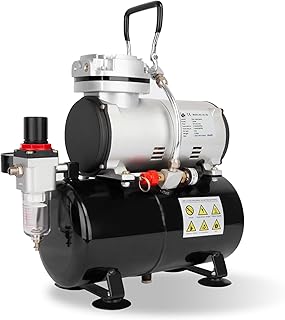
Timbertech ABPST08 Airbrush Compressor
The 3L tank, regulator, and moisture trap cover everything airbrush work needs, and the cooling fan lets it run long enough for detailed custom graphics without heat-cycling. This is a precision tool for pinstriping, flames, and lettering — not a substitute for a shop compressor.
Frequently Asked Questions
How much CFM do I really need to paint a car?
It depends entirely on the gun. Modern LVLP guns can work with 3–5 CFM at 90 PSI, while traditional HVLP guns often demand 10–13 CFM. Check your gun’s air consumption rating first, then buy the compressor.
Is an oil-free compressor better for painting?
For paint work, yes, mainly because it removes the risk of oil carryover contaminating your finish. The tradeoff is that oil-free pumps are typically louder and shorter-lived than oil-lubricated designs, though the quiet models here are exceptions.
Do I still need a filter and dryer?
Always. Compressing air condenses moisture out of it, and that water will reach your gun no matter how good the pump is. A water separator plus a desiccant dryer mounted at the gun handle is the minimum for automotive-quality results.
Can an airbrush compressor spray automotive clear coat?
Not on panels. Airbrush units like the AS186 lack the volume for any full-size spray gun, but they’re excellent for graphics, touch-up, and detail work where a large gun would be clumsy.
Final Thoughts
For serious panel work where run time matters, the Klutch 29-Gallon is the most honest choice here — the tank capacity and 5.1 CFM output mean your gun never runs dry. The VEVOR 13-Gallon is the better value for occasional bodywork and doubles as a general shop compressor, while the California Air Tools 8010 PK is the simplest entry point because the gun and air supply are already matched to each other.