Sandblasting is the one shop task that humbles a compressor. You can strip paint with a cheap gun and a pancake tank for about eight seconds before the pressure collapses and you’re standing there listening to the motor scream. Blasting isn’t a burst-demand job like driving nails or filling tires — it’s a continuous-flow job, and the nozzle doesn’t care how many gallons your tank holds. It cares about CFM, sustained, without interruption. Most people who give up on refinishing furniture hardware or restoring a cast-iron table base didn’t buy the wrong blaster. They bought a compressor that couldn’t feed it.
This guide sorts the problem out from both ends. On one side, the air supply: what actually delivers enough volume to run a nozzle continuously, from serious rotary screw units down to a small airbrush pump for detail work. On the other side, the delivery gear: siphon guns, portable kits, and a bench cabinet that keeps grit off your floor and out of your lungs. Pair them correctly and the whole process gets dull in the best way — steady, predictable, repeatable.
Our top picks




As an Amazon Associate we earn from qualifying purchases at no extra cost to you.
🛒 Best Price Today on Amazon
Prime members get fast, free shipping on everything above, plus member-only deals. New members get a 30-day free trial — cancel anytime.
How to Choose a/an Air Compressor For Sand Blasting (2026)
- CFM at your working pressure: A 1/8″ nozzle wants roughly 6–8 CFM at 90 PSI; step up to 3/16″ and you’re near 16–20 CFM. Read the rating at the pressure you’ll actually blast at, not the peak number on the sticker, and add 30% headroom so the unit isn’t running at 100% duty.
- Duty cycle over horsepower: Reciprocating compressors are built to rest between cycles. Rotary screw units run continuously all day. If a blasting session lasts longer than fifteen minutes, duty cycle matters far more than the horsepower figure.
- Moisture control is non-negotiable: Damp air turns abrasive into concrete inside your gun. Budget for a water trap at minimum, and a refrigerated dryer if you’re blasting regularly — clogged nozzles waste more time than the dryer costs.
- Match your electrical service first: Three-phase 480V industrial machines are excellent and completely useless in a garage on single-phase 240V. Confirm your panel, breaker size, and wire gauge before you shop, not after delivery.
- Containment and recovery: Open blasting sprays media everywhere and you’ll only reclaim it once. A cabinet recycles abrasive, cuts cleanup to nothing, and keeps silica out of your breathing space.
The Best Air Compressor For Sand Blasting (2026)s Reviewed
40HP VSD Rotary Screw Compressor, 185CFM @ 125PSI
At 185 CFM this feeds large nozzles indefinitely, and the variable speed drive trims power draw when demand dips instead of dumping pressure. It needs 480V three-phase service, so this is production-shop equipment — but for restoration work at volume, nothing smaller keeps pace.
7.5KW 10HP Rotary Screw with 80-Gal Tank & Dryer
The sweet spot for a serious home or small commercial shop: 35 CFM at 125 PSI on 230V three-phase, with the ASME tank and air dryer already integrated. Continuous-duty operation and dry air out of the box means you can blast for an hour without babysitting the gauge.
Light-Duty Air Sandblaster Gun Kit
A metal-bodied gun that runs siphon or gravity feed with a swappable ceramic nozzle — genuinely useful for spot-treating rust on hardware, stripping small brackets, or etching glass inserts. Pair it with at least 6 CFM and treat the ceramic tip as a wear item.
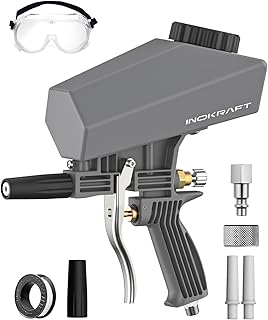
Inokraft Portable Sand Blaster Gun Kit
Designed around the 60–120 PSI range most garage compressors actually hit, with a leak-tight feed that handles aluminum oxide and soda without constant fiddling. The best entry point if you want to test whether blasting belongs in your workflow before committing to a cabinet.
40 Gallon Bench Top Sandblasting Cabinet
Heavy steel construction, four nozzles included, and a 6–25 CFM window that suits most two-stage reciprocating compressors. Reclaiming your media inside the cabinet pays for itself quickly, and the containment alone justifies the bench space.
Frequently Asked Questions
Can I sandblast with a small pancake compressor?
Only in short bursts on tiny parts, and even then you’ll spend most of the session waiting for recovery. Blasting draws air continuously, so tank size can’t compensate for low CFM output.
What does the PointZero airbrush compressor work for?
It’s a detail tool, not a blasting supply. The 1/5 HP pump with tank, regulator, and water trap is ideal for airbrushing finishes and touching up refinished furniture — pair it with a proper compressor for the actual abrasive work.
Do I really need an air dryer?
If you blast more than occasionally, yes. Moisture causes media bridging and inconsistent flow, and it accelerates corrosion on the freshly cleaned metal you just exposed.
Which abrasive should I start with?
Aluminum oxide cuts fast and lasts through multiple cycles in a cabinet. Use soda for softer substrates or delicate antique hardware where you want paint gone without altering the surface underneath.
Final Thoughts
For most home shops doing regular furniture restoration, the 7.5KW 10HP rotary screw with integrated dryer is the honest answer — continuous duty, dry air, and enough CFM to run a real nozzle. Add the 40 Gallon Bench Top Cabinet to contain and reclaim your media, and keep the Inokraft portable gun on hand for the pieces too large or awkward to fit inside. Scale up to the 40HP VSD unit only when your workload genuinely demands it and your electrical service can support it.