Key takeaways
- Tooth count drives finish: 24T to 40T clears sawdust fast for ripping thick stock, 50T combination blades handle general work, and 60T to 80T blades deliver glass-smooth crosscuts in hardwood, melamine, and plywood.
- Kerf and motor power: Thin-kerf blades around .098″ remove less material and put less strain on 1.5 HP saws. If your saw has 3 HP or more, a full-kerf blade resists deflection better in heavy rips.
- Grind geometry matters: ATB (alternate top bevel) teeth slice cleanly across grain, flat-top FTG teeth excel at ripping, and TCG (triple chip) is your friend for laminates and non-ferrous metals.
- Arbor fit and plate quality: Confirm the 5/8″ arbor matches your saw, and check for laser-cut expansion slots and a hardened, tensioned plate — cheap plates wobble once they heat up.
- Coatings and cleanup: Non-stick coatings like Perma-Shield reduce pitch buildup, gumming, and heat, which means fewer cleaning sessions and longer intervals between sharpenings.
What's inside
The blade that shipped with your table saw is almost certainly the weakest link in your shop. Most factory blades are 24-tooth ripping blades chosen to keep a saw’s price point down, and they leave behind splintered edges, scorched end grain, and tearout on plywood veneer that no amount of sanding fully rescues. You end up blaming the fence, the alignment, the wood itself — when the real culprit is spinning at 4,000 RPM in front of you.
Swapping in the right 10-inch blade is the cheapest meaningful upgrade you can make to a contractor or cabinet saw. Below are six blades worth your money in 2026, spanning dedicated fine-finish crosscut blades, all-purpose combination blades, and multi-packs that cover framing through furniture work. We look at tooth count, kerf, grind geometry, and where each blade earns its keep in a real home shop.
As an Amazon Associate we earn from qualifying purchases.


🛒 Best Price Today on Amazon
Prime members get fast, free shipping on everything above, plus member-only deals. New members get a 30-day free trial — cancel anytime.
How to Choose a 10in Table Saw Blade (2026)
- Tooth count drives finish: 24T to 40T clears sawdust fast for ripping thick stock, 50T combination blades handle general work, and 60T to 80T blades deliver glass-smooth crosscuts in hardwood, melamine, and plywood.
- Kerf and motor power: Thin-kerf blades around .098″ remove less material and put less strain on 1.5 HP saws. If your saw has 3 HP or more, a full-kerf blade resists deflection better in heavy rips.
- Grind geometry matters: ATB (alternate top bevel) teeth slice cleanly across grain, flat-top FTG teeth excel at ripping, and TCG (triple chip) is your friend for laminates and non-ferrous metals.
- Arbor fit and plate quality: Confirm the 5/8″ arbor matches your saw, and check for laser-cut expansion slots and a hardened, tensioned plate — cheap plates wobble once they heat up.
- Coatings and cleanup: Non-stick coatings like Perma-Shield reduce pitch buildup, gumming, and heat, which means fewer cleaning sessions and longer intervals between sharpenings.
The Best 10in Table Saw Blade (2026)s Reviewed
DEWALT 40-Tooth Fine Finish Blade (DWA11040)
The 40-tooth count hits the sweet spot for a shop that rips and crosscuts in the same session, and the tungsten carbide teeth hold their edge through plenty of hardwood. It’s a sensible first upgrade if you own one blade and want it to do most jobs well.
FOXBC 80-Tooth Ultra Finish Blade
Eighty teeth on a 10-inch plate means very small bites and correspondingly clean exit cuts, which is exactly what you want in birch ply or pre-finished trim. Feed slowly and let the blade work, since forcing an 80T blade through thick stock will burn your workpiece.
WEN BL1080 80-Tooth Blade
An affordable way into ultra-fine finish territory, and it moves easily between your miter saw and table saw. Ideal as a dedicated trim and crosscut blade you swap in for the last stage of a project.
Diablo D1050X 50-Tooth Combination Blade
The genuine do-it-all pick: a .098″ thin kerf keeps underpowered saws happy, the 15° hook angle balances feed rate against finish, and the Perma-Shield coating keeps resin from building up on the plate. If you only buy one blade this year, this is a strong contender.
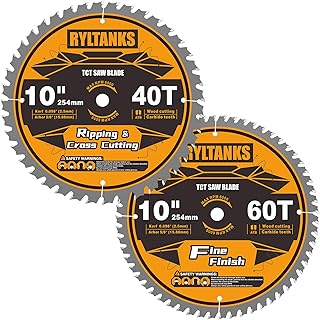
32T / 60T / 80T 3-Pack
Three blades covering framing, fine finish, and ultra-fine finish is a smart way to stock a new shop without paying premium prices per blade. They won’t outlast a top-shelf blade, but having the correct tooth count on hand beats forcing the wrong one through a cut.
Frequently Asked Questions
How often should I change or sharpen a blade?
Watch for symptoms rather than counting hours: increased feed resistance, burn marks, and rougher edges all point to a dull edge. Carbide-tipped blades can usually be professionally sharpened two or three times before replacement makes more sense.
Can I use a 10-inch table saw blade in my miter saw?
Often yes, provided the arbor size matches and the blade’s maximum RPM exceeds your saw’s speed. Check the hook angle too — aggressive positive hook angles designed for table saws can grab and self-feed on a sliding miter saw.
Is a thin-kerf blade always better?
Not always. Thin kerf saves stock and reduces motor load, which suits smaller saws, but the thinner plate is more prone to deflection in long rips. Use a zero-clearance insert and a splitter to get the most from one.
How do I clean pitch off a blade?
Soak the blade in a dedicated blade cleaner or simple green solution, then work the teeth gently with a brass brush. Skip oven cleaner, since caustic chemicals can attack the brazing that holds carbide teeth to the plate.
Final Thoughts
For most home furniture makers, the Diablo D1050X combination blade is the one to reach for first — it handles rips and crosscuts capably without punishing a smaller motor. Pair it with the FOXBC 80-tooth for veneered sheet goods and finish trim, and keep the DEWALT DWA11040 in rotation if you want a sturdier 40-tooth workhorse for daily use.