Key takeaways
- Tooth count: For hardwood crosscuts, plywood, and trim, 80 to 100 teeth is the sweet spot. Under 60 teeth cuts faster and cooler but leaves tearout you’ll have to sand out. Over 100 teeth on a 12-inch plate can bog underpowered saws and scorch dense stock.
- Grind geometry: ATB (alternate top bevel) teeth slice wood fibers cleanly and are what you want for furniture work. TCG and flat-top grinds belong on melamine, laminates, and non-ferrous metal, not on walnut.
- Kerf width: Thin kerf blades around 0.098 inch remove less material and put less strain on the motor, which matters on 15-amp saws and long miters. Full kerf plates are stiffer and track straighter in thick, wet, or knotty stock.
- Plate quality: Look for laser-cut expansion slots, a hardened tensioned body, and an anti-friction coating. A warped or under-tensioned plate will deflect mid-cut no matter how good the carbide is, and you’ll see it as a wandering shoulder on a mitered joint.
- Arbor and hardware: Nearly all 12-inch saws use a 1-inch arbor. Confirm before ordering, check that the blade’s maximum RPM exceeds your saw’s no-load speed, and keep the factory washer in place.
What's inside
You bolted a new blade onto your miter saw, made a crosscut in poplar, and the edge came off looking like it had been chewed rather than cut. Splintered top face, fuzzy shoulders, and a burn line halfway through the kerf. Most of the time the saw isn’t the problem. The blade that ships in the box is a general-purpose carbide plate built to move framing lumber quickly, and it will never give you a glue-ready end grain on a table apron or a crisp return on painted baseboard. Swapping it is the single cheapest upgrade you can make to a 12-inch saw.
The trouble is that blade specs read like a parts catalog. Tooth counts run from 24 to 100, hook angles are rarely printed on the label, and “fine finish” means whatever the marketing team decided. Below I’ve sorted through the 12-inch blades that actually earn a spot in a furniture shop, with notes on where each one shines and where it struggles. You’ll also find a short buying checklist so you can read a blade box the way a machinist reads a caliper.
As an Amazon Associate we earn from qualifying purchases.
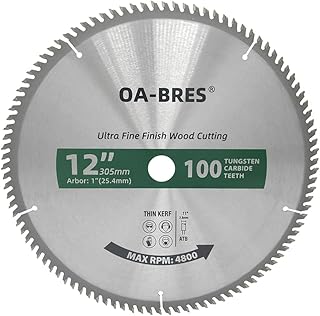


🛒 Best Price Today on Amazon
Prime members get fast, free shipping on everything above, plus member-only deals. New members get a 30-day free trial — cancel anytime.
How to Choose a 12-Inch Miter Saw Blade (2026)
- Tooth count: For hardwood crosscuts, plywood, and trim, 80 to 100 teeth is the sweet spot. Under 60 teeth cuts faster and cooler but leaves tearout you’ll have to sand out. Over 100 teeth on a 12-inch plate can bog underpowered saws and scorch dense stock.
- Grind geometry: ATB (alternate top bevel) teeth slice wood fibers cleanly and are what you want for furniture work. TCG and flat-top grinds belong on melamine, laminates, and non-ferrous metal, not on walnut.
- Kerf width: Thin kerf blades around 0.098 inch remove less material and put less strain on the motor, which matters on 15-amp saws and long miters. Full kerf plates are stiffer and track straighter in thick, wet, or knotty stock.
- Plate quality: Look for laser-cut expansion slots, a hardened tensioned body, and an anti-friction coating. A warped or under-tensioned plate will deflect mid-cut no matter how good the carbide is, and you’ll see it as a wandering shoulder on a mitered joint.
- Arbor and hardware: Nearly all 12-inch saws use a 1-inch arbor. Confirm before ordering, check that the blade’s maximum RPM exceeds your saw’s no-load speed, and keep the factory washer in place.
The Best 12-Inch Miter Saw Blades Reviewed (2026)
DEWALT 12-Inch 100-Tooth Fine Finish (DWA112100)
This is my default recommendation for anyone building case goods or hanging trim, because the tungsten carbide teeth hold an edge through hundreds of cuts in maple without polishing over. Feed it slowly and let the blade do the work; rush a 100-tooth blade through thick oak and you’ll get burn marks that have nothing to do with the carbide.
Diablo D1280X 12-Inch 80-Tooth
Freud’s Hi-Density carbide and the perma-shield coating make this the most versatile blade in the group, quick enough for a run of 2x material yet clean enough for a finished miter. If you only want one blade on the saw permanently, the 80-tooth count is the smarter compromise than a 100.
Makita B-67000 12-Inch 100T Max Efficiency
The thin kerf and aggressive tooth geometry here let a cordless or lower-amp saw cut like a bigger machine, with noticeably less motor lug on wide crosscuts. Build quality is excellent, though the price sits above the rest and the thin plate rewards a saw with tight bearings and no arbor slop.
Freud LU86R012 12-Inch 48T Thin Kerf
A genuinely underrated blade if you cut a lot of construction lumber and sheet goods in the same session, since 48 teeth clear chips fast without shredding plywood veneer. It won’t match the 100-tooth blades on a show-face miter, but it’s the one I reach for when I’m breaking down rough stock.
FOXBC 12-Inch 100-Tooth Polished Finish
The budget entry, and it genuinely surprised me on pine and poplar, laying down a glassy surface right off the saw. Carbide life is shorter than the name-brand blades and it dulls faster in hardwood, so treat it as a great value blade for softwood trim rather than a lifetime purchase.
Frequently Asked Questions
Is a 100-tooth blade always better than an 80?
No. More teeth means a finer finish but slower feed rate and more heat, since each tooth removes a smaller chip. For stock over an inch and a half thick, an 80-tooth blade usually cuts cleaner because it clears sawdust instead of packing it into the kerf.
Why is my new blade burning the wood?
Usually feed rate or dwell time. Burning happens when the blade spins against the workpiece without cutting, so lower the head at a steady pace, don’t pause at the bottom of the stroke, and lift the head only after the blade clears. Pitch buildup on the teeth causes it too, and a spray-on resin remover fixes that in minutes.
Can I sharpen these blades or should I replace them?
Carbide-tipped blades can be professionally resharpened three to five times, and on a premium 80- or 100-tooth blade that’s clearly worth the cost. Budget blades usually cost less to replace than to send out.
Do I need a negative hook angle?
For sliding miter saws, yes, a low or slightly negative hook angle keeps the blade from self-feeding and grabbing the workpiece. On a standard chop saw, a mild positive hook is fine and cuts a little faster.
Final Thoughts
If you build furniture and want one blade that handles almost everything, the Diablo D1280X is the practical choice. Step up to the DEWALT DWA112100 when finish quality on hardwood matters more than speed, and put the Freud LU86R012 on the saw when you’re processing rough lumber and don’t want to dull an expensive fine-finish blade doing it.