Anyone who has hauled a corded jobsite saw into a half-finished garage knows the ritual: find the outlet, unspool fifty feet of extension cord, then trip over it twice while breaking down plywood for a bookcase. Cordless table saws promise to end that dance, but the category is genuinely tricky to shop. Battery platforms don’t cross-pollinate, blade sizes shrink to 8-1/4 inches, and a saw that cuts beautifully through pine can bog down halfway through 3/4-inch white oak if the battery can’t keep up with the amp draw.
This guide sorts through what actually matters when you’re building furniture rather than framing walls: rip capacity for cabinet-grade sheet goods, how many cuts you realistically get per charge, fence accuracy you can trust for repeat joinery, and whether a battery saw or a light corded model is the smarter buy for your shop. Below are the models worth your money in 2026, including two corded picks that still outperform anything cordless if your outlet situation isn’t hopeless.
Our top picks




As an Amazon Associate we earn from qualifying purchases at no extra cost to you.
🛒 Best Price Today on Amazon
Prime members get fast, free shipping on everything above, plus member-only deals. New members get a 30-day free trial — cancel anytime.
How to Choose a Cordless Table Saw (2026)
- Battery platform first: Buy into the system you already own. A RYOBI ONE+ HP saw is a bargain if you have five 18V packs on the shelf, and a poor value if your batteries are all DEWALT FLEXVOLT. Factor spare batteries into your real cost.
- Rip capacity over blade size: Nearly every cordless saw runs an 8-1/4-inch blade, so the differentiator is how far the fence travels. Look for 24 inches minimum to rip a sheet of plywood down the middle; 32-1/2 inches lets you center a cut on a full 4×8 without flipping the panel.
- Watch depth of cut: An 8-1/4-inch blade gives roughly 2-1/2 inches at 90 degrees, which handles 2x material but limits you on thick tabletop stock. If you regularly resaw or cut 4×4 legs, a 10-inch corded saw is the honest answer.
- Fence and miter slot quality: Furniture work lives or dies on repeatability. Check that the rack-and-pinion fence locks square without deflection and that the miter slots are standard T-track so your crosscut sled and feather boards will fit.
- Stand and dust management: A folding rolling stand turns a 60-pound saw into something one person can move alone. Pair it with a 2-1/2-inch dust port and a shop vac — cordless saws throw sawdust just as enthusiastically as corded ones.
The Best Cordless Table Saws Reviewed (2026)
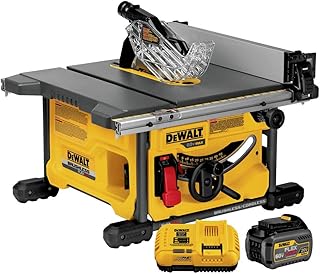
DEWALT FLEXVOLT 60V MAX 8-1/4-Inch (DCS7485T1)
This is the cordless saw that finally feels like a real table saw — the 60V FLEXVOLT pack pushes through hardwood rips without the RPM sag that plagues 18V and 20V machines, and the 24-1/2-inch rip capacity covers most casework. The included battery also runs your 20V tools at 20V, which softens the sting of the price.
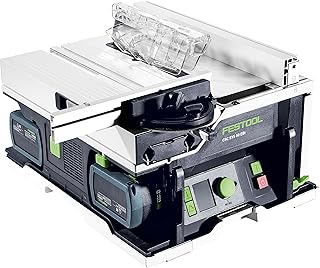
FLEX 24V Brushless 8-1/4-Inch (FX7211-1H)
FLEX’s stacked-lithium 6.0Ah pack is the standout here, delivering sustained power and recharging in a genuinely fast window with the 280W rapid charger. The fence is crisp and the deck is flatter than you’d expect at this size, making it a strong choice for anyone building a cordless shop from scratch.
RYOBI ONE+ HP 18V Brushless 8-1/4-Inch Kit
The value play, especially if you already live on the ONE+ platform — the kit ships with two 4.0Ah batteries, so you can keep one charging while you work. It’s happiest in softwoods, plywood, and MDF; slow your feed rate in dense hardwood and it holds up fine.
DEWALT 10-Inch with Rolling Stand (DWE7491RS)
Still the benchmark for a portable furniture-shop saw: 32-1/2 inches of rip capacity, a full 10-inch blade for thicker stock, and a rolling stand that folds down and wheels out of the way. If you have power at the bench, this beats every cordless saw on capability.
SKIL 15 Amp 10-Inch with Folding Stand (TS6307-00)
An underrated corded option with a rack-and-pinion fence that stays parallel and a stand that folds in seconds. The 10-inch blade and generous table make it a smart first table saw for someone furnishing a garage shop on a budget.
Frequently Asked Questions
How many cuts can I get per battery charge?
Expect roughly 25 to 60 crosscuts in 3/4-inch plywood from a healthy 6.0Ah pack, dropping sharply in hardwood. Plan on two batteries minimum for any project day.
Is an 8-1/4-inch blade a real limitation for furniture?
For sheet goods, aprons, rails, and most solid stock up to 2 inches thick, no. For thick tabletops, chunky legs, or resawing, you’ll want a 10-inch saw.
Can I use my existing 10-inch blades?
No — arbor size may match, but the smaller saw’s guard and throat won’t accept a larger diameter. Buy quality 40- to 60-tooth 8-1/4-inch blades for clean furniture cuts.
Do cordless saws come with a riving knife?
All current models ship with a riving knife, anti-kickback pawls, and a blade guard. Keep the riving knife installed for every through-cut; it is the single best defense against kickback.
Final Thoughts
If you want true cordless freedom with hardwood capability, the DEWALT FLEXVOLT 60V (DCS7485T1) is the most complete package on the market, with the FLEX 24V FX7211-1H right behind it thanks to that stacked-lithium battery. Budget-minded makers already on the ONE+ platform should grab the RYOBI 18V HP kit — and if you have an outlet within reach of your bench, the DEWALT DWE7491RS remains the best furniture-building saw of the bunch.