Key takeaways
- Base and cylinder: Look for a steel or reinforced metal base rather than nylon, and check the gas lift class. A Class 3 or Class 4 cylinder resists the slow sink that ruins a chair long before the upholstery wears out.
- Cushion construction: Pocket spring seats hold their shape far longer than single-density foam. If the listing specifies foam only, look for a stated thickness above four inches and a molded (not cut) pad.
- Lumbar that moves: Adjustable lumbar support should travel vertically, ideally with depth adjustment too. A fixed bump lands wrong on most spines and becomes a pressure point after hour three.
- Seat width and depth: Measure your current chair before ordering. Extra-wide seats around 22 inches suit broader frames, but a seat that is too deep cuts circulation behind the knees no matter how good the padding is.
- Caster type for your floor: Rubber or PU-coated wheels roll quietly on hardwood and will not scar a finish. Hard plastic casters belong on carpet only, and swapping them out later is a five-minute job if the stems match.
What's inside
Anyone who has spent a full workday in a cheap desk chair knows the drill: the foam flattens by month three, the gas lift starts sinking mid-call, and the armrests wobble like a loose cabinet hinge. I have taken apart enough of these to see the pattern, and it is almost always the same three culprits: a nylon base that flexes under load, a seat pan cushioned with the density of packing foam, and lumbar “support” that is nothing more than a bulge stitched into the upholstery. Long hours punish every one of those shortcuts.
This guide looks at executive chairs through a builder’s eye: what the frame is made of, how the tilt mechanism is anchored, whether the lumbar block actually travels, and how much weight the whole assembly is rated to carry. I have focused on high-back models built for eight-hour-plus sessions, including several big-and-tall options with 400 to 500 lb capacities. Below you will find the picks, a practical buying checklist, short reviews, and answers to the questions that come up most often once the box is open on the living room floor.
As an Amazon Associate we earn from qualifying purchases.




🛒 Best Price Today on Amazon
Prime members get fast, free shipping on everything above, plus member-only deals. New members get a 30-day free trial — cancel anytime.
How to Choose an Executive Office Chair For Long Hours (2026)
- Base and cylinder: Look for a steel or reinforced metal base rather than nylon, and check the gas lift class. A Class 3 or Class 4 cylinder resists the slow sink that ruins a chair long before the upholstery wears out.
- Cushion construction: Pocket spring seats hold their shape far longer than single-density foam. If the listing specifies foam only, look for a stated thickness above four inches and a molded (not cut) pad.
- Lumbar that moves: Adjustable lumbar support should travel vertically, ideally with depth adjustment too. A fixed bump lands wrong on most spines and becomes a pressure point after hour three.
- Seat width and depth: Measure your current chair before ordering. Extra-wide seats around 22 inches suit broader frames, but a seat that is too deep cuts circulation behind the knees no matter how good the padding is.
- Caster type for your floor: Rubber or PU-coated wheels roll quietly on hardwood and will not scar a finish. Hard plastic casters belong on carpet only, and swapping them out later is a five-minute job if the stems match.
The Best Executive Office Chair For Long Hours (2026)s Reviewed
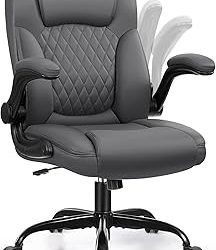
High Back Ergonomic Executive Chair with Flip Arms
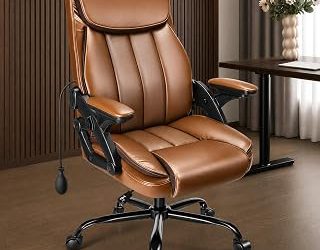
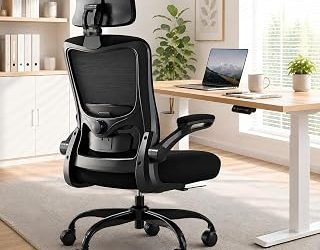
The flip-up arms make this the most practical pick for tight desks, letting you tuck the chair fully under a worktop when you need floor space. Its metal base and built-in adjustable lumbar block put it well ahead of the nylon-framed chairs in the same price bracket, and the thick padding holds up through long stretches.
X100 Ergonomic Mesh Chair with Footrest
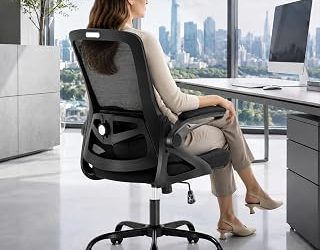
Breathable mesh solves the heat problem that leather executive chairs never quite fix, and the 5D flip-up arms adjust in more directions than most chairs twice the price. The 3D lumbar support is the standout here, moving up, down, and forward so you can dial in the exact contact point along your lower back.
Big and Tall Executive Chair with Extra Wide Seat
Built around a heavy-duty frame with a genuinely wide seat pan, this one suits larger builds that bottom out on standard chairs within weeks. Quiet rolling wheels and a straightforward lumbar adjustment make it an easy recommendation for anyone who wants durability without a long list of levers.
EXCEBET Big and Tall Chair with Footrest
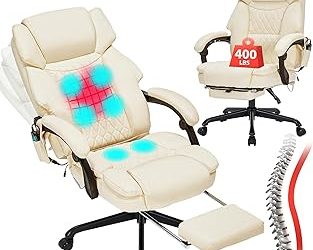
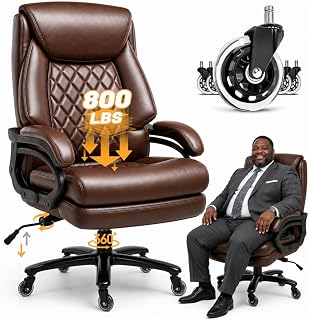
The 400 lb rating and brown PU leather give this chair a traditional executive look with real structural backing underneath. The retractable footrest earns its keep during reading or long calls, and the padded armrests spare your elbows the hard plastic edge you find on budget models.
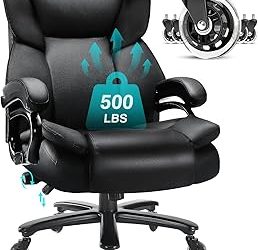
500lbs Big and Tall Chair with Pocket Spring Cushion
Pocket spring seating is the upgrade most buyers overlook, and it is the main reason this chair still feels supportive at the end of a long day. Combined with a 500 lb capacity, quiet rubber casters, and adjustable lumbar support, it is the most heavy-duty pick in this lineup.
Frequently Asked Questions
How long does assembly usually take?
Plan on 30 to 45 minutes for a high-back executive chair. Keep the included Allen key handy but finish tightening with a proper hex driver, and leave every bolt slightly loose until the whole frame is together so the holes line up without a fight.
Is mesh or leather better for all-day sitting?
Mesh wins on airflow and suits warm rooms or anyone who runs hot. PU leather feels more substantial and wipes clean easily, but it traps heat, so consider your climate before deciding.
Do I really need a big-and-tall chair?
If you are over roughly 250 lb or 6 feet tall, yes. These models use thicker steel, wider seat pans, and higher-class cylinders, all of which extend service life considerably under heavier daily loads.
Why does my chair keep sinking?
That is the gas cylinder failing, not the chair itself. Replacement cylinders are inexpensive and standard-sized, and swapping one takes about 15 minutes with a rubber mallet and a pipe wrench.
Final Thoughts
For most home offices, the X100 mesh chair offers the best balance of adjustability and ventilation, while the High Back Ergonomic Executive Chair with flip arms is the smarter buy if desk clearance matters. If you need serious load capacity, the 500lbs pocket spring model is the one I would build a workday around.