Key takeaways
- Match reach to your actual house: A single-story home with 8-foot ceilings needs something entirely different than a two-story with gutters at 20 feet. Measure your highest realistic target, then subtract about four feet from the ladder’s stated length — that’s roughly your safe standing reach on an extension.
- Duty rating over headline capacity: Type IA (300 lbs) and the 330-lb ratings on most telescoping models aren’t just about your body weight. Add tools, a paint can, and shingles you’re hauling up. Aim for a rating that leaves 75 pounds of headroom.
- Fiberglass for anything electrical: Aluminum conducts. If you’re anywhere near a service panel, exterior wiring, or overhead lines, fiberglass is the only defensible choice. It’s heavier, and that’s the tradeoff you accept.
- Storage footprint is a real constraint: Telescoping models collapse to roughly three feet, which matters enormously if you’re in a townhouse or apartment. A traditional A-frame needs wall space and a garage that can spare it.
- Stabilizer bars and outriggers earn their keep: Wide stabilizers dramatically reduce side-to-side sway on uneven ground — lawn, gravel, sloped driveways. Once you’ve used one, going back to bare feet feels unnervingly tippy.
Every homeowner hits the same wall eventually. You need to swap a smoke detector battery, and the folding chair you’re standing on wobbles in a way that makes your stomach drop. Or you’re clearing gutters in October and realize the ancient wooden ladder in the garage has a crack running through the third rung. The problem isn’t that ladders are complicated — it’s that most of us buy one ladder and expect it to handle everything from a light bulb change to a second-story roofline. Those are genuinely different jobs, and a single ladder can’t always split the difference.
I’ve spent enough weekends on renovation projects to have opinions about this. The good news for 2026 is that telescoping and multi-position ladders have gotten genuinely solid — stabilizer bars, locking hinges that actually click into place, and aluminum extrusions that don’t flex like a diving board. This guide walks through six options covering the realistic range of homeowner tasks, from a straightforward fiberglass step ladder for electrical work to convertible units that collapse small enough to live in a closet. I’ll flag what each one does well and where it falls short.
Our top picks




As an Amazon Associate we earn from qualifying purchases at no extra cost to you. Ratings are shown as listed on Amazon.
🛒 Best Price Today on Amazon
Prime members get fast, free shipping on everything above, plus member-only deals. New members get a 30-day free trial — cancel anytime.
How to Choose a Ladder For Homeowner (2026)
- Match reach to your actual house: A single-story home with 8-foot ceilings needs something entirely different than a two-story with gutters at 20 feet. Measure your highest realistic target, then subtract about four feet from the ladder’s stated length — that’s roughly your safe standing reach on an extension.
- Duty rating over headline capacity: Type IA (300 lbs) and the 330-lb ratings on most telescoping models aren’t just about your body weight. Add tools, a paint can, and shingles you’re hauling up. Aim for a rating that leaves 75 pounds of headroom.
- Fiberglass for anything electrical: Aluminum conducts. If you’re anywhere near a service panel, exterior wiring, or overhead lines, fiberglass is the only defensible choice. It’s heavier, and that’s the tradeoff you accept.
- Storage footprint is a real constraint: Telescoping models collapse to roughly three feet, which matters enormously if you’re in a townhouse or apartment. A traditional A-frame needs wall space and a garage that can spare it.
- Stabilizer bars and outriggers earn their keep: Wide stabilizers dramatically reduce side-to-side sway on uneven ground — lawn, gravel, sloped driveways. Once you’ve used one, going back to bare feet feels unnervingly tippy.
The Best Ladder For Homeowner (2026)s Reviewed
SocTone 12.5FT Telescoping Ladder with Stabilizers
This is the ladder I’d hand a first-time homeowner: it extends rung-by-rung so you can dial in exactly the height you need, then collapses to something you can carry one-handed to the car. The stabilizer bar makes a noticeable difference on soft ground, and 12.5 feet covers gutters and single-story rooflines comfortably.
LANBITOU 14FT A-Frame Multi-Position Ladder
The hinge design here converts between A-frame, extension, and stairwell configurations without fighting you, which makes it genuinely useful for interior painting where you’re working over a staircase. Anti-slip treads are wide enough to stand on for twenty minutes without your arches complaining.
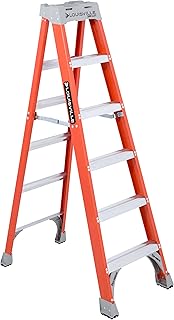
Louisville Ladder 6-Foot Fiberglass Step Ladder (FS1506)
Not exciting, just correct. Louisville has been making these forever, and the Type IA fiberglass build with its molded top and tool slots is the right answer for ceiling fixtures, panel work, and anything where you’d rather not be holding conductive metal.
5-Step Folding Ladder for Home Use
For indoor work — closet shelves, curtain rods, cabinet tops — this hits the sweet spot between reach and convenience. Wide anti-slip steps and a 330-lb capacity mean it feels planted, and it folds flat enough to tuck behind a door.
Telescoping A-Frame Ladder, 17FT with Stabilizer Bar & Wheels
The wheels are the underrated feature: 17 feet of aluminum gets awkward to carry, and rolling it across the driveway beats wrestling it. This is the pick for two-story exteriors where you need real vertical range without buying a dedicated extension ladder.
Frequently Asked Questions
How tall a ladder do I actually need for gutters?
For a typical single-story home with gutters at 10 to 12 feet, a 12.5-foot telescoping ladder works well. Two-story homes generally need 17 to 20 feet, since you want the top resting three feet above your working point.
Are telescoping ladders safe compared to traditional ones?
Modern ones with proper locking mechanisms are, provided you verify every rung has clicked and locked before climbing. Inspect the locks periodically — grit in the mechanism is the main failure point, and a quick wipe-down after dusty jobs prevents it.
What’s the deal with duty ratings like Type IA?
Type IA means 300-pound capacity, rated for heavy industrial use. Type II is 225 pounds and Type III is 200. For homeowner work, Type IA or a 330-lb rating gives you margin for tools and materials.
Can I use a multi-position ladder on stairs?
Yes, that’s one of the main reasons to buy one. The independently adjustable legs let you set different heights on adjacent steps, which no standard A-frame can do safely.
Final Thoughts
If you want one ladder to cover the widest range of household jobs, the SocTone 12.5FT telescoping model is the most practical starting point — compact storage, real stability, enough reach for most single-story work. Homeowners with two stories or steep rooflines should step up to the 17FT telescoping A-frame with wheels, and anyone doing electrical work should keep the Louisville FS1506 fiberglass step ladder on hand as a dedicated second ladder. That pairing covers nearly everything a house will throw at you.