Key takeaways
- Footprint: Measure both the saw and the outfeed space it needs; a compact machine is only useful if you can safely feed long boards.
- Rip capacity: Around 24 inches handles most furniture parts, while 30 inches or more is helpful when breaking down plywood.
- Fence and adjustments: Look for a fence that locks squarely and handwheels or controls that move smoothly without excessive play.
- Stand and storage: A folding or wheeled stand saves setup time and makes it easier to clear the shop when the saw is not in use.
- Safety and dust: A riving knife, blade guard, reliable switch, and dust port are more important than headline RPM figures.
Small shops rarely have room for a full-size cabinet saw, but that does not mean you should settle for sloppy cuts or a fence that shifts halfway through a panel. The right portable table saw can turn a corner of a garage into a capable furniture-making station—provided it balances footprint, accuracy, dust control, and easy storage.
This guide looks at the practical details that matter at the workbench: rip capacity for sheet goods, stand stability, fence quality, blade adjustment, and how easily each saw fits into a small-shop workflow. The picks range from serious jobsite machines to compact benchtop options for lighter DIY projects.
Our top picks



As an Amazon Associate we earn from qualifying purchases at no extra cost to you. Ratings are shown as listed on Amazon.
🛒 Best Price Today on Amazon
Prime members get fast, free shipping on everything above, plus member-only deals. New members get a 30-day free trial — cancel anytime.
How to Choose a Table Saw For Small Shops (2026)
- Footprint: Measure both the saw and the outfeed space it needs; a compact machine is only useful if you can safely feed long boards.
- Rip capacity: Around 24 inches handles most furniture parts, while 30 inches or more is helpful when breaking down plywood.
- Fence and adjustments: Look for a fence that locks squarely and handwheels or controls that move smoothly without excessive play.
- Stand and storage: A folding or wheeled stand saves setup time and makes it easier to clear the shop when the saw is not in use.
- Safety and dust: A riving knife, blade guard, reliable switch, and dust port are more important than headline RPM figures.
The Best Table Saw For Small Shops (2026)s Reviewed
DEWALT DWE7491RS 10-Inch Table Saw
The DWE7491RS is the strongest all-around choice for a small furniture shop that regularly works with plywood and wider boards. Its rolling stand is genuinely useful when the saw must share space with assembly tables, and the generous rip capacity gives you room to grow into larger cabinet and shelving projects. The rack-and-pinion fence is a standout feature for quick, repeatable adjustments.
SKIL TS6307-00 10-Inch Portable Table Saw
SKIL’s TS6307-00 offers a practical mix of capacity, portability, and price-conscious design. The folding stand makes setup straightforward, while the 10-inch blade and bevel range cover the everyday cuts used in furniture construction. It is a sensible pick for a new maker who wants a capable saw without jumping immediately to a premium jobsite model.
DEWALT DWE7485 8-1/4-Inch Compact Table Saw
When floor space is the limiting factor, the DWE7485 makes a convincing case. Its smaller blade and compact body are easier to store on a shelf or mobile cart, yet the saw still delivers the controlled feel expected from DEWALT’s jobsite range. It is especially well suited to trim parts, hardwood components, and plywood work where maximum rip width is not the priority.
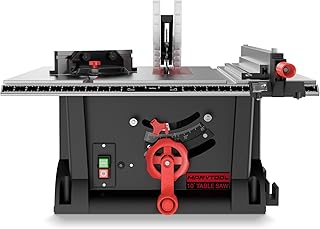
10-Inch 15-Amp Portable Table Saw, 4600 RPM
This compact 10-inch portable saw is aimed at DIY furniture makers who want a broad set of basic capabilities in one benchtop package. The included 36-tooth blade, cross-cut function, and bevel adjustment make it versatile on paper, but buyers should inspect the fence alignment and table flatness carefully before demanding cabinetmaking-level precision. It is best viewed as a budget-friendly project saw.
10-Inch 15-Amp Table Saw With Stand and Cover
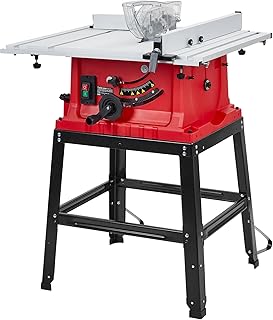
With a larger tabletop, stand, protective cover, and adjustable cutting depth, this model is designed to offer a complete starter setup. The listed 90-degree cross-cut and 0-to-45-degree bevel functions cover common workshop tasks, including framing-style cuts and angled furniture parts. It can be attractive for occasional makers, though experienced woodworkers should verify calibration, replacement-blade compatibility, and the quality of the included stand.
Frequently Asked Questions
Can a portable table saw handle furniture making?
Yes. A good portable saw can produce accurate furniture parts when the fence is properly aligned and the work is supported on both sides of the blade. For large panels, use an outfeed table or roller support rather than relying on the saw’s tabletop alone.
Is a 10-inch table saw better than an 8-1/4-inch model?
A 10-inch saw generally offers greater cutting depth and a wider selection of blades. An 8-1/4-inch model is often easier to store and transport, making it a better match for small shops focused on thinner stock and compact projects.
Do I need a rolling stand?
Not necessarily, but it is a major convenience when your workshop has to serve several purposes. A folding or rolling stand reduces setup friction and encourages you to use the saw safely instead of balancing it on an improvised surface.
What should I check when the saw arrives?
Check that the tabletop is flat, the blade is parallel to the miter slot, and the fence locks squarely along its full length. Also test the blade guard, riving knife, bevel mechanism, and dust port before making your first project cut.
Final Thoughts
For most small furniture shops, the DEWALT DWE7491RS is the best blend of rip capacity, mobility, and repeatable setup. The SKIL TS6307-00 is a strong value-oriented alternative, while the DEWALT DWE7485 is the better fit when storage space is extremely tight.