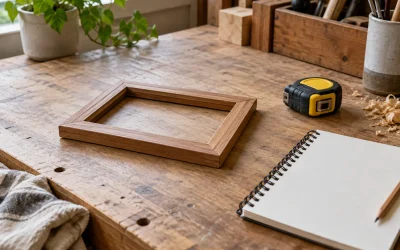
The stock mitre gauge that shipped with your table saw is almost certainly the weakest part of the machine. Mine had a stamped steel bar that rattled in the slot with enough side-to-side slop to turn a 90-degree crosscut into something you could measure the gap on with a business card. Add a plastic protractor head with vague angle markings, and repeat cuts become a guessing game. If you have ever glued up a picture frame and watched four “45-degree” mitres open into a visible V at the corner, you already know where the fault lies.
An aftermarket mitre gauge fixes three things at once: a machined bar with adjustable shims or spring plungers that lock into the T-slot with zero play, a fence long enough to actually support stock, and detented angle stops you can trust without pulling out a digital protractor. This guide walks through what separates a genuinely accurate gauge from a shiny aluminium extrusion, then reviews the models worth your money in 2026 — from compact units for benchtop saws to extendable fences built for wide panel work.
Our top picks


As an Amazon Associate we earn from qualifying purchases at no extra cost to you.
🛒 Best Price Today on Amazon
Prime members get fast, free shipping on everything above, plus member-only deals. New members get a 30-day free trial — cancel anytime.
How to Choose a Mitre Gauge For Table Saw (2026)
- Slot fit and play control: Nearly every North American and European saw uses a 3/4″ x 3/8″ T-slot, but tolerances vary between machines. Look for spring-loaded plungers or adjustable set screws along the bar so you can dial out slop yourself rather than hoping the factory guessed your saw’s slot width correctly.
- Fence length versus your saw: An 18-inch fence supports most furniture parts, rails, stiles, and drawer fronts. Extendable fences reaching 32 inches earn their keep if you break down cabinet panels, but on a small jobsite saw a 360mm fence keeps the gauge from cantilevering off the table and drooping.
- Angle stop count and repeatability: Positive detents at common angles beat a friction-lock protractor every time. Thirteen stops covers the usual suspects; 27 stops gets you 5-degree increments for polygon work. A micro-adjust knob on top of the detents is what lets you chase that last quarter-degree on a stubborn mitre.
- Flip stop quality: This is the feature you will use most. It should flip up cleanly out of the sawdust path, lock without shifting, and return to the same spot every time. Cheap flip stops with a single thumbscrew wander after a dozen cuts; look for a proper clamping shoe or micro-adjust barrel.
- Materials and mass: Extruded aluminium fences with anodised T-tracks resist dings and won’t rust in a damp garage. Steel bars with brass handles feel heirloom-solid and add helpful weight, but check the bar is milled flat, not stamped, before you commit.
The Best Mitre Gauges For Table Saw (2026) Reviewed
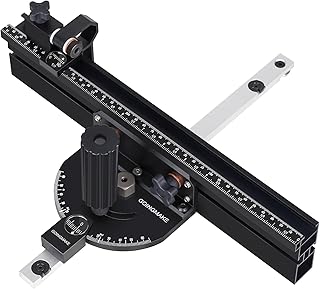
GOINGMAKE Compact Miter Gauge with 360mm Fence
The right answer for benchtop and contractor saws where a long fence hangs out into thin air — the 360mm extrusion stays supported on the table while the positive angle stops keep repeat cuts honest. The multifunction flip stop is the standout here, holding position through a long batch of identical rail cuts without creeping.
GOINGMAKE Miter Gauge with 18-Inch Fence and 13 Angle Stops
This is the sweet-spot model for general furniture work: enough fence to support a cabinet door stile, thirteen detented stops for everything from 90 to 45, and a micro-adjust flip stop that lets you sneak up on a length rather than reset and re-measure. If you only own one aftermarket gauge, make it this one.
GOINGMAKE Extendable 18-to-32-Inch Miter Gauge
The telescoping fence is the reason to spend up — collapsed it behaves like a standard 18-inch gauge, extended it will carry a 30-inch shelf through the blade without you supporting the free end by hand. Combined with micro-adjust and 13 stops, it handles both casework and small trim without a swap.
VEVOR Precision Miter Gauge with 18-Inch Grating Fence
VEVOR’s spring-loaded plunger system is genuinely effective at eliminating slot play, and the removable disc makes calibration straightforward on saws with tight T-slots. Fifteen angle stops and an etched grating scale on the fence make it a strong value pick for a shop that’s still building out its accessories.
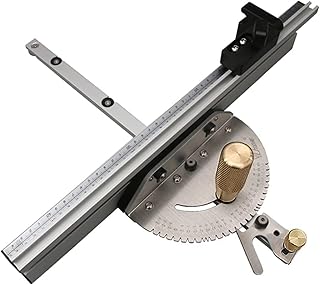
WEN WA1401 Steel and Brass Premium Miter Gauge
The most traditional of the bunch: milled steel bar, brass hardware, and 27 angle stops in 5-degree increments that also serve router tables and band saws. It’s heavier and less feature-dense than the aluminium extrusions, but the fit and finish inspire confidence and the extra detents pay off for segmented and polygon work.
Frequently Asked Questions
Will these fit my table saw?
If your mitre slot measures 3/4 inch wide by 3/8 inch deep with a T-shaped undercut — the standard on SawStop, DeWalt, Bosch, Delta, Ridgid, and most others — yes. Measure yours with calipers before ordering, since a handful of older and imported saws use non-standard slots.
Do I still need a crosscut sled?
They solve different problems. A sled supports the workpiece and the offcut on a moving platform, which is better for wide panels and small parts. A good mitre gauge is faster to set up, far quicker for changing angles, and takes up no storage space.
How do I calibrate the 90-degree stop?
Set the gauge to its 90 detent, then check it against a machinist square referenced off the blade body — not the teeth. Adjust the stop screw, then cut a test piece and flip one half over against the other; any error doubles and becomes visible immediately.
Is a 450mm T-bar gauge worth considering?
Yes, if your saw has deep slots front to back. A longer T-bar like the 450mm brass-handled gauges with 27 stops stays engaged in the slot further into the cut, which noticeably reduces deflection on heavier stock.
Final Thoughts
For most home furniture makers, the GOINGMAKE 18-inch gauge with micro-adjust flip stop hits the best balance of accuracy, capacity, and price. Step up to the GOINGMAKE extendable 18-to-32-inch model if panel crosscutting is part of your routine, and choose the WEN WA1401 if you want a heavier steel-and-brass tool with a fuller set of angle detents.