Key takeaways
- Verify the clearance claim: True zero-clearance designs recline with the back touching baseboard; most “wall huggers” still want 3 to 6 inches. Check the listed measurement, then add an inch for trim and outlet covers, because a plug behind the chair becomes a pressure point fast.
- Motor count changes everything: Single-motor chairs move back and footrest together on one path. Dual motors let you drop the back without lifting your legs — the difference between reading upright and napping flat. Pay for two if you’ll use the chair more than an hour at a stretch.
- Look for a stated frame rating: A tested weight capacity (400 lb, for example) tells you more than “heavy-duty hardwood.” It means someone loaded the frame and recorded the result rather than describing lumber.
- Match upholstery to your climate and traffic: Genuine leather ages well and wipes clean but runs cold in winter and expensive up front. Faux leather is the budget wipe-clean option. Chenille and other breathable woven fabrics stay comfortable in warm rooms and hide crumbs better, though they need vacuuming.
- Plan for power and assembly: Powered models need a cord run — measure to your nearest outlet before ordering. Most of these arrive in two or three pieces with a bracket-slide back, which is a genuine ten-minute solo job. Manual models skip the cord but need arm clearance for the lever or a strong pull handle.
What's inside
Anyone who has dragged a traditional recliner four inches from the wall, then another four, then given up and shoved a side table into a corner knows the problem. Standard recliners need clearance behind them to work, and that lost floor space is exactly what small living rooms, apartment nooks, and RV slide-outs don’t have. Wall hugger recliners solve it with a different mechanism: the seat glides forward as the back tilts, so the frame stays put. The catch is that “wall hugger” gets stamped on plenty of chairs that still want six inches of breathing room, and the spec sheets rarely make that obvious.
I’ve measured, assembled, and disassembled enough of these to know where the shortcuts hide — thin plywood frames, single motors pretending to be dual, USB ports wired to nothing useful. This guide covers what actually matters when you’re buying blind online: real clearance numbers, motor configuration, frame construction you can verify, and upholstery that survives daily use. Below are the wall huggers worth your money in 2026, plus the checklist I use before recommending any of them.
As an Amazon Associate we earn from qualifying purchases.


🛒 Best Price Today on Amazon
Prime members get fast, free shipping on everything above, plus member-only deals. New members get a 30-day free trial — cancel anytime.
How to Choose a Wall Hugger Recliner (2026)
- Verify the clearance claim: True zero-clearance designs recline with the back touching baseboard; most “wall huggers” still want 3 to 6 inches. Check the listed measurement, then add an inch for trim and outlet covers, because a plug behind the chair becomes a pressure point fast.
- Motor count changes everything: Single-motor chairs move back and footrest together on one path. Dual motors let you drop the back without lifting your legs — the difference between reading upright and napping flat. Pay for two if you’ll use the chair more than an hour at a stretch.
- Look for a stated frame rating: A tested weight capacity (400 lb, for example) tells you more than “heavy-duty hardwood.” It means someone loaded the frame and recorded the result rather than describing lumber.
- Match upholstery to your climate and traffic: Genuine leather ages well and wipes clean but runs cold in winter and expensive up front. Faux leather is the budget wipe-clean option. Chenille and other breathable woven fabrics stay comfortable in warm rooms and hide crumbs better, though they need vacuuming.
- Plan for power and assembly: Powered models need a cord run — measure to your nearest outlet before ordering. Most of these arrive in two or three pieces with a bracket-slide back, which is a genuine ten-minute solo job. Manual models skip the cord but need arm clearance for the lever or a strong pull handle.
The Best Wall Hugger Recliner (2026)s Reviewed
EONIX Dual Motor Zero Clearance Wall Hugger Recliner
Independent back and footrest control plus a power headrest puts this at the top for anyone who wants to fine-tune their position instead of picking from two presets. The USB and USB-C combo is properly integrated rather than dangling off the side panel, and the breathable upholstery makes it a smarter pick than leather for RVs and sun-facing rooms.
EONIX Zero Clearance Wall Hugger Power Recliner, Small
The compact frame is the point here — it fits reading corners and narrow slide-outs where a full-size recliner simply won’t sit. One-button synchronized operation keeps things simple, and the 400 lb tested frame rating is unusually specific for a chair this size, which is reassuring given the smaller footprint.
Watson & Whitely Genuine Leather Wall Hugger Power Recliner
Real leather at this size is the long-game purchase: it softens where you sit rather than cracking, and spills wipe off with a damp cloth. Power headrest and dual charging ports round it out, so you’re not sacrificing features for material quality.
KISLOT Wall Hugger Recliner Chair
The value entry, and a sensible one for spare rooms, home theater seating, or a second chair you don’t need to overspend on. Faux leather cleans easily, the power mechanism is smooth for the price, and the USB ports mean you’re not running a charging cable across the floor.
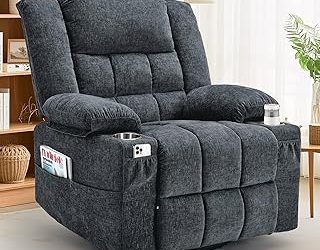
Massage Recliner Chair with Heat, Chenille Upholstered
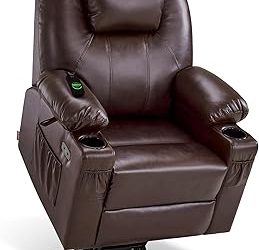
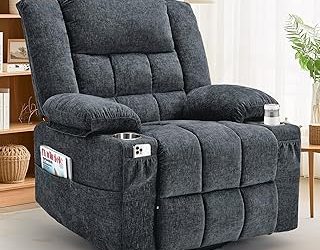
Manual reclining keeps the price down and removes the cord from the equation entirely — useful if your ideal chair placement is nowhere near an outlet. Cup holders, side pockets, and the heat-plus-massage function make it the most self-contained option here, and chenille breathes far better than vinyl through summer.
Frequently Asked Questions
How much space does a wall hugger recliner actually need?
True zero-clearance models recline with the back against the wall. Most others need 3 to 6 inches. Always add an inch of margin for baseboard, trim, and outlet plates — that’s where the measurement usually goes wrong.
Is a dual motor worth the extra cost?
If you sit for extended periods, yes. Independent back and footrest adjustment lets you find a genuinely comfortable angle rather than accepting whatever position the linkage forces. For occasional guest-room use, a single motor is fine.
Can I put one of these in an RV?
That’s one of their best uses. Look for compact models with breathable upholstery and check the total reclined depth against your slide-out. Powered chairs need a working outlet, so confirm your inverter or shore power handles the draw.
How hard is assembly?
Easier than most furniture. The back typically slides onto steel brackets and clicks into place, taking around ten minutes with no tools. Set the base where you want it before attaching the back — the assembled chair is heavy and awkward to reposition alone.
Final Thoughts
For most buyers, the EONIX Dual Motor Zero Clearance model is the one to get — independent controls and a power headrest make it the most adaptable chair here, and the breathable fabric suits warm rooms better than leather. If you want a material that improves with age, the Watson & Whitely genuine leather recliner earns its premium. And if you’re furnishing a tight corner on a budget, the compact EONIX small model delivers real zero-clearance performance without the footprint.